On Survival, Storytelling, and Saving Your Own Life: An Interview with Sarah Hanson
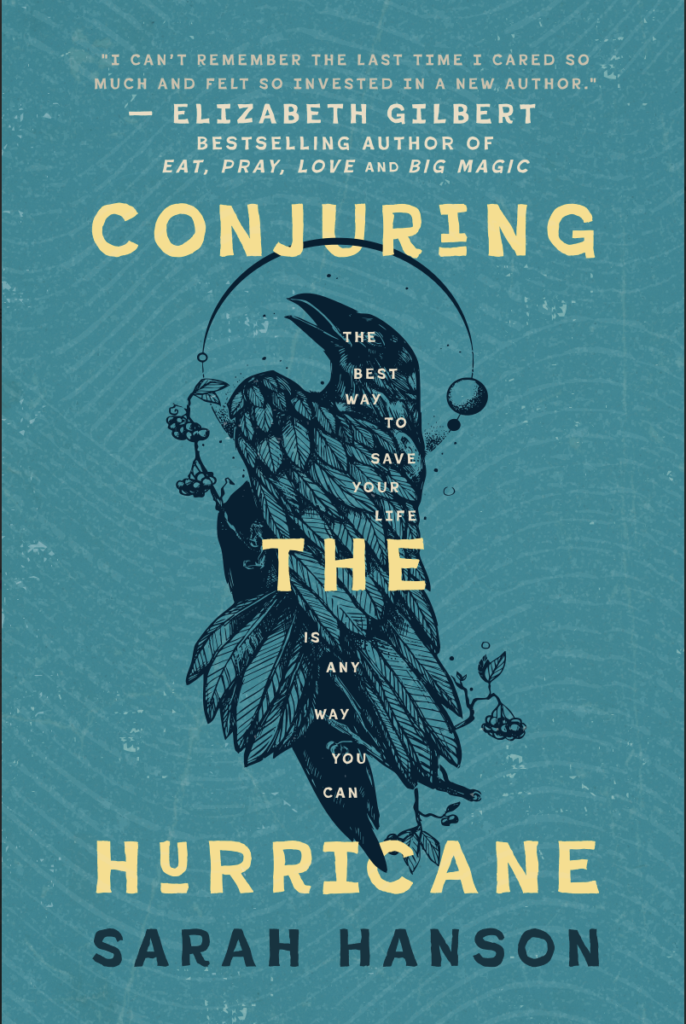
Sarah Hanson’s memoir-in-verse, Conjuring the Hurricane: The Best Way to Save Your Life is Any Way You Can (Inked Elephant Publishing), is a study in rebirth and resilience. After leaving an abusive and dangerous relationship, Hanson rebuilt her life and reclaimed her agency. Conjuring the Hurricane delves into the complexities of leaving and what lies on the other side.
As many as one in four women will experience domestic violence in their lifetimes; Hanson’s book invites readers to understand the human experience behind the statistic. But this is not just a survival story. The poems in this collection teeter between sorrow and joy, asking the reader to see the beauty in imperfect endings and beginnings.
I spoke with Hanson about trauma, recovery, and writing through it all for MUTHA. Our conversation has been edited for length and clarity. – Jen Bryant
*
JEN BRYANT: As a writer who’s active in multiple genres, what made you choose to write this memoir as poetry and not prose?
SARAH HANSON: I actually didn’t set out to write the memoir in verse. I started trying to tell it straight on in a narrative form. I was trying to unearth a lot of traumatic memories, and I had been diagnosed with complex PTSD. What I found was that trying to pick up a heavy story and write it straight through got really confusing and disorienting. I’d set out to write about a particular memory, and I would immediately start to question, “Do I have that right? Was that in the right order? Was this the same argument, or did I collapse three arguments together?” And it felt like I was trying to do a transcription that would stand up on a legal basis, which quickly froze my entire process.
I started taking some poetry workshops around the same time. They weren’t expecting full chapters or stories, and so I could pick up a memory and kind of spin it around, write what I could see, and then get out of it without doing a lot of connective tissue. And that was so freeing. What it allowed me to do over time is pick up the same memory and look at it again, from above, from underneath, and get as much truth out of it as possible without having to be like, “Ah, yes, here are the eighteen facts.” Poetry is really all about using only the most necessary words, and you see how quickly someone can go from point A to point W and it’s just mind-blowing. That’s really how I learned, by watching other people do incredibly smart, joyful, surprising things.
And then as I was editing, my goal was to talk about trauma without traumatizing the reader. Being able to put these stories together in a way that says, “This turns out okay,” and also give these places of respite and breath, felt really important. The format was a fortunate happenstance.
JB: Several of the poems in this collection explore your relationship with your father and what it was like to grow up in a household often marked by anger. Looking back, how did this element of your childhood influence what felt normal to you in adult relationships?
SH: It took me a long time to understand how that component informed my relationship choices as an adult. Part of the book traces how I ended up leaving a very emotionally abusive relationship. I remember as I was getting out being like, “How did this happen to me?” It took years of therapy to understand the patterns I experienced as a child: what a house looked like, what love moved like, that it had these big angry expressions followed by half-assed apologies. That was just part of living in a home.
And so when I met someone who did a lot of those things, it did not raise red flags. I think a lot of women would’ve been like Whoopi Goldberg in Ghost: “Girl, you in danger!” But I was like, “I have a very particular skillset that can meet this exact type of person, and I know how to run a house that will feel like it is survivable. Let me try to get in there and fix this.” Which worked until it didn’t.
When you grow up in challenging environments as a kid – mine was anger and generational trauma, but you see that with other adverse experiences too, like poverty or food scarcity –you carry all these coping mechanisms you figured out as a kid into adulthood. Kids are the smartest creatures in the world, because they have so few skills and so few resources, and they figure out really quickly how to navigate within these limited environments. But then as an adult you have all these maladaptive behaviors that started out really smart, for a kid. It takes a lot of looking at that intentionally and asking, “Do I still need to do this? Do I still need to be the reform school for angry men?” I don’t wish to do that anymore. And that takes a long time to unravel and see more clearly.
JB: Your poem “In Another Version of This Story” explores what might have happened if you’d stayed in your relationship, which had an escalating pattern of abuse. This line is particularly chilling: “He uses two bullets instead of one, / because I never found the courage / to leave.” When did you realize that what you were experiencing wasn’t just difficult, but dangerous as well, and what happened next?
SH: Things escalated over this four and a half year relationship. We were long distance for the first year, and then we didn’t live together for another year, and then he was working second shift. So it was in that last year, when we were working the same schedule, that the mask he could sustain when he had more time away slipped. The more I saw of him directly, the more dangerous, because the harder it was for him to maintain this façade, and then the angrier he was at me for witnessing reality instead of the stagecraft.
I was aware that he was an angry man with seven handguns and an alcohol problem. This was never a great place of safety. And I remember talking to a couple of my friends while I was still with him and saying, “I think about what would happen if I was on an episode of Dateline.” And they were like, “What?” And I said, “Well, I mean, there’s maybe like a 5% chance that that would happen.” And they said, “It should be zero.” And I was like, “Oh. Right.”
In the last couple of months he progressed to destroying property, and he taped a picture of my face to his punching bag. But the day after I packed up the cats and left, I came back with my mom to get some clothes and things. The house was in complete disarray, and he was gone. And my mom actually found a loaded handgun on my pillow. It was such a clear message that this was not going to end well. It was him, me, or both of us, and I was like, “Well, it’s not going to be me.”
He ultimately did die by suicide in that same townhome, I think nine years after I left. And so it took a long time, but I that day, I thought, I know how this ends. What I’m going to do is make sure it doesn’t end with me in the room.
We didn’t have children, which made it tactically easier. But leaving is the moment with the most potential for violence – if it’s likely to occur in a relationship, it’s usually after an attempt at separation. And so I was very worried. Back then I was working in a corporate office, and they had his photo and knew not to let him into the building. I set up things in the apartment where I lived, too, because I was very concerned. And so I don’t want readers to think, “Oh, you just pack up and leave, and that’s it.” I got married to someone else five years later, and I hired security for my wedding just in case. That threat never really felt like it went away, which is just a crappy reality.
JB: That’s a really good callout – leaving doesn’t necessarily mean the danger is over.
SH: Right. And the protection that I built was in being really transparent with my friends, my family, my job, which was embarrassing. It’s important when you’re trying to survive to be transparent with the people around you, so that they know how to protect you. Manipulators are gonna manipulate, and you need everyone on the same page.
I didn’t want to tell my boss and security and HR; I just wanted to, you know, go do my little job and leave, but I had to make sure that everyone that was going to be in my life moving forward and have access to knowledge about me knew that he was dangerous so that no one would hear his sob story and buy into it. And so my world shrank probably by 90% – it got very, very small.
JB: Your book also looks at what it was like for you to find joy again, and to know that you were deserving of joy. What did the process of rebuilding your life look like after you left, and what steps did you take to reimagine what might be possible after being suppressed for so long?
SH: The first component of rebuilding – I think it’s sort of the same as gardening – was to let the soil rest. For about a year, my now-husband and I lived in a very small apartment. We completely changed towns, and I let myself re-cocoon into safety, into a new rhythm of what a life felt like when no one was yelling at me. I just had to let my body get used to that. And then we moved to downtown Minneapolis and started to rebuild.
I said yes to a lot of things. I was like, “I don’t know what I like anymore – I don’t know what I like to do, or wear, or what hobbies I might enjoy.” And so I went to hot yoga, I tried rock climbing, indoor skydiving, all these things. That was how I started to reconnect with myself.
I was also intentional about building a women’s sisterhood of friends that would prioritize honesty and emotional accessibility, because I had a real sisterhood wound. I had committed the cardinal girl sin. My now-husband was married at the time I left my ex, and we were living together, and that’s not a great story starter for this lifelong romantic partnership with the person who is the love of my life. I had to do some work and therapy to heal: “Am I a safe person who can be friends with women? And how do I grow and sustain and find these women who are really going to understand me in my full humanity and celebrate the fullness of what an imperfect life looks like?” And I built some incredibly beautiful friendships that are still in my life. Most of those people had experienced some version of imperfect choices; they had the flexibility to see a story from multiple viewpoints and the capacity to meet me there. We lost one of our friends to cancer, which is in the book, and had the privilege to walk with her through her terminal prognosis and journey, which was an incredible experience of loving through imperfect circumstances.
JB: Your book explores that contradiction so well – how beauty can still be found in hard places, and dark places, and places that are stigmatized, like falling in love with someone who’s married. Life is complicated, but that doesn’t mean that it can’t be beautiful too.
SH: I had early readers ask, “Are you sure you want to leave in the adultery? Are you sure you want to leave in the abortion?” That part is scary, because it opens up a lot of judgment. But that is what happened.
The box that we have currently for survivors to tell their story and be believed is so small. We just don’t make room for imperfect survivors, and we are so quick to judge women who come forward with stories of men behaving badly. We latch onto one or two imperfections and use that as a reason to not listen to the stories that they’re telling of survival. And so I wanted to make an attempt to show how that can be done.
There are going to be a bunch of people who don’t make it past page three, because that’s where it mentions the affair. I just have to let them go and say, “I understand. This one is not for you, and that’s okay.” But for anyone who has made imperfect choices to save their own life, I hope that they are able to recognize that survival is still the most important thing.
There are so few options that can lead to safety in a lot of cases, which is why the subtitle of my book is “The Best Way to Save Your Life is Any Way You Can.” I don’t care if you stole those cats and loaded them up, because what I care about is that you’re safe, which I’m going to celebrate. So I had to share my own version of that. Let me tell you the things that were lost so you understand that it is possible. Imperfections don’t have to be stopping points to your survival.
It would be easier on me to put out a story that that wasn’t as messy, but if I’m in the middle of my own mess and have nothing but bad choices ahead of me and I read someone’s very clean, sterilized exit, I’m like, “That didn’t give me anything.” Like, good for her, yes, but what about me? There are parts of me that wish this wasn’t part of the story I had to tell, but it’s the truth, and so it is what it is. I’m just trying to trust that the people that this is for are going to find it.
JB: How do you practice self-care while writing through difficult memories?
SH: For a while, I didn’t have a good practice. Now, if I know I’m going to be working with something difficult, I try to be really grounded. I’ll light a candle, and I’ve got the plants and cats. I also set a timer, which acts like a little tether in space for astronauts: “You can go into this, but you’re only going to go so far. We’re not going to let you just blow away in the darkness.” That has been the most helpful for me – to time-bound things, and to write in short bursts, and that’s enough to bring me back. And I’ll text my husband, “I had a big day of writing, and I’m going to be really tired – can you take care of dinner, or can we order in?” Just trying to make sure that the rest of my day is as easy as I can make it.
Especially for people who are writing and have kids, or have to go into an office, or anything where you have to change up your energy, try to put that at a point in your day where you can create the physical space – maybe you light the candle, or whatever the thing is – and then just leave it. You’ve got to find a way to capsule that off, because you do have to go shift into these other things that you have to get done.
But I don’t always get it right either. There are times when I’m like, “Wow, that got away from me.” On those nights, I’m just gonna lay on the couch and say, “I can’t do anything today, and that’s okay.” And I try to let the people around me know, “Today was a lot and I’m not showing up the way I want to,” rather than having people think that it’s somehow their fault. I’m behind the veil, give me some time, but don’t take this personally. I just went to a weird place and I’ve got to emerge out of it.
And generally speaking, it’s too hard for me to carry multiple big things all at once, so if I’ve got a graduation or a wedding or a big family dinner, the afternoon before is not when I’m like, “Let’s get in there!” Because I won’t have enough time to pivot out, and that’s just not very fun for anyone. So I’ll jot the idea down and then let it go. I’m not going to forget it, because I lived it.
Cover photo by Daniel Lerman on Unsplash
About the Author

Jen Bryant is a senior editor at MUTHA Magazine and a creative nonfiction reader for Mud Season Review. Her work has appeared in The Sun, Ms., BUST, Cleaver Magazine, JMWW, MER Literary, Hip Mama, and elsewhere. Jen is a Ucross Foundation Fellow, and her writing has been nominated for the Pushcart Prize and Best American Essays. Originally from the South, she currently lives in the Midwest.
Related Posts
Where Are You →

Earthside →

Childcare and Breathing: An Excerpt from STUDENT PARENT →