

Think of Your Brain as a Puzzle: An Excerpt from PIECES YOU’LL NEVER GET BACK
“Think of your brain as a puzzle,” the neurologist was telling me. We’d just finished another round of his poking and prodding. Can you move your toes? Can you grip my fingers firmly? Your eye is droopy. Can you tell me how many fingers I’m holding up? You’re gripping your chest—on a scale of 1 to 10, how would you rate the pain? You’re not getting enough oxygen; you need to exercise your lungs by breathing deeper. It was late. He was on his way home. My parents had already left for the night. Scott was up in the room he’d been assigned on the maternity ward eating a hospital dinner. My private nurse was switching shifts. The latest MRI scan results had just come back and it was clear that something about them had disturbed the neurologist. He spoke slowly and intentionally, watching my face for any signs of understanding.
“In a healthy brain all the pieces fit together. The connections between brain cells are called neural pathways. Those pathways keep everything running smoothly.” To illustrate this, he interlaced his fingers, locking his two hands together. “The global trauma to your brain has scattered those pieces.” He pulled his hands apart and held up all ten fingers for me to see, splayed apart. “Your job from here on out is to recover as many puzzle pieces as possible to put yourself back together.”
I was too debilitated to understand what he was telling me, and I remember looking as intently into his face as he was mine, searching for clues from his expression. Despite the concern I detected in his voice, he kept his face emotionless, perhaps intentionally so as not to alarm me.
He must have seen my confusion because he finally patted my arm and said, “You know what? I think tomorrow might be a great day for you to meet your son!” As the new nurse slipped inside the curtain carrying a needle for yet another blood draw, the neurologist told her, “Let’s get Ishmael down here tomorrow. Meeting him might be the spark Mom here needs.”
*
In preparation for meeting my newborn, my nurse adjusted my bed so that I was in a seated position. Then she adjusted my arms, explaining how I was to hold my son. Finally, the neonatal nurse wheeled my newborn down from the nursery to the neuro-ICU in an incubator. She gently broke the news to me that he’d been stationed in the neonatal ICU since the delivery, but I didn’t ask what was wrong with him. She told me that his health was frail and she didn’t like bringing him down to this ward, that the visit would be kept short to ensure he wasn’t exposed to bacteria. Again, I didn’t say anything. I simply watched the nurse carefully open the incubator and gently set his little body in my arms. I held him exactly as my nurse had instructed.
My mom and dad, Scott and the two nurses, all held their breath in anticipation. I could feel their excitement. It alerted me that this was a pivotal meeting, that I should be feeling something momentous myself. But I had lost my depth perception and had blotches in my vision, blind spots preventing me from seeing the entirety of what was in front of me—similar to looking at a photograph where insects have eaten away holes. My body was weakened from the many days I’d lain limp in bed as well as by my many injuries. A plastic pump was pushing oxygen into my nostrils. And I was dimly confused and lethargic.
Still, I clutched my newborn as best I could and closed one eye and shifted my head about, thinking I could somehow maneuver to see beyond the splotches. No matter what I tried, I couldn’t get a good look at my son. A round gray spot in my vision shifted with my movements, blocking out his features. I grew frustrated. My arms were on fire. At six pounds my son’s weight was too much for me to bear. His hard skull was pressing down on needles shooting into my veins. I fumbled over words, trying to tell the nurse to take him from me. Not understanding what I was saying, she smiled indulgently. Why in the world was my family still gawking at me? I grunted in pain. Then I made a decision that seemed perfectly reasonable at the time but haunts me still today. Unable to endure the agony any longer, I simply let go of my son. His little body fell awkwardly across my lap. I heard a faint sound like a hiccup followed by a loud shriek. The nurse swooped forward and scooped him up. Scott and my parents crowded around her, patting my son’s back, soothing him. I watched them glancing at one another, speechless, horrified.
I felt nothing but relief.
*
The first time I understood something was wrong with me was when my dad began arguing with one of the doctors who came in to perform a routine neurological exam. This neurologist happened to be of Indian descent, and my dad, upon seeing another Indian face, immediately launched into complaints about my care. He told her that he’d understand if I’d fallen through the cracks at a hospital in India but not at a hospital of this caliber!
From the argument, I gathered that my dad had been demanding that the hospital let him meet with the obstetrician who’d delivered my baby, the tall, wiry man with an Australian accent. No matter how often he’d insisted, that obstetrician never showed his face. Why was it that he was never among the long line of doctors who came to see me every day, my dad wanted to know. The OB’s absence became a point of contention, angering my dad to the point where he became intent on suing the hospital.
“Have you seen what’s become of my daughter?” he now asked the neurologist, incensed. “She’s twenty-nine. She came here to have a baby. Now look at her! Don’t you think the very least that doctor can do is come and take a good look at her to see what he’s done?” He was shaking with anger.

“What do you mean ‘take a look at me,’ Daddy?” I asked him in Urdu, confused by what he was saying about me and frightened by his rage. Just as with a newborn’s brain, just as with my son’s brain, in those early days, it was intense emotions like these that cut through to make an impression. Hearing the fury in my dad’s voice, I shrank into myself in my hospital bed. Up until then, the brain damage had served as a sort of blessing: my lack of comprehension shielded me from being able to perceive what I’d become. Although I now recognized something had changed in me, I couldn’t see what exactly that might be. But I could sense from my dad’s heightened emotions that it wasn’t good.
When my dad didn’t answer straight away, I asked quietly again, “What happened to me, Daddy?”
Since Urdu is my first language, it’s hardwired in the Broca’s area of my brain and so was left intact. English, which I’d learned in grade school, was difficult for me now. The French I’d learned in high school and had become fluent in, as well as the Arabic I’d been tutored in as a child and then formally studied in college, had vanished. The only Arabic I retained was in the form of prayers I’d memorized as a child. Although I had no trouble communicating in Urdu, I must have regressed to sounding like a toddler because my mother immediately stepped in and spoke to me in the same high-pitched tone that I’d heard her using with my newborn.
“Nothing happened to you, beta,” she consoled me. “You made it through, didn’t you? The only thing that’s happened is a mojiza.”
She swatted my dad’s arm and ordered him to control himself.
Not grasping the larger nuances of what was taking place around me, I believed her. And so it was that all my development over the years, my learning and my knowledge and my artistic expression, evaporated along with the dead neurons, and I was once more a child, needing my parents to explain the world to me, to care for and comfort me, to assure me that I was going to be just fine.
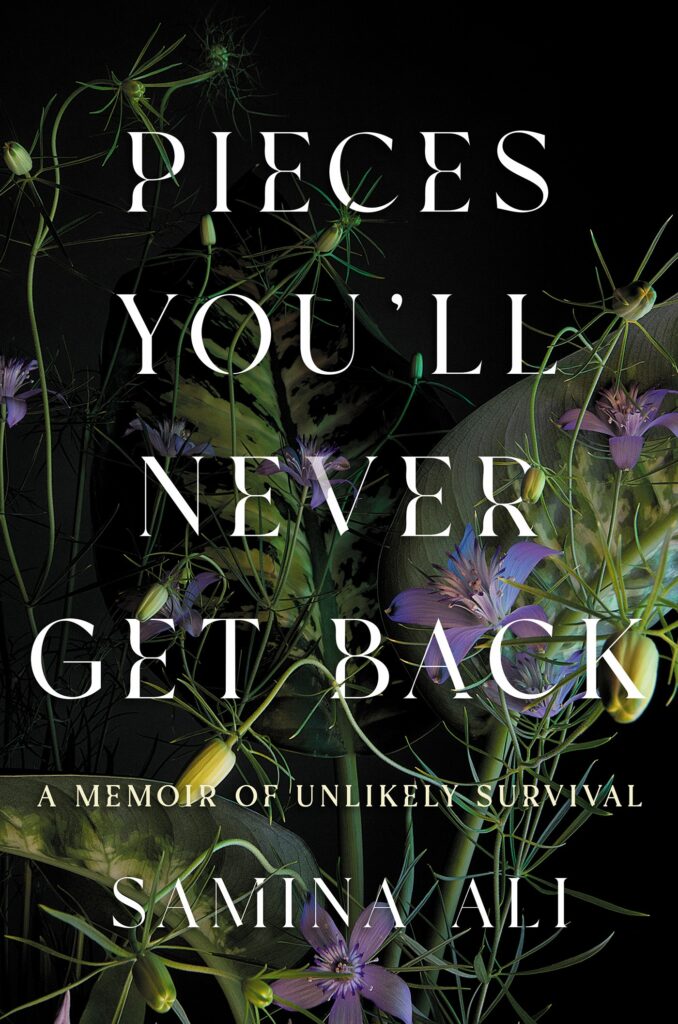
Excerpted from PIECES YOU’LL NEVER GET BACK: A Memoir of Unlikely Survival by Samina Ali. Published with permission of Catapult. Copyright © 2025 by Samina Ali.
About the Author

Samina Ali is the author of Pieces You’ll Never Get Back (on sale now from Catapult) and Madras on Rainy Days, winner of the French Prix Premier Roman Etranger Award and finalist for the PEN/Hemingway Award in Fiction. She is also a recipient of a Rona Jaffe Foundation Writers’ Award. Her writing has been featured in various outlets, from NPR to The Economist.
Related Posts
Childcare and Breathing: An Excerpt from STUDENT PARENT →
Lost and Found: Join us at the Brooklyn Book Festival x MUTHA x Pen Parentis Lit party! →

“Everyone Sees Color”: An Excerpt from MOM, UNFILTERED →

One Response to Think of Your Brain as a Puzzle: An Excerpt from PIECES YOU’LL NEVER GET BACK