
Connecting the Dots of our Struggles: Widening Our Aperture from Individual to Collective Liberation
Yesterday was my first day of childcare in four weeks. Which means: it’s been four weeks since I’ve last written. There exists a highly causal relationship between my childcare hours and my ability to write. That’s real. It’s honest. It’s a thread we will keep tugging at.
During my extended leave last year, much of my writing focused on the feeling of drowning in childcare logistics. On the impossibility of the nuclear family structure. On this siloed society not designed for our collective thriving.
When you feel as though you are drowning, your view tunnels in—becomes myopic. You only see what is right in front of your nose. For a good year, I felt like I was drowning, only seeing the lashing waves in front of me just before they crashed overhead and submerged me under. Sometimes I was able to doggie paddle out of drowning long enough to scream, “We mothers are drowning! None of this is okay!” before another wave struck me in the face, salt water up my nose.
And then, in September, my youngest entered part-time preschool, and I had a breath from the constant pummeling of relentless waves. This allowed me a modicum of space to pick up a book to anchor in: bell hooks’ Feminist Theory: From Margin to Center. In it, hooks says:
Feminism in the United States has never emerged from the women who are most victimized by sexist oppression; women who are daily beaten down, mentally, physically, and spiritually—women who are powerless to change their condition in life. They are a silent majority.
And it hit me: my ability to finally come up for air is a privilege not afforded to the silent majority of those most beaten down by this system. This realization allowed me to begin to reckon with just how tunneled in my lens had gotten. I hold immense privilege just in my ability to sit weekly to write. The silent majority who struggle most under this system aren’t afforded the luxury of time to come up for air to write about it.
bell hooks had me reckon with how narrow my aperture had gotten in my writing. Who was I speaking to, in these posts on drowning? Who identified with my plights? Whose stories was I leaving out? Who was struggling more than me? Whose stories in the wider discourse on the plight of motherhood were being left completely out?

In the breath childcare afforded me, I began the necessary work of re-widening my aperture from my individual struggle to our collective struggle. I began reconnecting dots of our feminist struggle with wider racial and class struggles. In the piece Screaming into the Mother Void, which I wrote in September (not coincidentally shortly after my kiddo started preschool), I wrote:
We are currently living through a moment of auto workers’ strikes, prolonged writers’ strikes, and here in San Francisco, potential teachers’ strikes. Mothers exist as workers across all of those industries. But how are we weaving the feminist discourse around mothering and motherhood into wider political organizing? How do we bridge our discourse on paid parental leave and childcare tax credits and guaranteed income, on bodily and temporal autonomy, into the worker organizing that’s happening today? If we’re operating in silos, are we mothers just screaming into a mother void?
A month later, Israel started its genocidal assault on Gaza in response to the October 7th attacks, and my aperture grew ever wider. As we started watching the Israeli government, funded and supported by my US tax dollars and president, commit war crime piled atop war crime— killing over 30,000 people, mass expelling at least 85% of the population, decimating the entirety of the healthcare system, and destroying over half of Gaza’s housing—I couldn’t help but look around and notice the silence and disconnect from so many white feminists, many of whom have made their profits writing about feminism.
I can already feel the defenses go up as I write out “white feminist,” so I’ll just pause here to say: I’m not here to shame anyone into caring about Gaza.
I am here, though, with deep compassion for how easy it is to fall into myopic lenses of our own struggles, to say that it is our moral responsibility to widen our apertures and connect the dots of our struggles if we are to write about feminism. Connecting the dots isn’t just the right thing to do; it is also imperative to our collective liberation.
If we’re angry by our own childcare logistics, but not the logistical nightmare of Gaza’s mothers being forced to transport their entire families by foot for over ten miles from North to South Gaza without stops for rest, only to find that South Gaza has no safe havens, we have to widen our apertures and connect the dots of our struggles.

If we care about our own bodily autonomy and not the bodily autonomy of women in Gaza—who are being forced to miscarry their babies, undergo C-sections without anesthesia, travel 10 miles just hours after birth by foot with their newborn without stops for rest or breastfeeding, or bury their firstborn twins after 10 years of trying and three rounds of IVF treatment to birth them into being— we have to widen our apertures and connect the dots of our struggles.
If we care about birth justice here, but are silent as 5,000 women, about 180 each day, are forced to give birth in Gaza in the middle of relentless bombing with no functioning hospitals, food, or shelter at their disposal, we have to widen our apertures and connect the dots of our struggles.
If we care about connection parenting our own kids but our hearts don’t hurt for the kids and parents and elders and entire families—once together—torn apart, entire lineages wiped out, mothers losing babies, babies losing mothers, elders grieving the entirety of their offspring, we have to widen our apertures and connect the dots of our struggles.
And if we feel our mom rage boiling at our own seemingly impossible setups, but we are not raging with the mothers in Gaza for what they have been forced to endure the last 150 + days, we have to widen our apertures and connect the dots of our struggles.
Angela Davis speaks of the imperative of connecting these dots in her book Freedom is a Constant Struggle. In it, she says:
Black women were frequently asked to choose whether the Black movement or the women’s movement was most important. The response was that this was the wrong question. The more appropriate question was how to understand the intersections and interconnections between the two movements. We are still faced with the challenge of understanding the complex way race, class, gender, sexuality, nation and ability are intertwined—but also how we move beyond these categories to understand the interrelationships of ideas and processes that seem to be separate and unrelated. Insisting on the connections between struggles and racism in the US and struggles against Israeli repression of Palestinians, in this sense, is a feminist process.
To white feminists making their livings off of writing about the plight of women in the West who still stay silent on Gaza: I lovingly implore you to change course and see Gaza’s struggle as critical to feminist discourse and liberation. I know we are all capable of this. bell hooks says:
Feminist willingness to change direction when needed has been a major source of strength and vitality in feminist struggle. That internal critique is essential to any politics of transformation. Just as our lives are not static but always changing, our theory must remain fluid, open, responsive to new information.
This is a loving call to shift course on our silence and disconnect. This is the time to use our platforms to connect our own feminist struggle across race and class, globally. This is the time to connect the dots of our struggles for our readers. To widen our aperture. To widen our connection. Which is really just another way to say, this is the time to widen our hearts and the hearts of those who read our words. Because all of our collective struggles are intertwined in one messy tangled knot.
When it feels like you are drowning, it can feel impossible to catch a breath enough to see past the wave looming overhead. But no liberation work succeeds in silos. If we keep our apertures small, if our call for liberation as women and mothers only includes ourselves and not everyone else, we are honestly just participating in reifying this current oppressive system. And if that’s what you choose, at least see and acknowledge that clearly to yourself. And if you’re already doing the work: thank you from my heart. I see you.
Right now, as I write this, 1.3 million Palestinians are forcibly displaced in Rafah, their fates seemingly at the whim of the United States and Israel. The acute reality in Gaza demands our collective yank at the thread of liberating Palestine, which is a collective yank to liberate us all. Because all of our freedoms are bound together in this sacred work.
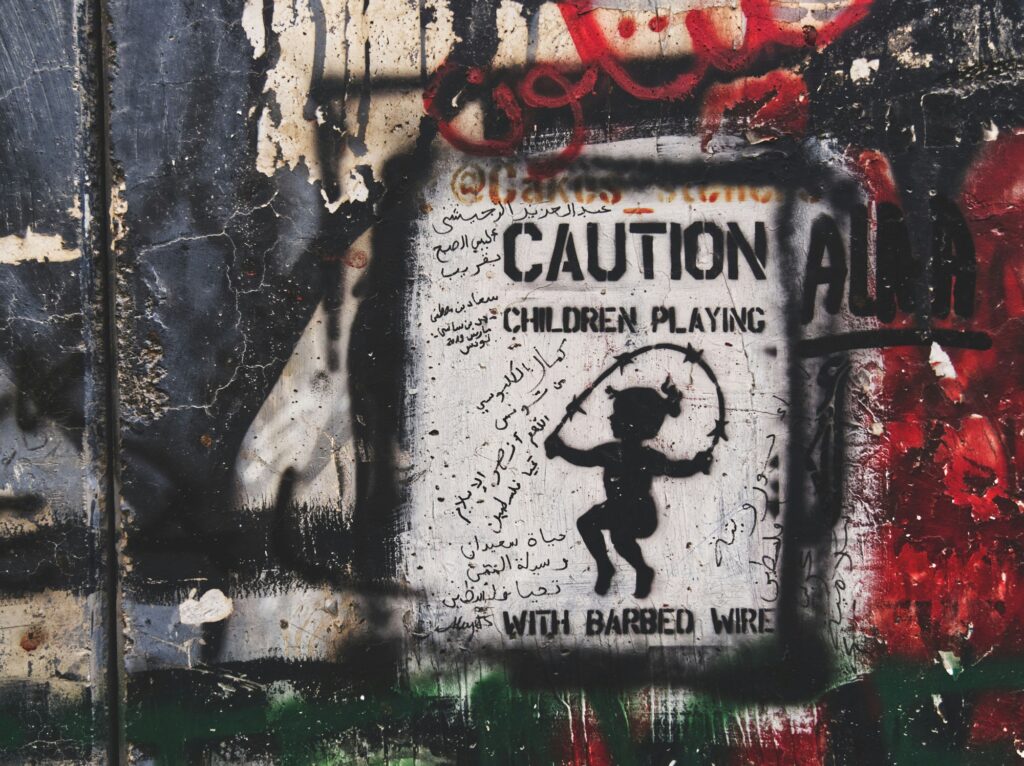
Cover photo by Nazar Hrabovyi on Unsplash
About the Author

Related Posts

Earthside →
Lucky →

Childcare and Breathing: An Excerpt from STUDENT PARENT →