
At Guadalupe’s Feet
My third child is born in February. They put him on my chest and I am smitten with the creamy film of his skin and how his big eyes flutter open as we melt into each other. Once we shared blood and breath, and now love transfers between us like a transfusion.
“Congratulations,” my obstetrician says.
“You were the best idea ever,” I whisper, even though he wasn’t my idea. Or my husband’s. We name him Mateo, or “gift of God” in Spanish.
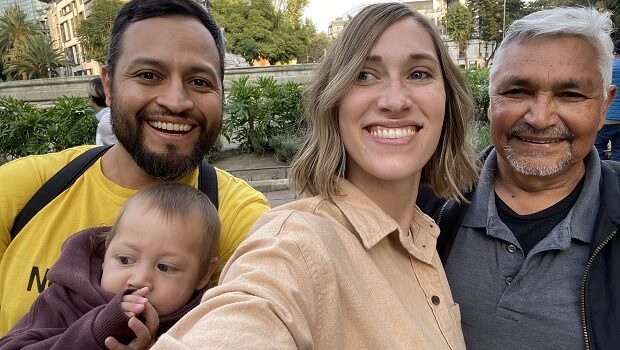
A few months later, I rock him on the back porch of my in-laws’ cabin in the woods as he nurses. He stares up at me and I return his gaze, admiring his rich brown irises. Ignacio, my father in-law, drops into the chair next to me.
My focus slides to him and I notice his irises are the same color as my babe’s. I’m struck with the idea that my children carry this man’s blood and histories, along with my own. We’re tied by them.
Ignacio is a quiet man of few words. I used to watch him and wonder, Where did he come from?
It has been five years since the first time he and I sat down on this very porch, and I asked him, “Will you tell me about your childhood? Can I write it down?”
Now, after five years of interviews and conversations, I am turning his childhood into a manuscript. I have applied for a grant to fund us to travel to Mexico City to revisit the home of his youth. I’m waiting to hear back.
My son nuzzles into my breast and it reminds me of one of his stories. “Tell me again,” I say to my father-in-law, “the story of how your mom nursed your baby sister while she was in jail.”
“My mamá,” he says, “got in a fist fight with a woman in the street and spent the night in jail. They brought Carmen to her so my sister could nurse.”
The image of a cell full of nursing mothers tingles my skin.
Through our conversations, I have discovered his grandparents owned a ranch in a tropical paradise an hour outside of Mexico City at the base of two legendary volcanoes. They spoke Nahuatl, the language of the Aztecs, and lived in a house of branches.

Every day, as a boy, Ignacio herded their cattle up the mountains to fresh water sources. Once, he almost tumbled off the cliffs when his mule slipped. Another time, he beat an aggressive snake to death with the machete he wore religiously on his hip just as his mother wore her Virgin Guadalupe rosary coiled around her neck.
With every story Ignacio tells me, I am trying to make sense of how this self-reliant man’s heritage is carried inside my own children. Something about bringing new life into the world nudges me to remember the old.
#
The next morning, I visit my grandparents, who, like Ignacio, grew up far from the forestland where we now find ourselves. They are from New York, but, like Ignacio, came to settle in Arizona.
As we sit for lunch, my grandmother smiles down at my infant son.
“He has dimples like my brother,” she says.
It’s then that I realize a strange irony: in this all-consuming, multi-year pursuit of understanding Ignacio’s heritage, I have neglected to collect my own grandparents’ stories.
“Tell me again about your side of the family, Grandma?” I ask her.
She informs me that on her side of the family, my great-great grandmother’s real name was Ida. An Austrian Jew, she arrived in America as a teenager. Ida fell in love with an Irish boy named Thomas, but his father would not give his blessing because of Ida’s religion and culture. “It will disgrace the family,” he lamented. When the father died a decade later, she converted to Catholicism, changed her name to Ada, and married Thomas anyway. They had seven children.
To her family, she was pious, rosary-fervent Grandma Ada. But when she died at ninety-six, her secret identity came whooshing from the grave. One of her relatives found a 1910 census that revealed the primary language spoken in her childhood home—
Yiddish.
Ida, the Jew, mother to seven rosy, Irish Catholic babes.
“During WW2, the American soldiers’ families put a blue star in their windows for every child they had serving,” my grandma explains. “No one ever understood why Ada refused to hang the stars for her five children serving (three sons in the navy and two daughters, one a Lady Marine, and the other a nurse). But now it makes more sense.
“She carried around this hidden identity and, I think, hanging stars—a shape symbolic of Judaism, though of course it wasn’t the same star–triggered some deep-seated fear of being seen for who she really was.”
Though it was an irrational fear, I understand what my grandma means. Anti-Semitism wasn’t just a German thing.
My grandma continues, “The other peculiar thing was that she spent every Saturday afternoon with her sister Rose and Rose’s Jewish husband, but never let her family come to these gatherings.”
Were these Saturdays Ida’s sacred and secret way of honoring Shabbat—of keeping her mother tongue alive?
I think of how Ignacio’s eyes crinkle with joy when someone speaks Spanish with him.

“In my mind, Ada was this devout Irish woman who attended Mass,” my grandmother says. “But suddenly she was Jewish, which meant we were too.”
My grandma and I are quiet for a moment, pondering this. We lose part of our heritage and identity simply by not knowing the ancestral stories omitted, secrets held, and histories lost and forgotten. Ignacio does not know where he was born–his original birth certificate lost and his mother, deceased, unable to set the record straight. Just as I will never know what it is like to keep track of Hebrew holidays, to understand their meaning.
According to the Nuremberg Laws, Ada’s children, grandchildren, and even me, her great-great grandchild, is a Michlinge. Of mixed-race. How clinical, hateful the word michlinge sounds—a reminder of the prejudice that could have erased my existence.
My father-in-law shares sparse details of being a Mexican immigrant, but I know he harbors the sting of derogatory names. Once, my own grandfather, in his dementia-riddled years, turned to my husband’s adopted brother, Scott, a six-foot, half-white male and asked, “What is it like being raised by these—.”
His last word—a racial slur.
Ignacio’s face froze in cold shock. He and my mother-in-law have never attended another family gathering on my side.
And there was the time I told my father-in-law I did not know you could not talk on the phone anymore while driving.
“I did it the other day,” I admitted, “and a cop pulled up next to me. He didn’t pull me over.”
My father-in-law shook his head. “It’s because you are white.”
I felt the weight of his words, the times he must’ve been profiled.
And I think of Grandma Ada. How assimilating into white culture meant her blue-eyed grandchildren would not be stopped by an officer. But they also would not speak Yiddish, just as my own husband barely speaks Spanish–his father and mother always addressing him in English so that his accent is perfectly American.
Is forgotten language buried in our DNA like fossils? Do my children carry the memory of rolled r’s on their tongue? Of the ancient Nahuatl word for corn?
#
In the middle of a blue-cold November, I scan the words “pleased to inform you” and smile. I have received the research grant so Ignacio and I can go to Mexico together to visit his childhood places and interview others from the same regions.

It’s been my hyper focus for months and I am dizzy with what this means for our manuscript’s progress. Then the baby whimpers and I hug him close to my chest, an unease burying itself like a cholla spine under my skin.
The night I submitted my grant application, I took a positive pregnancy test. At the time, as the double line spread across the Dollar Store’s flimsy stick, my heart sunk, just a little. I’d already spent nearly a decade mothering and it was time for writing. Then, guilt ballooned in my stomach for that thought. Now, of course, I can’t imagine a life, or a writing life, for that matter, without him. So, here I am: I got the grant, I got the baby, and I’m scared.
I cannot leave this nursling for eight days. But every time I imagine taking my children on a trip, especially international, pre-trip anxiety swirls in my mind. What if we get in a car or plane crash? What if one of my children contracts deadly e. Coli? Yet I want to travel as a family so my children and husband can discover their paternal roots.
My father-in-law was abandoned by his mother when she chose an abusive boyfriend over him. He spent his teen years homeless in Mexico City, peddling wares with a controlling older brother for a time, then sleeping on the couch of a friend until charity ran out.
When Ignacio became a father, my husband said he took to drinking, admitting in a rare show of vulnerability that he did not know how to be a father. How it scared him.
I wonder if this is the same reason his mother left him behind. The fear of not knowing how to be a parent kept her from trying.
Fear is a strange thing. In a science journal, I read that our ancestors up to fourteen generations ago may influence our genome. Their stresses and behaviors transmitted to us like genetic memories.
Grandma Ada refused to hang blue stars to protect her children’s identity—to keep them safe. Did I inherit her fear for my children’s safety? Did Ignacio inherit his mother’s fear?
#
With the yellow-crisp autumn, we pack our bags and fly to Mexico City—my family of five and my in-laws.
Upon landing, we enter a world moving like a clogged river. It takes two hours to get from the airport to our Airbnb a few miles away. Color swirls and dances before our eyes: painted on buildings, murals, billboards, anywhere a free inch of space is found.
Along El Centro’s streets, painted sugar skulls and deep orange and marigolds remind us Día de los Muertos is only a few weeks away. Costumes litter the markets too: face masks like Mario and Luigi, vampires, even Barbie.
Ignacio and I walk the markets where he hustled for pesos selling chicle (gum) as a young boy and visit the jail where his mother nursed his sister, now a museum. Then we stop in the pink church his mother loved, where she knelt and prayed her rosaries. I stand at the altar, perhaps the very place where her huarache-strapped feet once stood. What prayers did she send to heaven? Ignacio’s voice softens as he runs his hand along her favorite worn pew. And I know, despite her choices, he loves her so much. I send my own prayer up, asking that my children might find grace for my faults as he has grace for hers.

I suppose most of us are the product of a complex past – abandonment, fierce love, forced resilience.
On the last day of our trip, in the zocalo, we enter the ornate cathedral, erected from stolen Aztec stones, whose foundation conceals a human sacrifice altar. Lights flicker at the statued feet of Señora Guadalupe. She holds out her arms for an embrace.
The baby is cocooned in the carrier strapped to my back. My husband is nearby, admiring the frescos that line the stucco walls. He turns and snaps a picture of me.
I am bright-eyed, thirty-something, my hair in a fresh bob, just as I imagined when I clicked submit on my application a little over a year ago. I glance back at Guadalupe with her arms stretched open to me and I think of my own Catholic roots. How my mother’s middle name is Mary. I touch the cold stone, wondering if my future generations will reduce the sum of me to a singular story, or single identity, just as I have done with my Yiddish-speaking Austrian Jewish grandmother turned Catholic. How I have done it to Ignacio’s mother too, seeing her only as a woman who abandoned her son, and not a complex product of poverty and little opportunity. A woman whose dreams were likely crushed in her palms, whose heart bruised from too many injustices.
And then there is me—a woman of much support and opportunity. If I print this picture of me, how long will it survive? Will my great-grandchildren know I was a curious writer? Prone to wanderlust? A mother? How full of fear and love and hope like them?
At Guadalupe’s feet, I kneel, the hard flagstones digging into my knees, and raise my eyes towards the flickering light, reflecting off the votive’s glass, like distant gold stars.
We don’t get to choose what they remember about us.
In Ida’s case, her secrets came whooshing from the grave, determined to outlive her. But most stories aren’t preserved forever like a 1910 census. Our lives, our stories, compost for the next generation, stones sacrificed to build a church.
About the Author

Kris Ann Valdez is an Arizona-based freelance writer, wife, and mother to three children. Her personal essays appear in Scary Mommy, Motherwell, HuffPost, among others. Find her online @krisannvaldezwrites and KrisAnnvaldez.com.
Related Posts

Reading the Body →

Rodent Mother →

Signing My Babysitter’s High School Graduation Card →
