

Reading the Body
They circle her the way the women move around the statue of the Virgin Mary on Assumption Day in our Dalmatian hinterland village—slowly, half-whispering prayers. I remember standing near the altar, holding my mother’s hand, watching them: scarves loose, lips moving, feet tracing an invisible ring around the painted wooden figure. Mary was beautiful. Her face smooth, her cheeks pale rose. Her gown was snowdrop white, and a sky-blue cape fell behind her in rippling folds. On her head: a wire crown with twelve little stars, spaced evenly. Mother called her Prečista—more than pure. Super-pure. Her belly was flat. Her face, calm. She was the Virgin—the Prečista Gospa—our purest woman, but not, somehow, a mother yet. Not visibly. Not in that church.
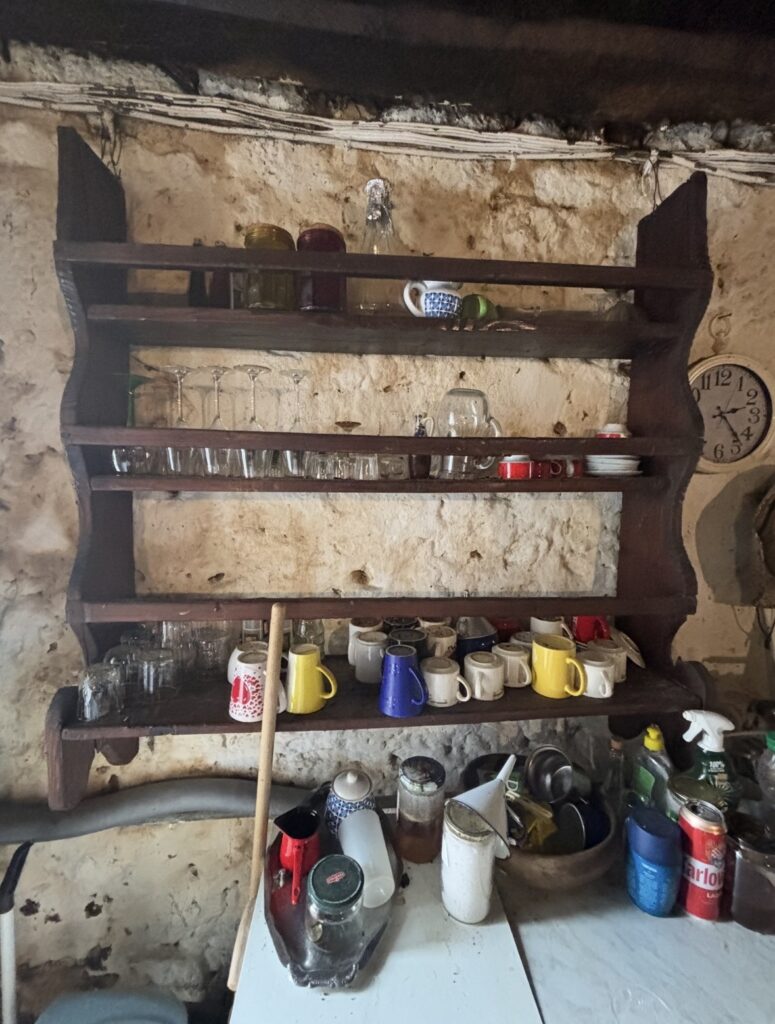
Later, I saw women do the same thing in our neighbor’s open-hearth kitchen. A cousin, swollen with her third child, stood still while the women circled her like a secret. The kitchen carried the sweet-charred smell of burning wood and the tang of smoked meats hanging from the rafters. Dust shimmered only where the light broke through the seams, drifting in slow, dancing threads, catching in the women’s hair, settling on her shoulders like a faint golden veil. Their prayers became predictions. Their glances turned to touch. One cupped the pregnant woman’s chin and tilted her face toward the door light. Another lifted the scarf at her neck. A third rested her palm on the belly, fingers spread, weighing the life inside. They read her like scripture—her body was a message sent down.
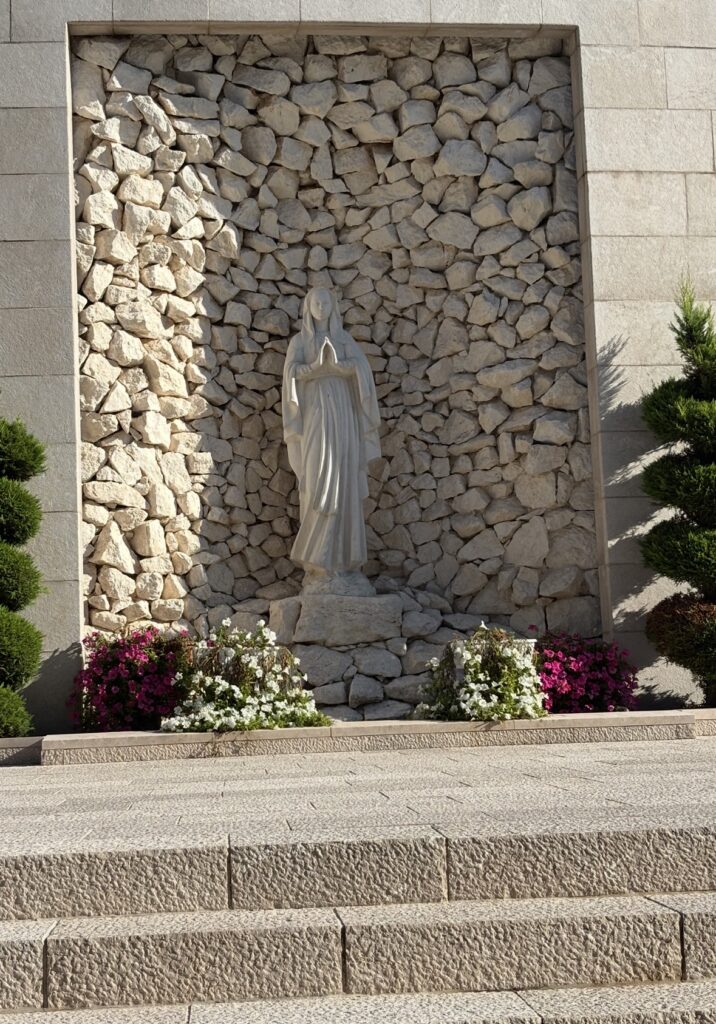
The statue was wood. This woman was warm. The statue stood on a pedestal. This woman stood barefoot on the dirt floor, quiet and waiting. But the circle was the same. They didn’t ask her questions. They examined. One woman lifted the edge of her apron, wiped her face, and said, “She’s carrying high. That’s a boy.”
Another nodded but pointed to her face. “Too clear. If it were a boy, she’d have spots. They steal your beauty, the boys.”
The youngest among them disagreed. “No, no—boys steal your color, not your beauty. Look how pale she is.”
They weren’t laughing. It was serious. It felt like church.
I stood off to the side by the hearth, where Grandmother had already prepared a tent-like wooden pile to burn later. I pretended not to watch, but I watched everything.
The woman stood in the center with her hands under her belly, like she was holding it up—or maybe holding it in. She smiled sometimes, her eyes following the women as they passed around her, stroking gently.
Another lifted her scarf.
“Look here,” one woman said, brushing the curve beneath her jaw. “No blotches. It must be a girl.”
But then another pointed lower, to where the skin had darkened to walnut brown at the collarbone. “That’s the mark of a boy,” she said. They nodded slowly, as if the truth might be in the shading—just beneath the skin.
They turned her wrists over gently, palms up. “Dry? A boy,” one said. “But see the veins—so blue? A girl.” They studied her fingers. “See how she holds them?” I looked too, but I didn’t see anything different.
They never touched her chest, but they looked. One woman tilted her head and whispered, “Already full. That means a girl.” Another said, “No, with my boys, I swelled just like that.” They stared, and the woman shifted slightly, tugging her lightweight navy-blue sweater over the swell. I wondered if it hurt, being examined like that. She adjusted the collar beneath her sweater and smiled the way women do when they have something to say but have learned to stay quiet.
Someone asked her to turn. “Slowly.” She did, and the circle rearranged itself behind her, the voices now softer.
“See how she stands? Wide in the back. Must be a boy.”
“She’s carrying to the front,” said another. “That’s a girl’s shape.”
I stared at her spine and tried to see what they saw. The back seemed like the part you shouldn’t study—because it’s the one place a person can’t see themselves.
“She’s widening. You can always tell with boys—they take more space.”
The other women nodded. They all seemed to remember. I didn’t know hips could mean anything. I only knew mine were still narrow, still quiet.
Her eyes didn’t hold a gender. They held something else—something like water, deep and still. The women slowed when they reached her face. They didn’t say much. They stood quiet, as if something in her gaze unsettled them. One of them smoothed her hair back with a quiet, practiced hand.
The light caught in her pupils, two small embers reflecting the circle around her. For a heartbeat, the room held itself perfectly still. They were seeing themselves in her. Not her face, not her baby—the part of her that was about to vanish.
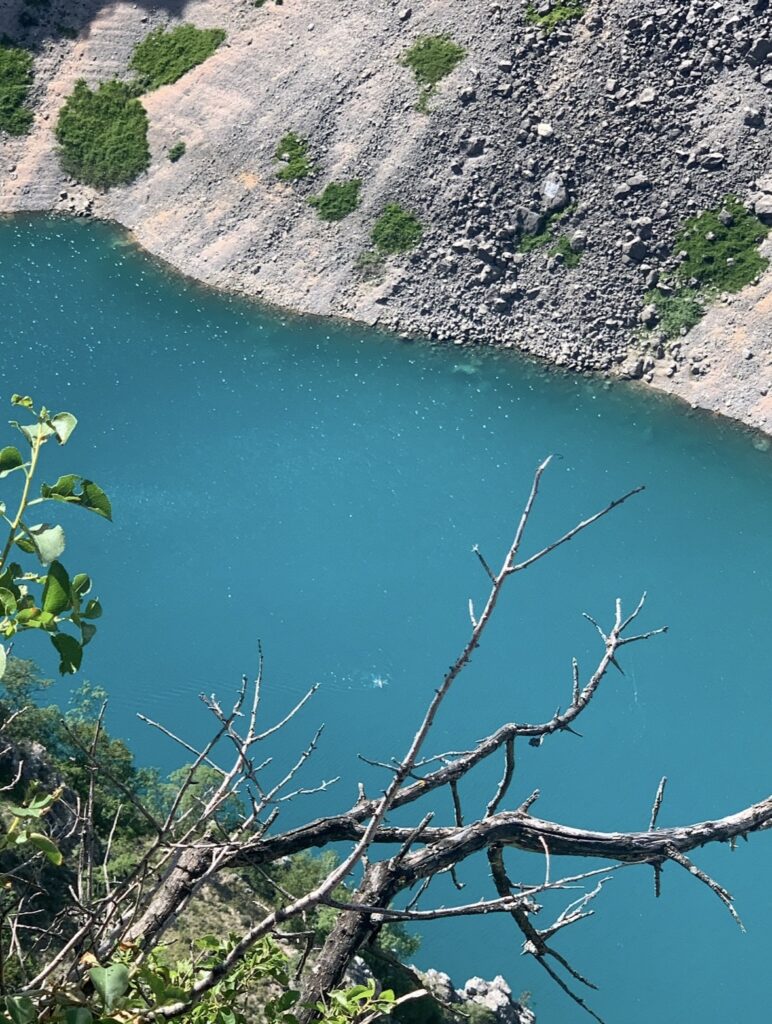
When I watched those women looking into her eyes, I thought of the lakes not far from our village—suspended in the karst cliffs, one red, one blue. From the Imotski valley below, they look like eyes set into the stone. One is round and glassy, the other long like an almond. The red has copper walls. The blue shimmers with limestone. People say you can see your future if you stare into them at dusk.
Gazing at her eyes, I thought they were searching for a reflection—not a boy or a girl, but some part of themselves, mirrored back. The woman in the middle was just the surface. The reflection came from what they carried with them—grief, hope, memory, the feeling of being needed for a little while.
The reverence only lasted as long as the mystery. Once the child came, the circle dissolved, the hands went still. The woman became just herself again. Or maybe even less—reduced to what she had made. The vessel emptied. The water gone.
But in that moment, they looked into her eyes as if she were holy.
Cover photo by Sian Labay on Unsplash
About the Author

Maria B. Olujic, Ph.D., is an anthropologist and writer who emigrated from communist Yugoslavia to the United States as a child and later returned to serve in Croatia’s wartime government. She writes about gendered violence, inherited silence, and the stories women’s bodies carry across borders and generations. Her work appears or is forthcoming in AGNI, Brevity, Dorothy Parker’s Ashes, HerStry, 100 Word Story, and more. She is completing a memoir about war, womanhood, and witnessing. www.mariaolujic.com

One Response to Reading the Body