“The Small Moments that Construct a Life”: An Interview with Heidi Seaborn
As a multi-media artist, writer, and mother, I’m intrigued when a book of poetry welcomes photography into its lyricism as another way of portraying parenting and other lived experiences. Heidi Seaborn’s new book, tic tic tic (Cornerstone Press) invites a reader to encounter what the poet calls “the small moments of life.” Fragments of memory, political events, and personal photos all appear as artifacts of time in this thought-provoking book. I love how tic tic tic offers a multi-generational sense of time through a lens turned toward politics and one’s interior storms. As the poet Arthur Sze writes, “Seaborn beautifully, movingly tracks and enacts an accelerating motion of insight through the inner and outer seasons of these challenging times.” Here’s my correspondence with Heidi about her newly released collection. – Tyler Mills
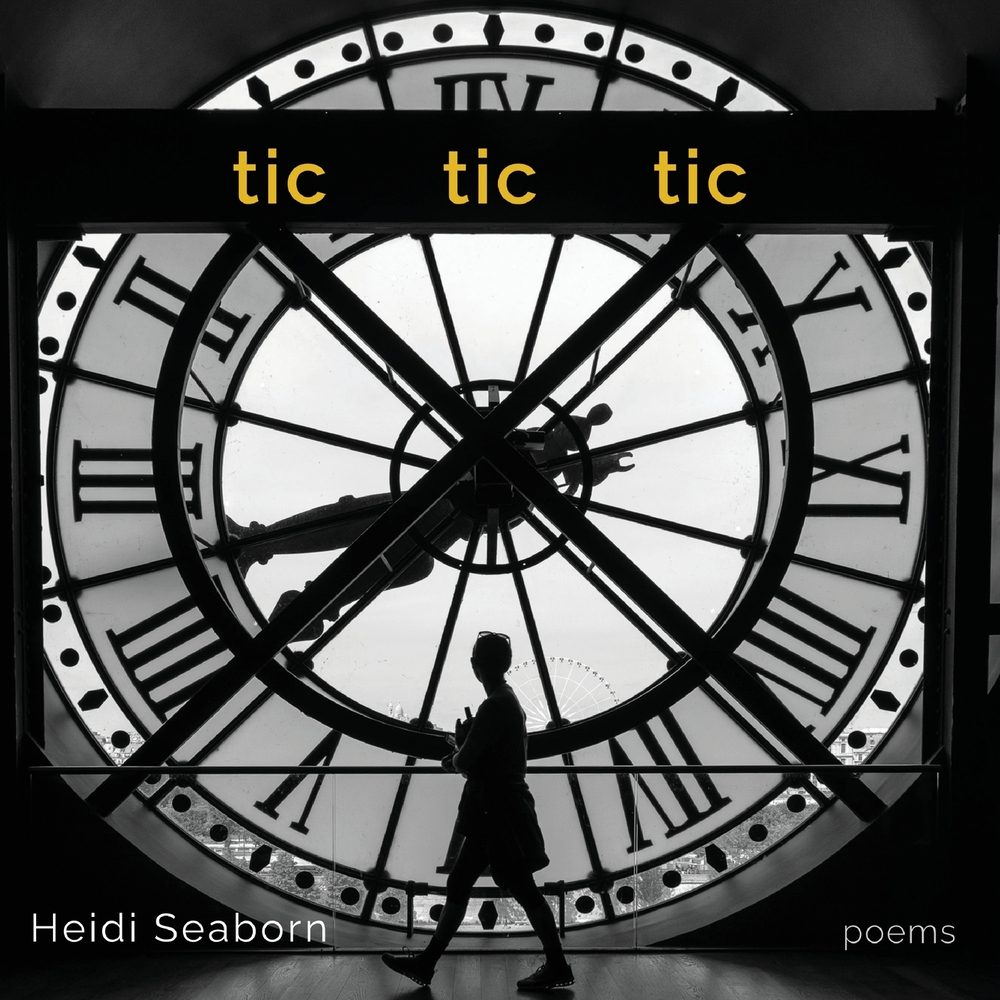
TM: I’m struck by how photos become secondary images in dialogue with the visual themes and subjects of your book. I keep thinking about photography as a way of relating to time, to the past. Perhaps the photos you’ve chosen, some from your own collection and some by other artists, becomes an additional layer in how tic tic tic confronts time. I’m curious about how you selected these photos (such as a class photo from your childhood, example) and what led you to include visual media in this book.
HS: Perhaps it was a Marshall McLuhan impulse, but I knew that tic tic tic had to depart from the traditional book form, not only because I didn’t want to break my long lines (and I really didn’t want to do that!) but because I felt that the book’s format had to embody the continuum of time. Once that decision was made, my editor suggested that we consider art. What an opening! Photography is time. A photograph preserves the past, but also travels into the future, bridging consciousness and experience.
Selecting the art began with the cover photograph by Erik Falk “Passing Through Time” that has deep meaning for me as it is taken at the Musée d’Orsay in Paris, a city I have returned to over a hundred times—layering memories. From there, I knew I wanted photographs of specific subjects to sidle up next to some of the poems, to add focus, enlightenment, contrast, heighten the emotion or trigger recognition. And the images couldn’t be stagnant, they needed to convey time, in that the viewer could sense what had happened just before and what could happen next: flight, open roads, children wiggling, wind in the trees, snow falling, fire, a violinist. And of course, I hope the result is a book that captures the precious beauty of the world we live in.

TM: And some of the photos within the book were taken by your eldest son! I also learned your youngest son designed the cover. What was it like to collaborate artistically in this way? How did this collaboration come about?
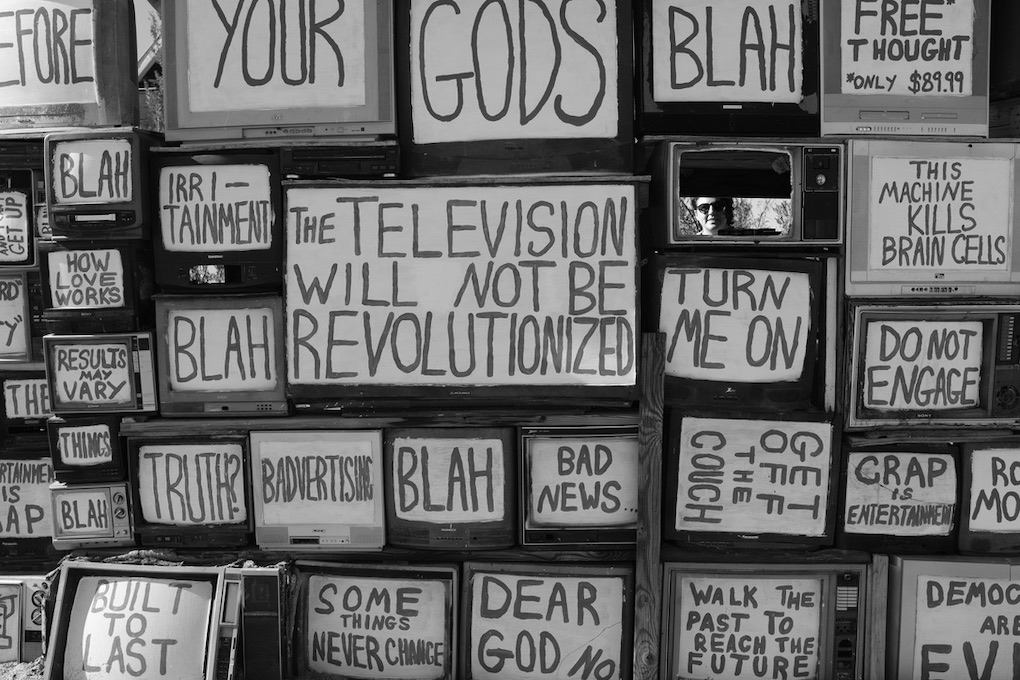
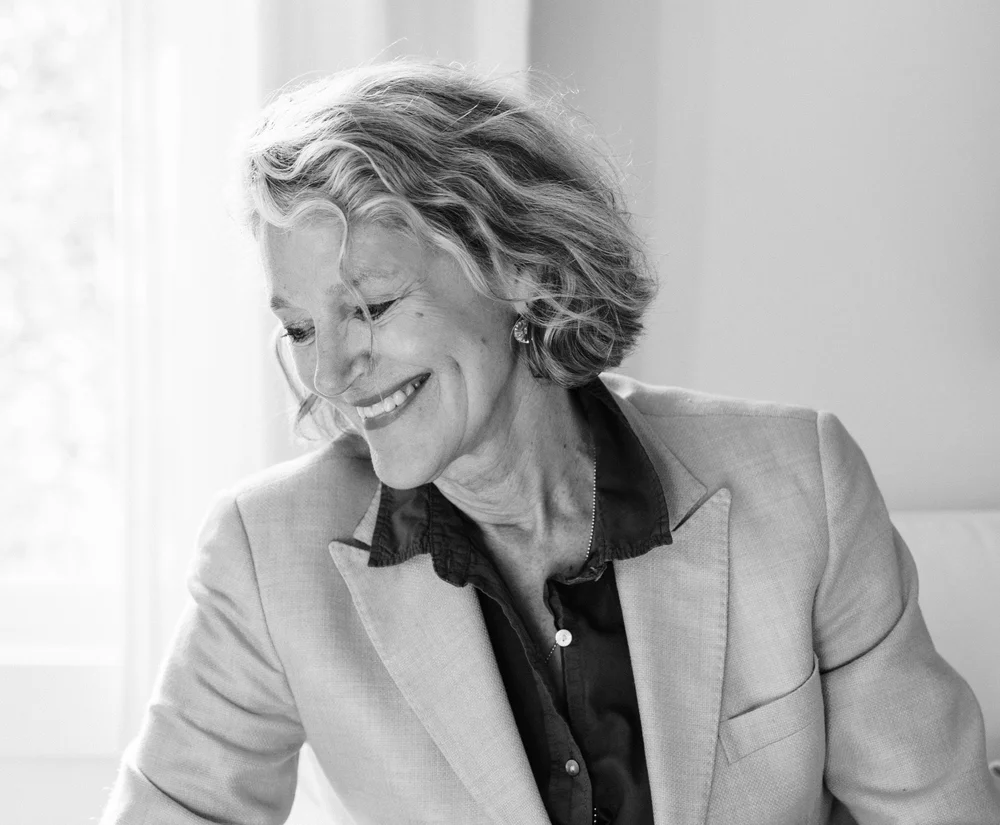
HS: With the editor’s encouragement to add photography, my first outreach was to my son, Jack Sinclair, who is an amateur photographer. In revisiting his portfolio, I found much thematic resonance with many of the poems in my book. But additionally, the photos from Jack have a sense of scale, bringing a dimension that I feel amplifies the idea of living through this historic moment. To think about our creative work building off one another on the page is such a joy. And it’s been amazing to see the response to Jack’s work as well as all the photography in tic tic tic. And the reaction to the book’s cover (a photo that’s not Jack’s) has also been exhilarating, since my youngest son, Nicky Sinclair, helped design it. And, I have a daughter, Hallie Sinclair, who, while not involved in tic tic tic creatively, can be seen peering out of a tv in Jack’s “Amusing Ourselves to Death” photograph! And one of my nieces, Kelsey Chance, took my author photo. So, a family artistic endeavor! I am fortunate to be part of a large, close-knit family with many creative branches.
TM: Included in tic tic tic is a sequence called Time Capsule, which I read as a contemporized Gertrude Stein-esque Tender Buttons. Ultrasounds, a used lube tube, a pandemic face mask, and a family photo are included as objects of contemplation for these prose poems. How is this sequence shaped by your own personal artifacts? As a poet working in this form, what were you thinking about what to disclose about your own life and what to leave out of the frame?
HS: I love the comparison to Gertrude Stein’s Tender Buttons! I hadn’t made that connection, probably because it has been decades, but now I must return to Stein’s book. “Time Capsule” came as a palette cleanse after writing “Continuum” which occurred over a three-week jam in January 2024. While another long sequence poem, the compressed prose form and playful language of “Time Capsule” served as a release. I wrote 30 of them over two weeks, not in any specific order, just whatever occurred in the moment. I think I started with “Tax Return, 1958” because my mom had given me a box of baby photos and in it was the tax return. And then I wrote “Ultrasounds, 1988, 1990, 1994” because my birth made me think of my children’s births and so on. I can’t say I applied a filter. And a lot of significant events in my life are missing—not by design. Rather I was having fun—writing a life, mine in this case, as accumulated objects and artifacts, an objective correlative of sorts of one long and messy life.
Then in revision, I began to sort them into a timeline, discarding those that didn’t enlighten or enliven the poem. I made another pass at “Time Capsule” within the tic tic tic manuscript, deleting, and separating two to place near the beginning and end of the book. By that time, I saw “Time Capsule” as integral to what I hope to accomplish with tic tic tic—that in these chaotic and challenging times, we continue to live and love and there is power in the small moments that construct a life.
TM: tic tic tic addresses the insurrection in “Winter 2020-21,” speaking to that foggy winter of the pandemic (“A year of tangled bedsheets, the bathrobe of evening”) and the horror of watching the violence of that day, in real time via “the hurrying up of CNN– / the scurrying up and over the barricades.” What was your process like as you wrote about the pandemic and other unforgettable political moments? Another poem, “Summer/Fall 2022,” [reprinted at the end of this interview] addresses the overturn of Roe v. Wade: “O ugly uterus, they deem not really part of us.” What was it like for you to write about yourself, as a citizen, and a mother, and a grandmother, all within the collective trauma of these events?
HS: These are extraordinary times—a global pandemic, political instability, loss of civil liberties, war, the rise of authoritarianism and AI, economic upheaval and of course the climate crisis. This is the world that my children have grown into and that my granddaughter was born into. Yet there appears to be a degree of collective amnesia about the events of this young decade, prompting me to write the long poem “Continuum” that begins with New Year’s Eve of 2019. The writing came urgently, as I drafted section after section, chronicling season after season. Somehow, I thought to thread my writing with other creative influences: musicians, philosophers, and poets, with myth and history. In particular, T.S. Eliot’s “The Waste Land” that is set during the time of the Spanish flu pandemic, aftermath of World War I, and the growing clamor of fascism, served as my writing companion. While the writing of these events came quickly, in a sprint, the reliving was exhausting but I feel, necessary. Especially as a mother. I’ve dedicated tic tic tic to my children and their children, as acknowledgement and documentation of their challenging inheritance and, to provide a sense of how to meet the moment with hope, faith and love.
TM: I love your poem “Missive to My Father from the Now,” which begins as though the speaker is in the middle of a conversation: “And you will wonder where the salmon have gone. / And I will respond about the physics of water.” Family—particular family members—surface throughout the poems of your book. What are the hardest things that came up for you while writing about family in tic tic tic?
HS: Well, that poem, “Missive to My Father from the Now” still guts me to read. My father died nearly 13 years ago. It seems like yesterday, but then I think of all that has happened over those years: in my own life (I was still a business executive then, not writing poetry and my kids were on the cusp of adulthood, but still kids in so many ways), and in our larger world. I find myself often talking to my dad about things, sometimes in poems, to express my fears but also my sources of strength and happiness. I miss him every day. So that is hard, but also amazing because through a poem, I can engage in that magical thinking where my father and I are together in conversation.
I’m also very close with my mother, and siblings, our children and all our loves. It’s a big family that is ever-present in my daily life and in my heart, so they are bound to appear in poems. Though of course, it being fiction, family members appear more as a character or an essence. My family is very supportive of my writing. I’m sure at times, it may feel uncomfortable to see themselves or a version of themselves in a poem. But they also understand it is an honoring of our relationship.
TM: What projects are you working on now?
HS: I have a pile of poems that I keep shaping and reshaping into a manuscript. I thought it was done a year or two ago, and then new poems arrive. I hope to take time this fall and winter to focus on what that book wants to be. And then this summer, I started writing a hybrid work of autofiction about my twenties spent in Silicon Valley in the 1980’s when it was just beginning. I have about 250 pages of that drafted and plan to return to it this winter, finish a first draft and see if that’s the form the story ultimately needs to take.
Summer/ Fall 2022
They asked politely but it was raining—
so I didn’t stop—
for the Planned Parenthood people.
Anyway, I’m on their list.
Still the next day I thought less—

of myself, you know. Thought maybe
they need money
to ferry women out of Idaho.

Every time I think, I mean I can’t not remember—
my own—
eons ago. Honestly, I’d forgotten
until having it taken stirred memory—
And Idaho! I mean I’ve had sex in Idaho!

Now, as if another century, as if chattel,
as if cattle lowing in a locked bard. Good night Bess!
Good night Lulu! Good night Mabel!

Over coffee, Linda recalls Mexico—
how the border patrol looked her
over. ¿ Dónde esta? ¿ Dónde esta?
the coiling streets—
a gated door, the swinging
noose of a light bulb—
shithold in the floor and sheets
like a Francis Bacon painting.

O ugly uterus, they deem not really part of us—
Estranged innards, impolite company—
too rude to include in any legalese—
Dis-ease with our kind, minds full of—
fluff. And so just like that, puff!

and now it’s as if—
my mind and body isn’t my own—
owned by the state of Idaho.

I think of my granddaughter living in a state
where a woman’s body is tethered
to a stake. Sometimes a river defines—
a border and all the residue

eventually flushes—
out to sea. Other times
there’s no geographic order,
just a cattle trail crossing a state line—
excerpted by permission from tic tic tic (Cornerstone Press)
Heidi Seaborn is the author of tic tic tic (Cournerstone Press 2025) as well as An Insomniac’s Slumber Party with Marilyn Monroe, Give a Girl Chaos, and Bite Marks. Recent work has appeared in AGNI, Blackbird, Copper Nickel, Financial Times, Image, Poetry Northwest, Rattle, Terrain.org, The Slowdown, and elsewhere, and has won The Missouri Review Editors Prize in Poetry. Heidi Seaborn is Executive Editor of The Adroit Journal.
About the Author

Tyler Mills is the author of the memoir The Bomb Cloud (Unbound Edition Press 2024), which received a Literature Grant from the Café Royal Foundation NYC. Her poetry guidebook, Poetry Studio: Prompts for Poets, a pedagogical book for new and experienced poets, appeared in June 2024 from the University of Akron Press. A poet and essayist, Tyler’s poems have appeared in The New Yorker, The Guardian, The New Republic, the Kenyon Review, The Believer, and Poetry, and her essays in AGNI, Brevity, Lit Hub, River Teeth, and The Rumpus. She is the author of the poetry books City Scattered (Tupelo Press 2022), Hawk Parable (University of Akron Press 2019), Tongue Lyre (Crab Orchard Series in Poetry First Book Award, Southern Illinois University Press 2013), and co-author with Kendra DeColo of Low Budget Movie (Diode Editions 2021). She has a Ph.D. from the University of Illinois-Chicago, teaches for Sarah Lawrence College’s Writing Institute, and lives in New York City.
Related Posts

Truck Around Town: Poems →
“A Place to Feel It All”: Kelly Grace Thomas on Infertility, Adoption, and Urgent Joy →
Where Are You →