
Do You See What I See?
By the time we arrive at my dad’s house on Christmas morning, my 8-year-old, Dash, has already aired his grievances: Everyone gets more presents than he does (not true), my family opens gifts too slowly (true), and I took the wrong route to get here, the one that doesn’t go over the bridge he likes (also true).
Sometime during the 1980s, my parents decided to push back on the cyclone of wrapping paper and kid-greed by instituting a one-gift-at-a-time ritual that stands to this day. Other things that haven’t changed: my dad’s red sweatshirt with the words Bah Humbug! appliqued by my mom thirty years ago; the ornaments on the tree; the fire in the fireplace; my dad’s cautionary tale about accidentally throwing away a gift that lay hidden in crumpled wrapping paper. He grew up in the era of backyard incinerators, and by the time he realized what had happened, it was already up in flames.
Things that have changed: My mom isn’t there and hasn’t been for twenty years. My dad’s longtime partner, Susan, takes her place on the couch, but has never tried to take her place in our lives. My partner, C.C., and Dash, and my sister’s husband have joined the mix over the years.
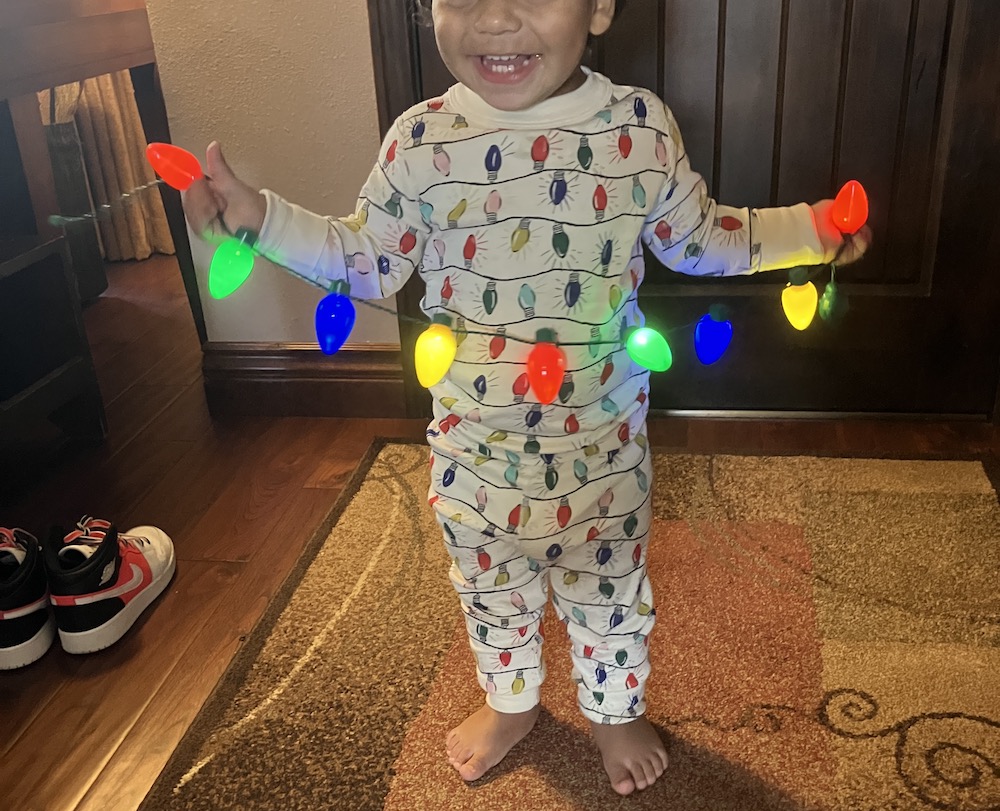
The newest addition is Joey, whom C.C. and I adopted two summers ago as a four-pound preemie. On this, his second Christmas, he is an energetic 18-month-old with a round belly (if you say “tummy,” he will point to it proudly), dark eyes, and curly brown hair. He toddles around the house with handfuls of coffee cake in his fists, and my dad follows him with a dustbuster. Another family tradition: Keep the mess to a minimum.

My dad has a habit of disappearing into other parts of the house—he needs scissors, or to check his Excel spreadsheet of gifts and recipients. We try to be patient.
Dash praises my sister’s scrambled eggs. Joey opens the spice cupboard and pulls out an ancient tin of McCormick’s cloves, which he shakes like a maraca.
My dad reappears with his laptop and opens it on the kitchen counter. We haven’t even started opening gifts. The clock is ticking because we’re due at C.C.’s family’s house by early afternoon.
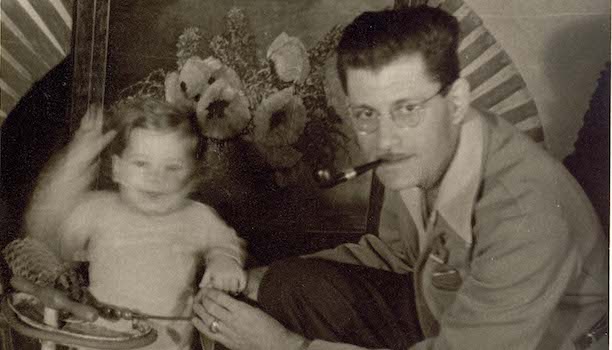
He pulls up a folder labeled “Klein Family Photos.” Right away, I see what my dad intends me to see. It’s a black-and-white photo from the 1940s, of his tow-headed four-year-old brother and my dad at fifteen months, seated in front of what looks like the base of a Christmas tree, though no branches are visible.
He is chunky, with dark eyes and curly brown hair.
“I see the resemblance,” I say. Behind me, C.C. steers our chunky, dark-eyed, curly child away from something breakable.

I also hear what he’s offering: a sense of kinship, a bit of himself. In theory, adoption denies people the excitement of seeing physical traits passed from generation to generation. In practice, some of those sightings are projections anyway, and are fully transferable to non-biological relatives.
When I look at Joey, I see his mom’s mouth and nose, and the eyes and brow of the man we think is his birth father. His light brown skin is the exact sum of her (white, half Jewish) and him (Black). I hope Joey will always feel connected to them in body and spirit. Still, family trees can grow with the grafting of branches, and I am touched that my dad seems to be tending to ours in this way.
“My dad must have taken the photo,” says my dad, who has taken many photos of our many Christmas mornings.
“When did he die?” I ask. “I mean, I know how old you were, but what time of year?”
“December 21st. He must have taken this just days before.”
His voice catches. I’ve seen my dad cry a half dozen times in my life. The last time was probably during the long, colorless months after my mom died.
His father worked at radios for military planes at Douglas Aircraft, which exempted him from the draft that took his peers overseas to fight in World War II. I inherited a toy chest he made from a wooden box that held airplane parts; he painted it light yellow and glued a picture of a bear on the top. Currently, it holds Dash and Joey’s artwork.

My grandfather had some kind of chronic stomach issue that required minor surgery. I don’t know more than that, and neither does my dad, although we have become a family that compulsively, doggedly digs for medical details. An infection took hold following the surgery. The standard treatment at the time would have been penicillin, but it was in short supply due to the war. And so he died, leaving my grandmother with two young kids to raise on her own.
My dad explains, “Of course it didn’t impact me, because I was so young, but I always felt bad for my mom, especially around Christmas.”
“It didn’t impact me” has been his mantra my whole life. And that must feel true to him, especially compared to his mom and brother. My uncle remembers being told, as a four-year-old, by a well-meaning friend or relative, “You’re the man of the house now.”
If I were to disappear from Joey’s life suddenly, I think he would carry it with him in the same pre-verbal part of his brain and soul that will always carry the loss of birth mom. She isn’t gone, but she’s not a daily presence, either. The voice he heard for his first seven months is now a choppy connection on our periodic video chats.
My dad didn’t learn to walk until he was 18 months old. He says it’s because he was “lazy.” After I point out that 18 months is still in the normal range, I always counter that maybe his toddler body was already keeping the score, reeling from a sudden shift in his home that he couldn’t understand. He scoffs.
But he does acknowledge a ripple effect. His mom drove an unreliable clunker of a car, and when it broke down, my dad vowed to learn to fix cars so he could prevent his family from ever being stranded by the side of the road again. He was true to his word. Maybe he didn’t save his mother from the anxiety of single parenthood, but he turned several jalopies into show cars.

He became a caretaker who would come to care for me; a penny pincher whose ship eventually came in, turning him into a small-scale philanthropist in his golden years (his favorite causes being redwood trees and his under-earning eldest daughter). My dad preaches personal responsibility, but changes my oil and washes my car when I visit home.
What I know about my grandfather is more a capsule-collection of facts than a portrait of a person. He was raised Jewish, the son of a musical theater composer and a teacher, and had a sister—my great aunt Mag, whom I remember sitting next to our Christmas tree drinking scotch on the rocks. In adulthood, he became a priest in the Liberal Catholic Church, which I’ve been told is similar to Episcopalian or Eastern Orthodox churches; they keep the pomp and circumstance and communion, but priests can marry. He married my grandmother, whom he met through the church, a little upstart branch in Santa Monica. I don’t know what brought either of them there, but after a short first marriage to a man her parents pushed on her, my grandmother craved true love, and found it in Rev. Jerry Klein.
I know that he wore round wire-rimmed glasses, and his favorite Christmas song was “I’m Dreaming of a White Christmas.” I think he must have liked cats, and was probably the one who named Jones, their orange and white tabby, after the Irving Berlin song, “This is the Army, Mr. Jones.” I know his ashes were buried beneath a Deodar Cedar in front of the two-bedroom tract house where my dad grew up. We drove past it often on the way to dinner at our favorite Mexican restaurant. When I asked my dad about it in the course of writing this piece, he told me it began as their 1944 Christmas tree, the Christmas his dad never saw.

As a kid, I understood the sadness around my grandfather’s early death—like most kids, I was terrified at the thought of losing my parents, even in a department store, even for a matter of minutes. I also got sad around Christmastime, even as I coveted My Little Ponies and Cabbage Patch Kids. But on the winding drives through the dark bluffs of the Palos Verdes Peninsula, on our way to midnight mass at the Wayfarer’s Chapel, where we only went once a year, I grew teary at the carols on the radio. Did I sense my dad’s sadness about this time of year? Was it the shortening days, the story of a magical baby born in the bleakest of times?
At church, they passed out waxy white candles wrapped in paper cones to catch the drippings. The chapel had glass walls and a glass ceiling, and when we sang with our lit candles, the reflection made a starry sky all around us.
My favorite Christmas song has always been “Do You Hear What I Hear?”—a story traveling through the night, from wind to lamb to shepherd boy to king. Part call and response, part game of telephone, part urban legend.
It’s been a long time since we went to midnight mass. Now on Christmas Eve we eat Chinese food with my Uncle Robin and Aunt Connee. We drive the late-night freeways to our separate homes and return for Christmas morning.
My dad swallows his words and closes his laptop. I put my arm around his shoulders, which are thinner than they used to be. He turned eighty last year, and has made a second career out of planning for his death. He is always cleaning out the already-clean attic. There is a folder on his desktop titled “When I Die” that contains step by step instructions about bank accounts and the like. I’m grateful for this, but I prefer him alive. He’s my dad, and he’s supposed to live forever. So was my mom, but since the universe fucked that one up, I’m hoping it steps up this time around.
They say that survivors of child abuse struggle when their own kids reach the age they were when the abuse happened. They understand on a visceral level how young they really were, and they wonder why no one protected them. Maybe it’s true for other types of trauma as well. Seeing a curly-haired toddler who has just learned to give wet kisses and mimic the sound of a barking dog. Maybe a person would understand, on a cellular level if not an intellectual one, that such a small person should not have his world blown up.
I am thinking about civilian casualties of war. Of who gets blown up, who dies because there was no medicine. I am thinking about grief that lasts for generations, even in happy families.
Lately, I’ve been grieving things that feel big and small at the same time. I love having two children, but I wither every time Dash closes himself into his room with his iPad to keep himself safe from getting hit in the face with a toy car by Joey. I think some part of me remembers getting unintentionally cast aside when my younger sister was born. Maybe that’s what I was grieving, already, those Christmases ago, as I pressed my face to the side window of our ‘65 Thunderbird and hummed “Do you see what I see?”
I’ve been making an effort to listen to music in my car more often, instead of podcasts and audiobooks. It exorcizes something that lives in my body, that for all my many, many words, I can’t articulate without a lot of speculative psychobabble.
Joey likes music. Almost any song calms him down in his car seat, or gets him dancing if he’s free. The other day, I sang “Twinkle Twinkle Little Star” and he started opening and closing his hands, making twinkle fingers. He must have learned it at daycare, but it felt like a miracle. A star, a star, shining in our living room.
About the Author

Cheryl Klein’s column, “Hold it Lightly,” appears monthly(ish) in MUTHA. She is the author of Crybaby (Brown Paper Press), a memoir about wanting a baby and getting cancer. She also wrote a story collection, The Commuters (City Works Press) and a novel, Lilac Mines (Manic D Press). Her stories and essays have appeared in Blunderbuss, The Normal School, Razorcake, Literary Mama, and several anthologies. Her MUTHA column “Onesie, Never Worn” was selected as a Notable Essay in Best American Essays 2022. She blogs about the intersection of art, life, and carbohydrates at breadandbread.blogspot.com. Follow her on Threads: @cherylekleinla.
Related Posts
“A Place to Feel It All”: Kelly Grace Thomas on Infertility, Adoption, and Urgent Joy →
Where Are You →

My Helga, My Omi →
2 Responses to Do You See What I See?