“A Place to Feel It All”: Kelly Grace Thomas on Infertility, Adoption, and Urgent Joy
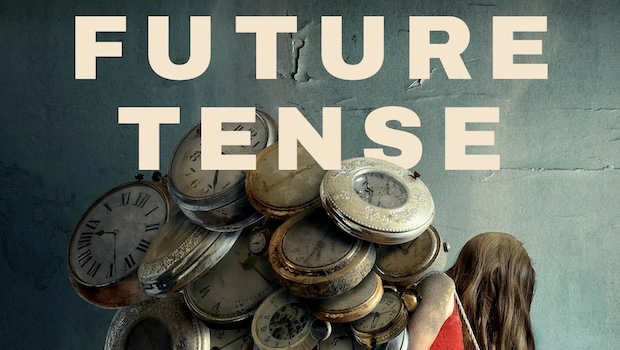
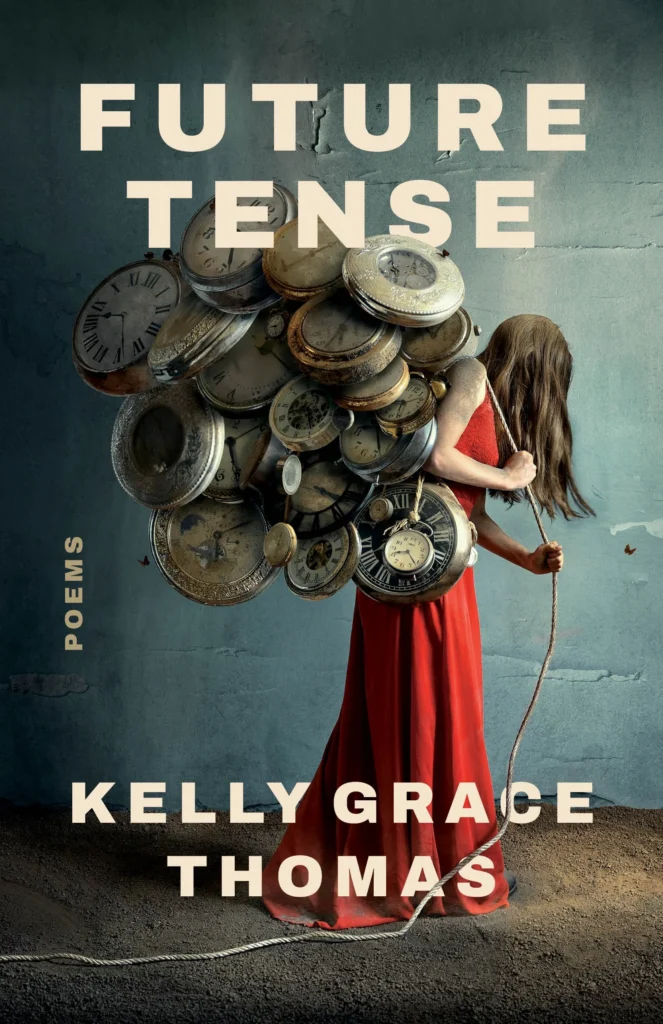
I read Future Tense, Kelly Grace Thomas’s new memoir in verse, on a plane ride from Oakland to Los Angeles, coming back from a work trip. (Go here for an excerpt.) I hadn’t seen my kids for almost three days, and I had gotten into a strange, stupid argument on Threads with a woman who claimed no one could ever love an adopted child as much as one they’d birthed. All of this only partially explains why I was soon sobbing over a pdf on my laptop as my seatmates politely ignored me.
The other reason is the book itself, which chronicles Thomas’s winding journey to parenthood— fertility treatments, the loss of her own mother, and her eventual adoption of a baby girl—with the kind of emotional precision only poetry can contain. My own road looked similar, and was similarly lonely at times.
One of the poems that stayed with me was “Dear Birth,” “An erasure of our adoption letter to potential birth parents.” It guts the template that prospective adoptive parents use when marketing themselves to expectant mothers, threading the needle between empathy for her “difficult situation” and sunny promises to provide her child with an idealized life. The format flattens both writer and reader into characters in a bad play, even as it attempts to connect them. In seven parts, “Dear Birth” pulls the thread and lets the narrative unravel, leaving a sparser truth that doesn’t try to conceal grief: “everything she wants…a…compass…almost…mother to our children.”
It is a book full of wanting and almost-motherhood, searching for a compass and creating one in herself. I was honored to ask Thomas about all of it.
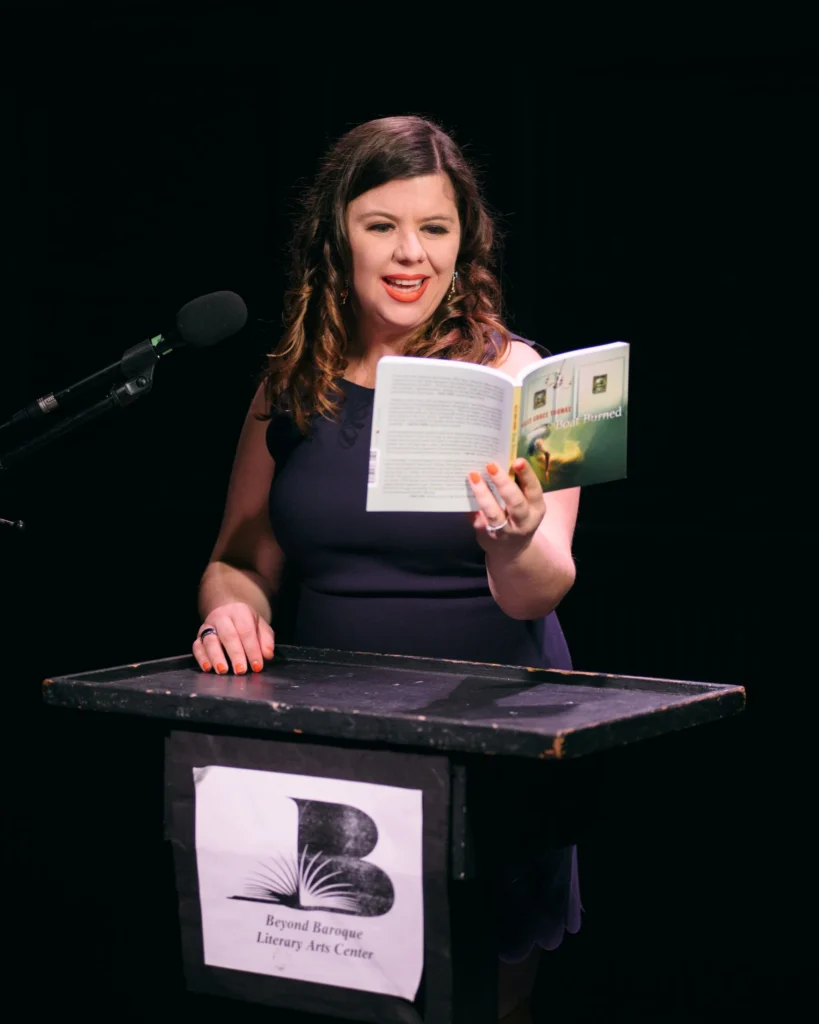
Cheryl Klein: A piece of good advice that adoptive parents often receive is: Grieve your infertility before adopting. How did writing these poems help you do that?
Kelly Grace Thomas: I pictured my life so differently: two kids, tiny heart-shaped faces that looked like mine. I always thought that being a mother would feel like creating another version or extension of me. But when that wasn’t possible, I struggled to see where I ended, and the disappointment and fear began.
In a way, these poems are what I could birth. Writing these poems gave me the space to consider the aftermath, how hurt I was by the unfortunate circumstances of life. Whenever I spoke of infertility, people often either gave me platitudes or a list of things I should do to try to fix myself. Blame felt everywhere. The harder it got, the quieter and more isolated I became.
These poems gave me a place to feel it all, to voice it with interruption, and eventually create a path back to myself. A part of me will always grieve infertility, just like I always grieve my mother, but in writing down that grief, it reminded me that this is my story; it’s part of who I am. Grief is just another measure of my love. And in sharing, I hope to help others with their grief, to give these stories air, to make other women feel less alone.
The “Dear Birthmother” letter as an erasure poem really spoke to the limitations of those letters we write in hopes of being chosen to adopt. What did you want to convey with the erasure poem that you couldn’t with the letter itself?
Erasing aspects of our adoption letter felt like an opportunity to strip our longing down to the most honest and essential parts of ourselves: our passions and promises. The poem became an echo of the way we move through the world, a distillation of all we wanted to build. Writing our adoption letter felt both hopeful and extremely strange—to try and sell ourselves as the parents, to convince someone to pick us to raise their child.
Writing the erasure was a chance to reclaim the beauty, to show the essence of who we are outside of the paperwork and competitiveness, to bring it back to why having a family was so important to us.
A line that really broke my heart—in the most relatable way—is “my mom and I told each other // I think it’s my fault.” It contains so much about how women are taught to be quiet about their bodies and yet take the blame when something goes wrong. How did you explore your relationship with your body in the process of writing this?
I’ve struggled with my body most of my life. Battling both eating disorders and an undiagnosed illness for 42 years of my life, I was often sick or dissatisfied with what my body looked like or its own limitations when it came to my health. Writing this book helped me say out loud what I was blaming myself for and what felt broken, and in doing so, I created a path to healing.
To heal, I had to look directly at my wounds and separate myself from them, to know I am not my wounds, but the wounds are there. I needed to parse out the difference between what I could control and what I couldn’t, and stop blaming myself for the body I was born into. In naming the blame I felt around infertility, and around being a woman with a body under pressure, I also began to reclaim some agency. Saying you feel blamed is the first step in asserting that, whatever the circumstance. It was important for my emotional well-being, my self-esteem, and my own messy heart that I found a way to share my story and advocate for myself, to separate myself from lack, or any perceived flaws. This book helped me make peace with my body’s imperfections and limitations, and in doing so I found a new path forward.
Did you ever consider writing a prose memoir? Why did poetry feel like the right form for telling this story?
I never planned to write this book. Even when it started to look like a book, I wasn’t sure I wanted to write it. Infertility was so hard for me; I didn’t think anyone would be interested in my experience. But I also didn’t understand then how many of us are affected.
When my mother was diagnosed, she asked us not to tell anyone she was sick. She didn’t want people’s pity, or for every conversation to be about what was wrong with her. So I never spoke about the fact that she was sick, let alone wrote about it, until after she died.
I never considered writing a memoir because I think that would feel like a project where I was embracing the narrative. Instead, I think the narrative embraced me. These three years changed my life forever, but I think I needed to look from a new angle, instead of head-on, as a memoir would require. To hold the weight of it all, I needed to, as Emily Dickinson would say, “tell it slant,” to approach it in a million different ways, with metaphor and form, to see what each poem and each individual construction was trying to teach me. In each small lesson, a narrative began to emerge naturally.
How old is your daughter now? How have your feelings about motherhood changed since becoming a mother?
My daughter is now five. She just started kindergarten and is teaching herself to read. Watching someone you adore become more of themselves is magical. Every day is a celebration.
Also, in the past six years, all three of the mother figures in my life—my mom, my aunt, and stepmom—have died of cancer. So much of her growing up has happened alongside grief. This changed something inside me. It gave an already urgent life more urgency and sparked a deep commitment to relentlessly pursue joy.
I see my role differently. If I pass one thing onto my daughter, I want it to be a deep appreciation for the world, and the understanding that a life is meant to be lived and loved loudly. Even amid so much loss, we cannot forget that we are shaped by what we give ourselves to. How, when, and why we show up for ourselves and one another becomes part of who we are.
What does your writing process look like now that you’re a mother?
I’m very lucky to have a job where I can be intentional about my schedule and prioritize my writing. As a poetry coach, creativity is built into my day. I split my coaching and writing time 50/50, which gives me about 20 hours of writing time a week. It is literally the life I have always dreamed of.
When I’m working on my novel, I usually go to yoga in the morning, then write at my favorite café for three hours, then walk by the water to reflect before I see clients. Poetry is often more spontaneous. I write a lot when I’m inspired by reading or while traveling. My daughter provides endless inspiration. The way she might mishear a word or ask a question I have never considered.
Poetry is a way to discover myself or the things around me—ideas or observations, or even ten minutes spent playing with language. I don’t always stick to the routine exactly, but I’m in the middle of two new poetry collections and a novel, so I’ll hold tightly to it in the new year.
The title alludes to planning for a future without any guarantees, and also planning for a future without your own mother. Imagining the future requires a certain amount of optimism, yet there is so much grief built into infertility and adoption. To me, that’s where the other meaning of “tense” (as in tension) comes in. How do you hold that tension in life and in your writing?
My daughter once asked me if I was scared when I adopted her. I said, of course I was, but what was scarier was not being her mother. I think that’s how I hold tension: I think about how I will feel and who I will be if I do not do this. And if I can’t bear that feeling, I must move forward.
The tension is most extreme when I imagine not living the life I want, not sharing my love, making art out of all that’s inside me. I’m living the creative life I always wanted, and I think the tension lies in never taking that for granted…. I feel a tension to make the most of my time here, to not waste a single second, and I think that keeps me creating with urgency and intentionality.
A line I liked in the acknowledgment section was your tribute to your husband Omid: “It hasn’t been easy, but it has been ours.” I appreciate the honesty in this book about how your road to parenthood put stress on your marriage (I’ve been there, too). What does repair look like as a spouse and as a parent?
My husband and I have gone to a lot of couples therapy, and it has changed everything in the best way possible. I think one of the most repairing things is being honest with one another, announcing our fears, being vulnerable enough to sit together when neither one of us has the answers, and thinking about how the kindness and patience we show one another will be my daughter’s model for relationships for the rest of her life.
Repair is a stronger motivator now that we have a tiny human who is watching everything we do. Our habits will become her habits, so we must be impeccable with how we love one another. Our marriage is always growing, and we are always trying to grow and expand together to show our daughter and ourselves what love makes possible.
About the Author

Cheryl Klein’s column, “Hold it Lightly,” appears monthly(ish) in MUTHA. She is the author of Crybaby (Brown Paper Press), a memoir about wanting a baby and getting cancer. She also wrote a story collection, The Commuters (City Works Press) and a novel, Lilac Mines (Manic D Press). Her stories and essays have appeared in Blunderbuss, The Normal School, Razorcake, Literary Mama, and several anthologies. Her MUTHA column “Onesie, Never Worn” was selected as a Notable Essay in Best American Essays 2022. She blogs about the intersection of art, life, and carbohydrates at breadandbread.blogspot.com. Follow her on Threads: @cherylekleinla.