A Little Taste of Freedom
I am standing in the hallway of my home’s second floor. I can hear my youngest son, Arthur, jumping in his crib. My middle son, Wyatt, tugs at my shirt hem. My oldest son, Henry, will need to be picked up from kindergarten in an hour.
The clock is ticking.
I have found that so much of parenting is everyone needing something all at the same time. This moment is no different.
Arthur needs to be released from his nap. Wyatt needs to get some fresh air. Henry needs a ride home.
I jump into action. Get Arthur from his crib, take a quick whiff, and escort him directly to his changing table. Our wrestling match begins. He’s a hulking one year-old, at that age when staying still for even two minutes feels impossible. I break a sweat tearing his tiny jeans from his lower half. Wyatt lingers nearby. His frustration grows. He wants to go for a walk, and waiting is a herculean task for a four-year-old.
The moment I pick Arthur up from his changing table, Wyatt says, “Can we finally go for a walk now?”
But I have to put on my shoes, tie back my hair, find the stroller, and lug it outside. I can almost feel his anger growing at that answer, like a fever heating his body from the inside out.
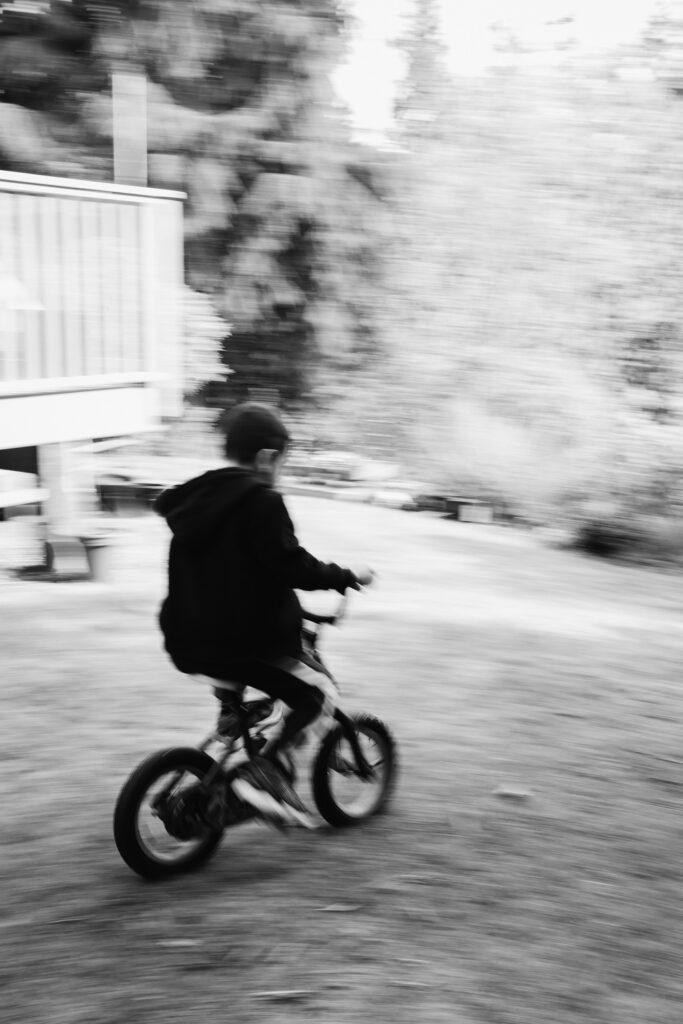
“How about this?” I say. “You go wait outside. I’ll finish getting ready and meet you out front in a few minutes. Just stay in the yard.”
We live in the furthest outskirts of Allentown, Pennsylvania, an average city in size, and most other qualities. My neighborhood is full of single-family homes, with the occasional stretch of doubles here and there. I often leave my car unlocked. Or even my back door.
So I don’t hesitate to let Wyatt have a few unsupervised minutes in our yard.
But I still rush through my tasks – slipping into sneakers that don’t require lacing, exactly why I bought them, clawing my hair into an oversized clip, racing Art down the stairs on my hip. I sit him on the floor when I reach the bottom, and start looking for the stroller. I don’t get far before the doorbell rings.
Through the leaded glass of my foyer door, I see an unfamiliar face peering into my home. The beveled windows distort her features. Fracture her face into puzzle pieces that don’t fit together.
I open the door, and find my Wyatt on the other side of the threshold, separated from me as though he belongs to this stranger. The distance between us feels immense, like we are standing on opposite ends of a dangerous ravine. My brain fractures just like her face had. All of this feels wrong.
“Is this your son?” she asks me.
“Yes,” I say.
“He was out here alone,” she says to me. Then into her phone, she says, “Someone is here. She answered the door.”
Then she angles her head away from me to better listen to the voice on the other end of her phone. It takes me a moment to realize that she’s called the police.
“I don’t understand the problem here,” I say. “My son was playing in his yard and not in the street?”
“Yes,” she says. “But he was out here all alone.” She turns back to her phone, confirms again that someone is home, and the officer on the other end hangs up on her.
“Thanks for your help,” I say to her, then pull Wyatt back into my arms, and shut the door without another word.
*
My mom likes to tell the story of her fifth birthday – a memorable one because it was also the first day she ever went to school. And she walked there. On her own. Meeting up along the way with neighbor friends. All of her older siblings went to another school. My mother’s was a mile away.
She was the second youngest of eight. It was 1969. No one thought twice about sending a freshly-minted five-year-old out the door to walk alone to her first day of kindergarten.
But by the time my mother was a mother, the standards for child safety and parental involvement had shifted. She remembers making a concerted effort with a neighborhood mom, Jen, to give us kids some unsupervised play time.
“It was a time of milk carton kids and it felt like everyone was getting scared about child abductions,” my mom told me recently when I asked her how she decided to give me and my sister a little freedom. “But Jen and I didn’t want our kids to be afraid of everything. We wanted them to have a childhood like ours.”
So she and Jen agreed to let me and my sister and Jen’s daughter, Alice, play in the alley between our houses while our moms stayed inside. They were nervous. And I picture them now, coiling the cords of their landlines around their fingers, stirring dinner pots with their other hands, whispering brave reminders to each other through their phones. Stay strong. Don’t interrupt them. They’ll be fine. What’s the worst that can happen?
I don’t remember their fear. But I do remember pretending that we were the world-famous girl-band The Gemstones. My sister, renamed Pearl, after her birthstone, used sticks to bang away on garbage can drums. Alice, now known as Ruby, sang into a lime and tangerine echo-phone mic. And I, going by Amethyst for my February birthday, strummed away at my air guitar. My imaginary hair, purple like my namesake, flowed behind me in waves down to my waist.
We were completely enthralled in our make-believe world. I wonder if we would have been able to give ourselves so completely over to it had our mothers been there, watching us.
I could hardly hear my mom calling me in for dinner over the deafening cheers of our invisible audience. But I made it to the table, that night and every other night, with no major incidents to report. Just the stirrings of great friendships, and a growing imagination I rely on to this day as a mother and a writer.
*
It takes them a while, but Henry and Wyatt finally master riding their bikes around the same time. And then it’s all they want to do. Henry is eight when this happens. Wyatt is six. Arthur, now four, trails behind them on his scooter. We have a fourth child now, a baby girl named Norah. While her oldest brothers try to balance on two wheels, Norah tries to balance on her two feet.
We spend a lot of this learning time in the alley behind our house. The boys ride up and down and up and down. And Norah and I walk the same route – up and down – with her fingers clenched around mine.
Henry and Wyatt outgrow our small alley quickly.
So on a warm September afternoon, I load their bikes and helmets into the back of my car. I squeeze my stroller in there too, and Arthur’s scooter. And when I pick them up from school, a jumble of uniform polo shirts and backpacks and lunchboxes, I surprise them with a trip to the park. There, they can spread out and ride a one-mile loop. A little taste of freedom.
I help the boys unload their bikes. I buckle a few helmets. And off they go. I tell them to stick together, and if they get nervous or need to check in with me, to either turn around or stay put. I’ll be following behind on foot, pushing Norah in her stroller.
There are few trees inside the track, leaving it largely visible from end to end. The boys ride ahead of me, but I can almost always see them.
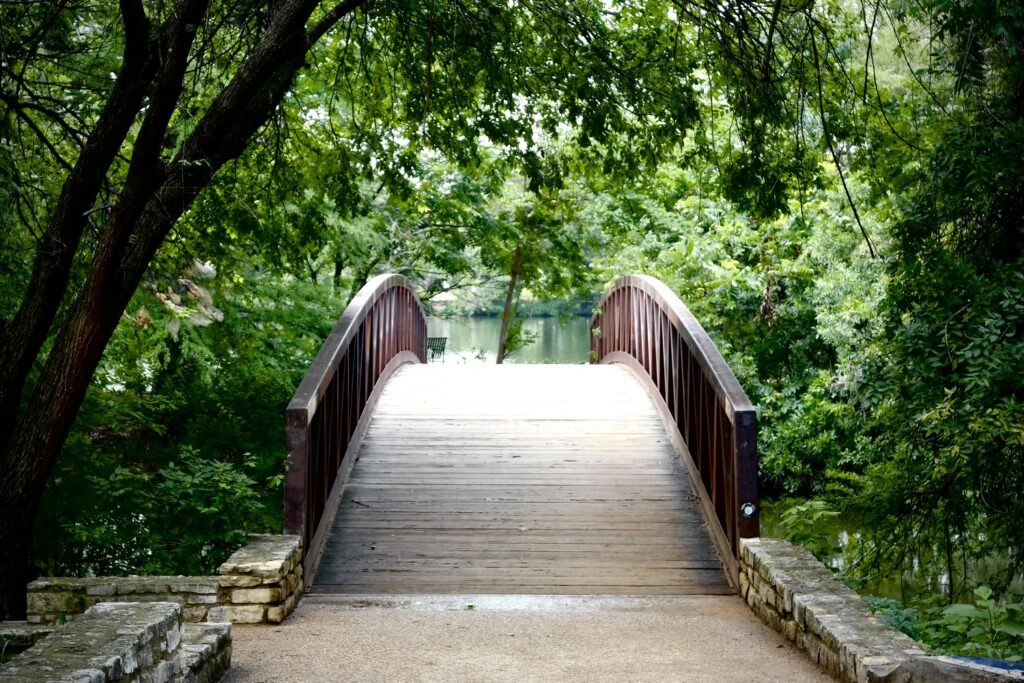
And I can see when they pull over by a bridge, and a woman starts talking to them. She leaves the park before I catch up. When I get there, Arthur has distanced himself from the bridge, and he stares at it with trepidation.
“What’s up?” I ask him.
“That lady told me there’s a gremlin that lives under the bridge and it will get me if I don’t stay with my mom.”
My eyebrows lift onto my forehead while I try to think of a response. I’m stunned into silence. I can only think to utter the truth.
“Artie, there’s no gremlin under there. You can scoot over the bridge if you want to. She was just trying to keep you safe. But you’re fine. You can keep going around the track if you want.”
He stares at the bridge a minute longer before kicking off with his right foot to speed away once again. He catches up with his brothers quickly, and the three of them continue on without me, sometimes within view, sometimes not.
I walk with Norah, taking in this gorgeous day, while thinking about that stranger’s words. I wonder why she decided to create a monster, when this world is full of plenty already. And by doing so, she turned herself into my version of a monster: someone afraid of the world around them, and trying so hard to have others feel just as scared.
But the fear won’t stick. At least not for me. It evaporates with the crunching sound of fallen leaves beneath my stroller’s wheels, with the smoky smell of a bonfire burning in the distance, with the jingle of Norah’s laughter as the wind tousles her hair. We pass another stranger, and I wave. She waves back, and smiles at Norah. “Beautiful day!” she says. And it is.
Cover photo by Anna Khromova on Unsplash
About the Author