
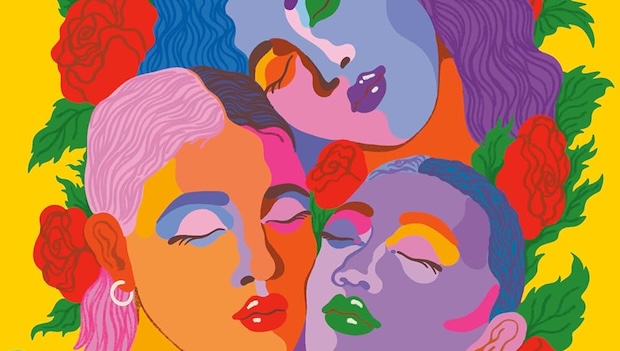
Drama in the Mommune: Domenica Ruta Talks to Jade Sanchez-Ventura About Her Radical Summer Read
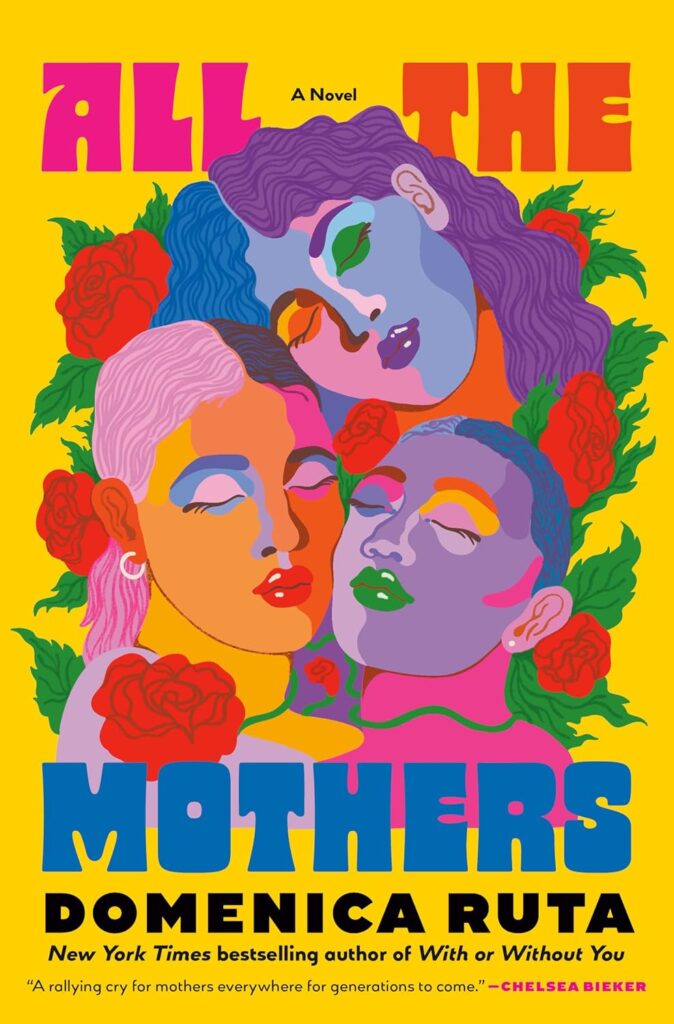
With all All the Mothers, New York Times bestselling author Domenica Ruta has given us a beautifully crafted, smart, romantic, burn-the-patriarchy to the ground, mommune-at-the-beach read. I mean, what more can a MUTHA ask for?
Since becoming a parent, I have been continuously struck by how much the act of caregiving makes legible. I came to parenting with a background in social justice and still, the contrast between the American emphasis on family life and the absence of meaningful structural support for the actual life of a parent, was a shock. I prefer my mommune talk to include a discussion of this problematic reality. The delight of All the Mothers is that it’s a hilarious, tender story that also doubles as a scathing take down of our current systems. You’ll just be so immersed in the lives of these women and their kids (also expertly crafted as characters on the page) that you may not realize it until you’re done.
All the Mothers centers on the lives of three women—Sandy, Steph, and Kya—who have a baby with the same man, Justin. They’re not all in love with him, or interested in marriage or living with him, but they do all want a responsible co-parent. When Justin does not show up in this capacity, the mothers turn to each other to make the family they need. What emerges gives the mothers, as much as their kids, a sense of home and belonging that they’d never experienced and for which they’d never even thought to ask. And ultimately, they find that the life they’ve made is one they’re going to have to fight to protect.
And did I mention it’s sexy? Thanks to Domenica for telling all, here’s an excerpt from a conversation that by end had us plotting our own Brooklyn commune full of kids and shared dinner prep. In the meantime, we have All the Mothers. – Jade Sanchez-Ventura
Jade Sanchez-Ventura: Can you tell me where All the Mothers began for you?
Domenica Ruta: The seed is my real life. One of my best friends, truly a sister to me, is my oldest son’s sister’s mom. (Yes, everyone has to do the math.) When my son was about two, his dad had another baby with another woman. We didn’t know each other, but we were both very curious about each other. She found me on social media, we met up and it was platonic love at first sight. And I thought, this is not the usual thing that happens. It’s certainly not the thing that our society teaches us and not the way I was raised. I was taught to see other women as a threat and a danger; that’s the modeling I got and, in some ways, I embodied that, shamefully. But this relationship with this woman has changed my life. She’s such a support to me and I consider her my third co-parent.
JSV: I love that so much. In thinking about how we’re raised, I was struck by the distinct cultural spaces that emerge in the book, and I’d love to start with Sandy’s arc, because to be honest, in the beginning she starts driving me crazy, right?
DR: To use a possibly pejorative term, I joke that this book is my basic bitch rescue mission. It’s all about a certain kind of woman who is trying so hard to make capitalist, heteropatriarchy work for her. She can see it’s not working. She can feel it’s not working, but she is committed to the bit. Until two things happen. Her mother dies, and she has a baby as a single woman and she actually can’t anymore. Life kicks her off of the path she would absolutely have otherwise stayed on.
JSV: And before she’s kicked off there are those moments when she questions the norms. For example, how she begins to interrogate the wellness gaslighting.
DR: The wellness gaslighting, the hetero-monogamy gaslighting, the idea that the most important thing in the world for a woman is to have a man who’s committed to her. This is something I have observed a lot with other people in my life, and I think there’s a terror to it, a conviction that if I don’t succeed in this hetero monogamous world, I will die. I will be the lone wolf in the forest who starves to death. And that is 100% not true, but it feels true to many of a certain kind of woman. It was a real risk for me to write an unlikable character. In the beginning, not everyone’s going to have sympathy for where Sandy is at, but the point is that she undergoes a radical shift.
JSV: One thing I love about Sandy’s arc is that it’s slow and then fast. There are those little confetti of her doubts and then very quickly she has changed. I think you also show the reason for that terror by showing how little external support there really is for parents and women. But then also how many of the common responses to that terror is to just feed into the same systems that create it.
DR: Exactly. And for some people—queer people, people of color, disabled people—you have to opt out because it was never going to work for you. But Sandy—it could potentially work for her until these other things happen and then it couldn’t anymore. And that’s why it’s slow and then fast. To a certain extent, the other women that she connects with have a similar arc, but at a different tempo.
JSV: With all the mothers, but especially with Steph [who is a Queer, social justice minded, former punk teenager from an Italian-American, Staten Island family, and also the one to set the mommune in motion] I see an examination and critique of whiteness.
DR: I’m Italian and the joke is that Italians are white, but we know how to season food. We’re spicy white. You know there were color wheels on Ellis Island and we were grouped with people from Africa? And we were put into the same neighborhoods. But as soon we could access whiteness, we did, even though we had an opportunity to not do that. And it really blows my mind how incredibly racist the Italian-American community has become in the Trump era, when there was a time when we weren’t white in the early 20th century. We were not white. And then, like many white European immigrant communities, we chose whiteness very consciously en masse.
Steph has a vestigial memory of that choice and she fights against it. Yet she still tries to make it work in Staten Island with her family because economically she can’t afford to do anything else.
JSV: You also show how these different paths to whiteness create different cultural realities for each of the women.
DR: Yes, Steph has this big, huge, Italian-American family that comes together for better or worse, and Sandy is very much that isolated white suburbia where you’re not connected to anything bigger than your nuclear family and is just so desperately lonely.
JSV: And then we have Kaya, who I think you describe as Greek and Jewish.
DR: She’s a huge mix of European origins; she’s Greek and Jewish and Irish and more. But she grew up primarily in the Bronx and the communities that adopted her inform her. Kaya is from a multi-cultural part of the city and has adjacency to other communities. I will also say that the middle-classness of capitalism protects Sandy for a while. Whereas Steph comes from uneducated, lower middle class and Kaya comes from dirt poor, like those who of us who move in the middle of the night escaping our landlord. And so, they have very different versions of whiteness through capitalism.
JSV: What was your process of starting to puzzle together these mothers?
DR: Their voices came to me first. They started having conversations with each other and I would transcribe their dialogue. The scene of them watching The Bachelor together came to me out of nowhere and it helped me get to know who they were.
I started to piece together how these three different mothers, these three different women, arrive at this cultural touchstone: a reality dating show that is a performance of hetero monogamy and capitalism essentially. They react to it in very different ways, but they love each other and watch cuddled on the couch, laughing and making fun of each other. And I loved that too.
JSV: When did you know that there would be romance in the mommune?
DR: Fairly early on because I love me a soap opera. If I have one ethos as a writer, it’s “make it messy.” Otherwise, there’s something so sweet, but still sanitary about how they’ve formed this mommune. But now, actually, there’s also sex.
JSV: When one of the moms asks if the other is a “bossy bottom,” I lost it. I laughed so hard. I really appreciated that segment where the conflict endures. Because sometimes you just can’t solve a problem because you don’t have time.
DR: There’s literally not time. You have to make a meal. You have to like get out the door and you have to just hope, later we’ll figure this out. And can we, you know, serenely and sanely just stomach the awkwardness until we can have that moment?
JSV: I could talk about the female friendship here endlessly. Femme mothers will want to climb into this book and live there. I think you speak to a very real need, especially in early parenting, to be piled onto a couch with women you love and are loved by.
DR: I’m in a happy monogamous heterosexual marriage. That was a choice I made because of the person that’s working out for me. But there’s so many times when I’m like, I don’t want a male partner right now. I just want two or three women to be with me and for us all to talk about bodies and hold each other.
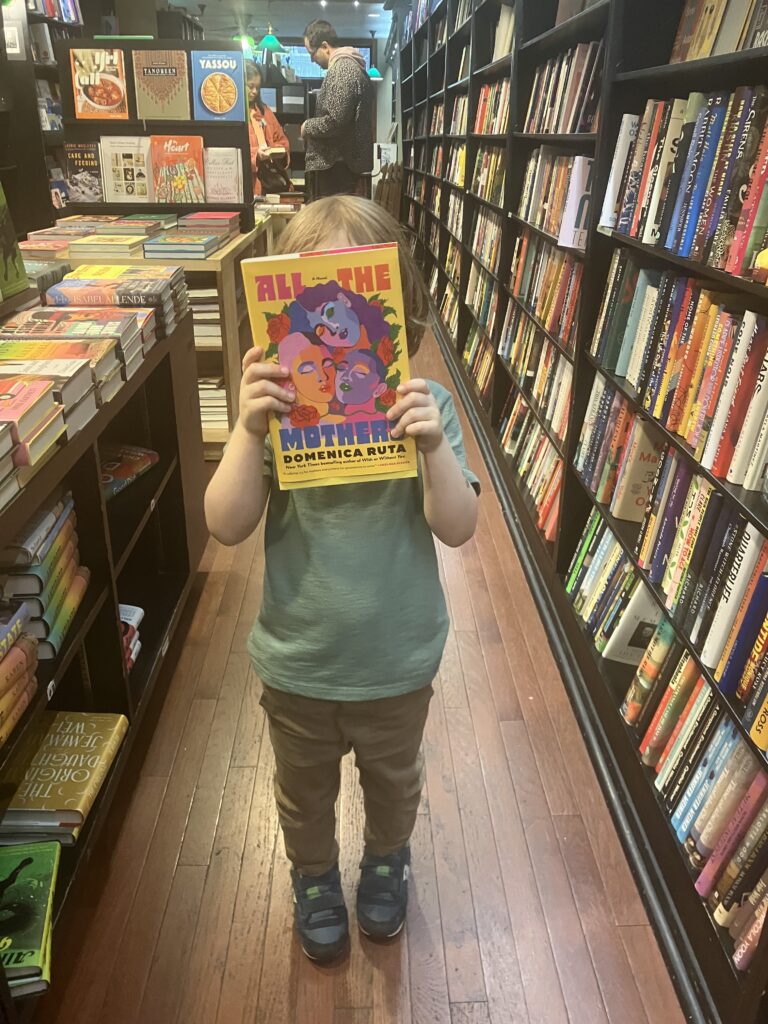
Pick up All the Mothers at your local indie and report back, from beach or subway or wherever you’re traveling this summer and beyond…
About the Author

Jade is a writer, radical educator, and is currently pursuing a Masters in Library Sciences. She works in memoir and fiction, and her personal essays have been published across an array of journals and presses, among them Slice Magazine and Seal Press. She’s been awarded the Slice Literary Conference Bridging the Gap award, a Disquiet Literary Conference fellowship, and she is a Hertog Fellow. As an educator, she is very good at being continually wowed by her students and their words on the page. Though she has ties to many countries, she has always made her home in Brooklyn, New York. Find her on Instagram @jade_m_sv.
Author photo (c) Ro Agents-Juska
Related Posts
Lucky →
Childcare and Breathing: An Excerpt from STUDENT PARENT →
Lost and Found: Join us at the Brooklyn Book Festival x MUTHA x Pen Parentis Lit party! →

One Response to Drama in the Mommune: Domenica Ruta Talks to Jade Sanchez-Ventura About Her Radical Summer Read