Eaton Fire Claims Yet Another Victim
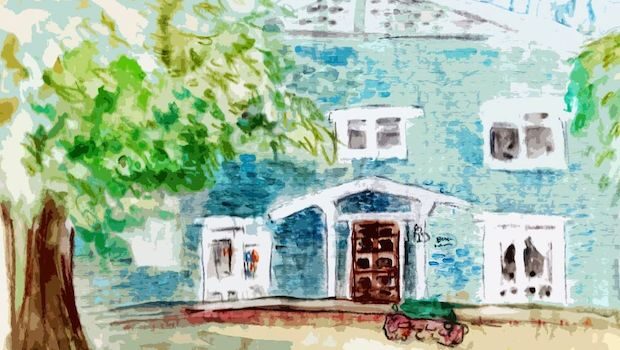
Before I ever had children, I knew where I wanted them to go for preschool: a large rambling house on a corner lot in Altadena, with goats peeking over the fence. A scrolled sign out front announced the name of the daycare, Children’s Country House, and a date, 1975, but that was all the information I knew about the place. My best friend lived down the street and we walked by it for years.
When I finally had a child of my own and they were old enough for preschool, we visited Children’s Country House. It was perfect: affordable, diverse, toys tumbling off of bookshelves and out of trunks, and kids who were allowed to play in the dirt. The school didn’t have a website, just a landline phone. Lunch was simple and homemade. CCH seemed like it was from a different place or time, certainly not fifteen minutes from Los Angeles. The neighborhood was high up in the mountains, surrounded by tall pines–I often saw it on television, a stand-in for the Pacific Northwest.
I met Tim Olausen on the first day of school. He was the caretaker of the animals: the aforementioned goats, a few chickens, a rabbit, and a one-eyed rescue pony named Starlight. He came every morning to take care of the chickens. The kids were usually inside eating their breakfasts then, and he would walk by their window and pretend that the chickens were dancing. Sometimes, when he came back in the afternoon, he’d bring his own horse, Nash, a beautiful golden pinto. He was a bit of a local celebrity–neighbors thought it was good luck to catch a glimpse of Tim and Nash walking down the street.


There were strong winds on the morning of the fires, and my child had a tantrum about going to school. They were afraid of the noises–of trash cans falling over and tree branches snapping. We told them there was nothing to worry about, and dropped them off at CCH like we usually did. I drove by Eaton Canyon on the way to pick them up, not knowing I was tracing the path of the fire that would come just a couple hours later.
We ended up that night with five extra people and four more animals in our home, which was three or four miles away from the fire. We spent hours calling our friends and family, trying to alert people in the path of the fire. Cell phone service was never great close to the mountains, which made it hard for residents to get information, especially when the first responders were overtaxed and too busy to stop by each house to warn them.
CCH burned that night, and all of the animals died. The two teachers who lived in an apartment above the classrooms thankfully made it out alive. Tim, who lived around the corner, was able to save Nash by walking him miles through the fire to safety.
Two days after the start of the fire, when we were still trying to track down everyone, and my hair had started to fall out in clumps due to stress, a friend sent me a video of Tim and Nash at the Rose Bowl, where they were taking shelter. “I’ve never been more scared in my life,” Tim said.

Information about the CCH community came out in dribs and drabs over the course of weeks in a complicated game of telephone. We were all scattered around, without an easy way to contact each other–all the records of the students burned. Most of us just had the odd phone number of another parent left over from a playdate, or the number of a teacher who sent us pictures from our child’s birthday celebration.
The official death toll from the Eaton fire is eighteen. That doesn’t count the people still missing, or people like Tim, whose death was reported in early September, almost eight months after the fire.
Beautiful Altadena, a local Instagram account, called him another fire victim. They reported that the depression Tim had battled his whole life had grown unbearable in the aftermath of the fire, and he died by suicide. The news of Tim’s death came on the heels of finding out about more health issues cropping up in the community post fire: cancer care delayed, heart issues and strokes in otherwise healthy adults. Other news, too: a discovery of toxic chemicals discovered up to six miles from the burn scar, an area I live in with my children.
My child remains afraid of fire, and the sound of wind. But to me, and the other adults I know, the fire seems like the most simple, understandable part of this situation. A spark in high winds after a dry autumn led to a catastrophe. What scares us, what is impossible to reconcile, is the absence of any care or accountability from the government. The emergency alerts that didn’t go out, the fire trucks that never came.

In the days, weeks, and months since, we have been focused on mutual aid, on sourcing new rentals for friends, often at exorbitant prices that doubled and quadrupled in the days after the fire, and filling their new places with kitchen goods and furniture.
The need is so much greater than we can provide. What we’re doing feels like a drop in the bucket. Casseroles and diapers don’t make up for the inaction on climate change, the wires left strung over dry canyons, insurance companies dragging their feet, requiring homeowners to account for every spatula and trowel lost. Most families have a gap of several hundreds of thousands of dollars between the cost of rebuilding and their insurance payouts, so many are forced to sell. Homes and lots are being bought up by private corporations, destroying a historically black community, a rare middle class enclave in Los Angeles.
The fire hadn’t even been fully contained before community members started collecting and passing out water, PPE, and other essentials. The National Day Laborers Organizing Network, an immigrants’ rights group in Pasadena, organized volunteers to begin debris cleanup and pass out formula, toiletries, and food. They began their work before any government agencies arrived, and continued a lot longer after they left, giving away goods without requiring forms, making people feel cared for and seen in the hardest time of their lives.
Nine months ago, we were a community ravaged by fire. Today we are a community ravaged by ICE, which has been raiding our neighborhoods, kidnapping new moms and brandishing weapons at passersby. This time, there is no official count of families destroyed or people who have disappeared, as many of the victims have to stay silent due to fear of retribution. Instead, mutual aid and community groups like NDLON are once again standing up to support each other.
Now, once again, no one is helping us, except ourselves.

In the days since Tim’s death, I’ve been thinking about the conversations we had. Life hadn’t been easy for him, and he saw it as his work to protect those more vulnerable than him, especially animals. I think of how courageous that impulse was, for Tim to stay open to connection despite his pain. I’ve been wondering what that means in the face of his loss. For me, it means that my grief over Tim is braided together with the desire to be there for my community, whether through potlucks or holding our officials accountable. And I will continue to be open to the heartbreaking joy of this world.
This morning, I drove my child to their new school. It’s different. I get official reports when my child trips over a rock. But there are still trees, and my child is learning Chinese. They come home eager to tell me all about the new words they’ve learned. They adore their teacher, who kindly waited with me while I burst into tears as I filled out the intake paperwork.
About the Author

Akina Cox is an artist and writer. She moved to Los Angeles in 2003 after being raised in the Unification Church. She received an MFA in Visual Arts from CalArts in 2012. Her artwork has been included in exhibitions at Commonwealth and Council, Bozo Mag, and Susanne Vielmetter Los Angeles. Her artist books have been sold or exhibited at Centre de Pompidou in Paris, Art Metropole in Toronto, Printed Matter in New York, and MoCA in Los Angeles. To read her article on MAGA and cults, published on HuffPost, click here. To read her article on ICE, published on Salon, click here.
Related Posts

Where Are You →

My Helga, My Omi →

A Lost Mother’s Love is Never Gone: An Interview with Anna Nordberg →