Diablicos in Panamá
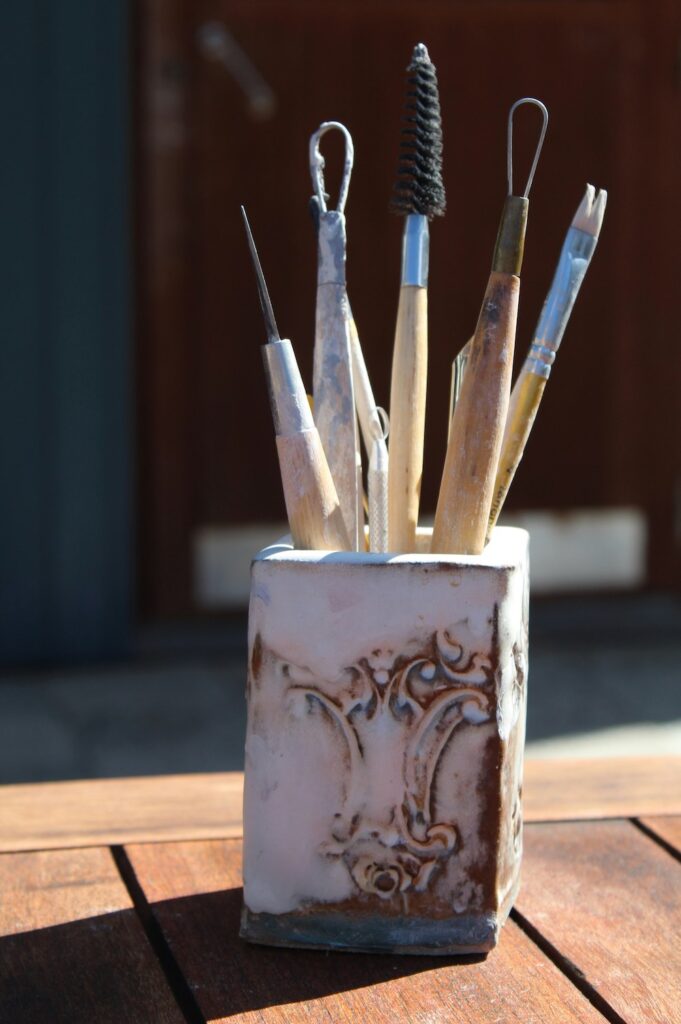
To make a mask, one must possess a vision for the clay.
An air-conditioned tour bus coursed us through the city to the beach in Panamá Oeste. We passed repainted versions of the school buses we used to ride in Los Estados Unidos when we were young. At fourteen, our kids had been learning Spanish together for the last nine years in an immersion school in Maryland. We, a group of about twenty Black parents, wanted to expose our children to authentic uses of this language that relies on accent marks. To have our young teens interact with a culture informed by Spain and the indigenous people of that region. To watch them listen to and speak with native speakers in a new environment. We wanted to give them the world, so Panamá was the destination for their eighth-grade trip.
One takes malleable clay in her hands.
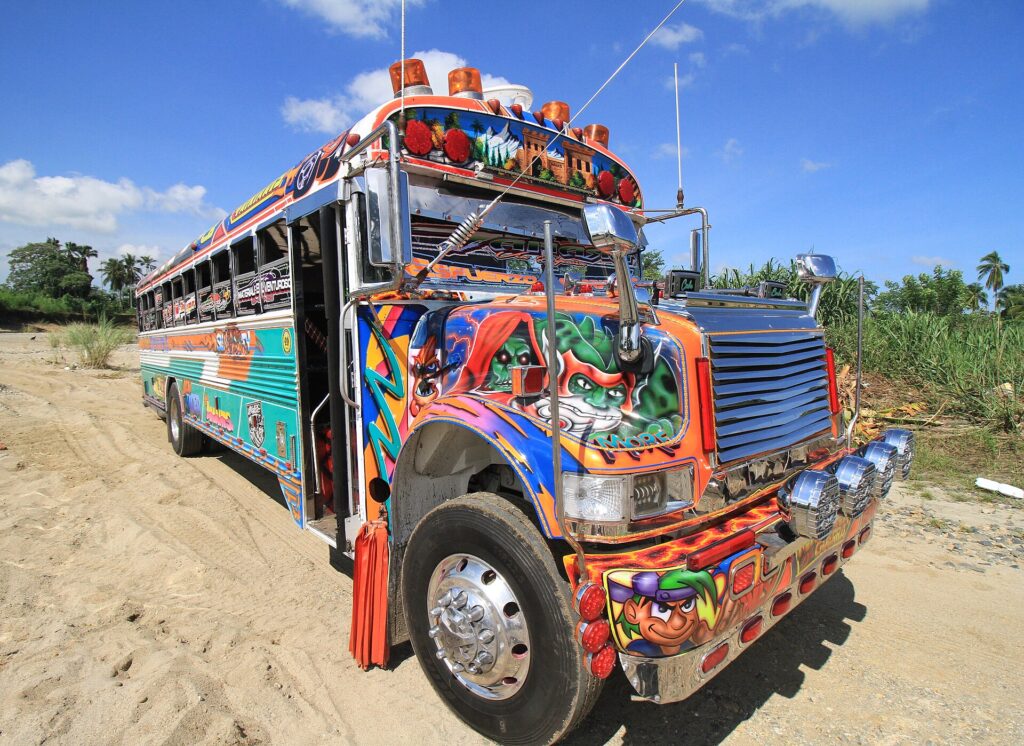
Diablos rojos: The retired American school buses—repainted by hand with folkloric designs—were imported into Panamá City and used for public transportation for forty years. Tired and weary, but reborn through a Panamanian tradition started by visionary folklore artist Andres Salazar in the 1950s. However, in 2013, the dangerous red devils were no longer considered safe and were outlawed in Panamá City. Yet they were still present elsewhere in the country. Their new owner’s vision made them vibrant sights.
A form is sculpted.
I didn’t raise up my children in the way they should go. My family’s attendance at church was consistent, sporadic, and non-existence across my mothering years. My oldest son converted to Islam. It was Easter season, and he was fasting for Ramadan.
After the sculpting, the clay is allowed to dry.
Many years ago, I was told that if I left the church I was raised in, I would lead people to hell. The gentleman who read my prophecy was someone I had admired and respected, someone I had even had a crush on. I was concerned; I did not want to lead anyone to hell.
Papier-mâché is layered over the form.
It was Holy Week. We learned that many people leave the city and go to the countryside to visit family during the holiday. Schools in Panamá were closed. Rest and rebirth.
On Holy Thursday, I left my fourteen-year-old behind at the hotel with his friends and other parents and struck out on an adventure into Panamá City’s nightlife. I was searching for an authentic Panamanian food experience and landed at a restaurant filled with devil costumes and masks with large wooden teeth. Restaurante Diablicos.
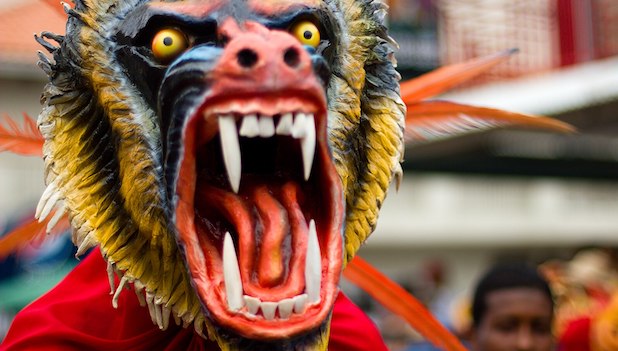
Horns are added to the clay to make a diablico sucio.
I had seen painted versions of these devils on different walls here and there and was curious about their history. Keep a safe distance, I told myself. But, remember things only have power if you bestow it upon them. I sank into amusement, entertainment, intrigue, and promised myself to Google their significance later.
Outsized wooden teeth are also added to the form.
Am I making good choices? How am I to mold my children? Will they yield beneath my hand? Or do I give them tools to mold themselves?
Then the mask creator uses bright colors to transform the clay into a spectacle.
Diablicos sucios adorned the interior of the restaurant. The forms donned terrifying mask heads and were dressed in the traditional red and black attire.
One of the performers slated to provide us with traditional Panamanian entertainment was fitted in a shrunken old lady mask and a dress covered in tiny mirrors. This was a diablico limpio.
During the festival of Corpus Christi in Panamá, there are two types of masked dances: the diablicos sucios (dirty little devils) and the diablicos limpios (clean little devils).
This is/was/will always be the battle between good and evil.
*
Walking through Casco Antiguo, the “old quarter,” I was reminded of the New Orleans’ French Quarter. Still, this was entirely new. I could not take my mind off of the lines stretched outside of churches.
Maundy Thursday. Maundy comes from the Latin mandātum, which means mandate. However, in the context of the Last Supper, after Christ’s washing of the apostles’ feet, the religious recognize Christ’s command—a mandate “to love one another as I have loved you.”
Love is a verb.
One church had enough room for the masses, so I entered, sat in a pew, and uttered a quick prayer. Humidity crouched between attendees who knelt in front of Mary. Parishioners touched an altar that bore a prostate, life-sized statue of Christ’s body before they left the church. Do I also touch this form? What keeps this statue from being an idol? I stood back a little and was pleased that people still perform their beliefs.

My Christian education equipped me with knowledge that Christ offered bread and wine as representative of his body and blood, telling his apostles to “Take, and eat, and do this in remembrance of me” during his last supper.
Like many Americans, Christian or not, we remembered Christ through Easter baskets and bunnies. I, too, participated in giving my children candy in cute containers and dying eggs regardless of whether we went to church on Resurrection Sunday or not. It was a fun tradition that brought joy, even if it was another product of man’s hands in/or against religion.
The diablicos in Panamá play a role in the European tradition of honoring the holy eucharist, the blood and body of Jesus Christ during the Feast of Corpus Christi, sixty days after Easter. In the thirteenth century, Thomas Aquinas was responsible for organizing this feast. And Panamanians added dancing diablicos in order to celebrate the battle of good versus evil and to pass down oral tradition through music and dance. (1)
The diablicos sucios clicked castanets to simulate the gnashing of the devil’s teeth and persuade the crowd to fear the devil and behave according to Catholic values.(2) Around Corpus Christi, the diablicos sucios frequently dance for eight hours at a time, making the dance a true endurance contest. The diablico’s whip can also be used to fend off drunken members of the public.
What a force fear can be!
And what do we make of traditions? How do they let us down? How do they lift us up?
On Good Friday, in Panamá, Christ is remembered by not drinking alcohol; no alcohol is sold on this day anywhere. The populace engages in collective abstention. I am fond of sacred ideals upheld and traditions passed down.
*
I’ve stopped going to church; watching church online during the pandemic did not work for my family, and so outward actions transitioned into an inward, quieter practice. When the doors to the sanctuary re-opened, easy Sunday mornings had taken over in my home. But I still hold fast to some of my Christian upbringing and have passed down certain principles and values.
We pray over our food, and for others. We remember to be grateful for all that we have. We are connected to our extended family. We give when we can. We are careful with our language and thoughts.
My purview has widened and I believe that more than one thing can be true. We get to choose which stories to believe, what will help guide us as we encounter diablicos and fear-mongers. We get to choose how to demonstrate love.
I also bend under peer pressure. I am cautious, anxious, even though I know some fears can be irrational. I am sometimes afraid that the job I have done as a mother is inadequate. Did I expose them to enough opportunities? Should I have enforced more Christian viewpoints and practices? Was I encouraging? Was I patient enough? How did my own stress get in the way of being a calmer, happier mother?
My crafting and molding shifted slowly as my sons aged. Today, my children show me that I have given them enough tools to combat their fears and to win battles between good and evil. My oldest son’s choice of Islam was an indicator that he is an open-minded explorer, seeking what works for him. My youngest son’s awareness of others’ feelings and needs reflects that he is compassionate practitioner of love. They know that things aren’t easily categorized as either black and white or undeniably right and wrong. They know they can question and develop nuanced understandings of everything put before them. I hope they have felt immensely loved. And that I have given my children enough light to journey onward courageously in whichever direction they choose.
*
- Warner, Natalie. “Diablicos Sucios of Panama.” Coronado Concierge, 9 Sept. 2019, coronadoconciergepanama.com/diablicos-sucios-panama.
- “Corpus Christi Celebrations of Panama.” Second Face, www.maskmuseum.org/corpus-christi-panama. Accessed 28 Feb. 2024.
About the Author

A Southern girl from Nashville, Yvette J. Green has grown to love Go-Go music having made the DC metro area home. A graduate of Xavier University of Louisiana (BA in English) and University of Maryland, College Park (MA in English). She is an alum of Tin House’s Winter Workshop and a Periplus Collective Finalist. Yvette’s writing can be found in Salon, Viator, midnight & indigo, and Brevity Blog, among others.
Related Posts
Wanderlust: A Supposedly Fun Thing I Would Definitely Do Again →

Wyoming →
Parenting Books Didn’t Tell Me →