The Limitations of Grit
Over his 6:30 a.m. breakfast, so early because Jazz Band at middle school started at 7:10, zero hour, my 8th grade son brought up one of his school mottos. It’s painted in the school gym, up high near the ceiling in red letters. “I don’t like that motto,” he said. “More Grit.”
I nodded. “No wonder. It’s ableist crap, for one.”
My 13-year-old was already acquainted with the phrase “ableist crap.” He’s autistic, and ADHD. He often wore his autistic pride t-shirts to school: “It comes in handy for subs. They always read the t-shirt and that tells them some important things about me.” That is, that he’s 1. autistic and 2. proud of it. He also knows that I am diagnosed as bipolar and having PTSD, and that I’m self-diagnosed as also autistic and ADHD.
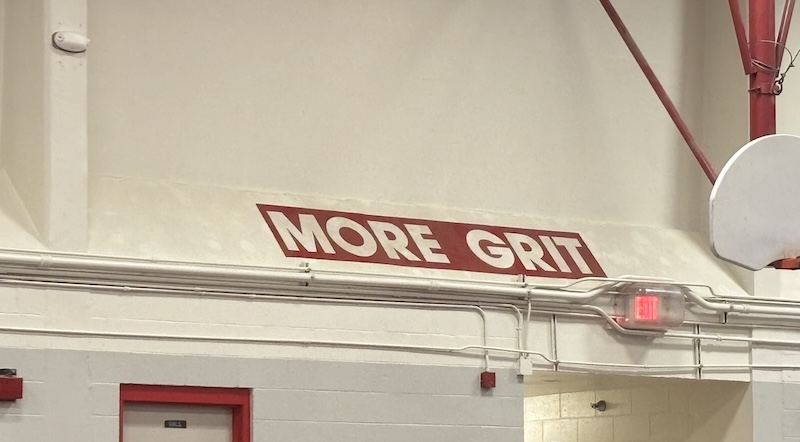
I’ve been asked, why be proud? I replied that these days “autistic” is slung around at school like the r-word and gay were when I was as a kid. I’ve heard it myself. I was sitting in the gym, waiting for a 7th grade band concert to start, More Grit painted on the wall across from the stadium style seating, when two 8th grade girls stood near me, chatting. One sighed, “Today was SO embarrassing. I ended up walking around campus by myself all morning, like I was autistic and had no friends.” Her friend giggled. I said nothing, because I was too busy restraining the urge to punch an 8th grade child.
My son has been known to call other kids out on using the word autistic like this. But the word is used so often, he chooses his battles. Like when the kids involved are friendly and might listen to the shame in their guts when he points out “I’m autistic you know, and you shouldn’t use the word like that.”
In the morning, as my son sipped on his smoothie, I expounded. “Schools have mottos like that to try to avoid responsibility. Instead of accommodating their students, they just say More Grit! Disabled students have more grit that most people realize. They use it every day to navigate school. But at some point, the answer isn’t yet more grit. Its accommodations.”
He nodded. “The vision impaired students at school can’t just see better if they use more grit.”
I’m guilty of trying to grit things out regularly. I realized my pain tolerance might be more of a problem than a brag when 95% of childbirth, unmedicated except for Pitocin, which I’m told makes it hurt more, felt like the kind of bad cramps I’d been powering through since I was a 6th grade girl. And powering through physical pain is one thing. Powering through psychic pain is another sort of bad idea.
My son has known I’m bipolar since he could talk. At first he just knew I had a doctor who helped me with my brain because I was bipolar. As he got older, I added more details. By grade school, he knew that without medicine sometimes I could become very sad, or too excited, and that either could get so bad that I started seeing and hearing things that weren’t there. Sometimes out of the blue he’d say, “Have you really heard things that weren’t there?” I wouldn’t give details. I never told him about hearing Bill Clinton on tv say, “We love you babydoll. And tonight, before we crucify, we’re going to love you all the right ways.” I never told him both times I’ve been psychotic, I thought I was the second coming of Christ. I just said, “Yup!”
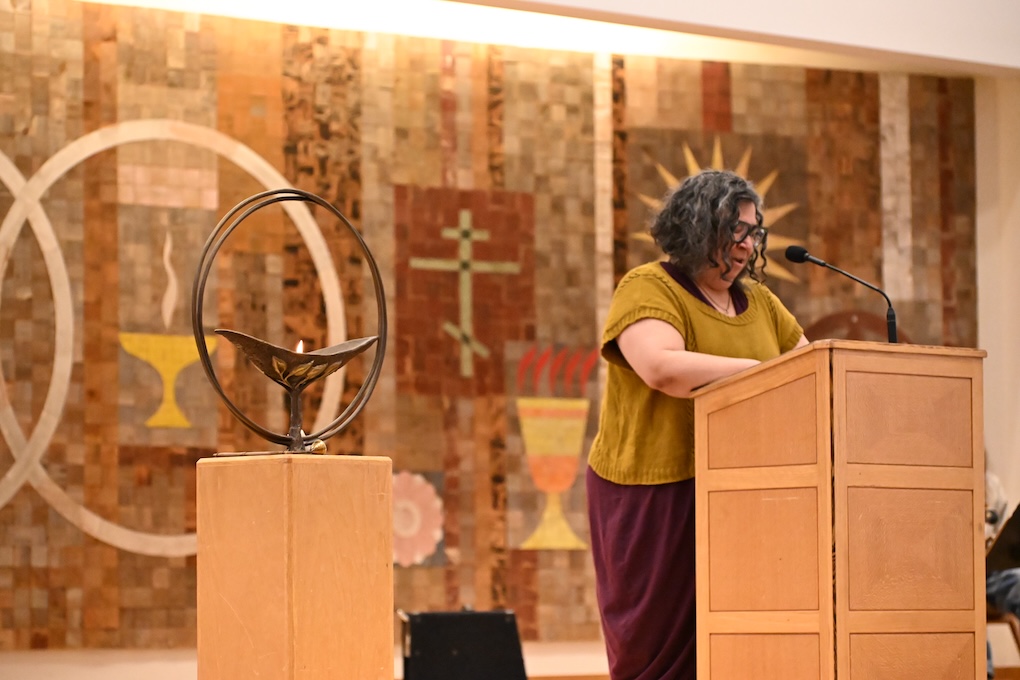
But it’s always been theoretical for him. He didn’t experience my illness in a way that hurt him until the spring of 7th grade. I’d given a sermon at our Unitarian Universalist church. I worked hard on it. It was called “A Daily Dose of Reliable Joy.” In it, I talked about my discovery of the fiber arts—embroidery to sewing to knitting to spinning to wool processing—and how it brought me an uncomplicated joy that fortified me, made me more able to weather hard times and work for good.
My son was front and center when I gave that sermon, glaring at me. “It’s going to feel so weird having my mom give the sermon,” he’d complained the week before. But it went well. I could feel the energy of the congregation as I read. Once I was done, there was applause, and a little later when we put one hand on our hearts and reached the other hand out to each other, my son reached his hand out to me, up there on stage, and locked eyes, almost smiling, and I knew my sermon had been good.
It turns out sermons get you a LOT more praise than publishing essays in literary magazines. I lost count of how many people came up to me afterwards to tell me how much they were moved. Some confessed their own desires for daily joy. A man with a firm handshake told me how he’d always wanted to draw animals in little clothes, like Beatrix Potter, and he was going to try it, who cared if others found it silly? Others showed me their crochet or knitting or told me about their poetry ambitions. I got a lovely thank you card in the mail later that week. It took months before I could go to church without at least one person saying something kind about that sermon.
All of that was great. Except that it led directly to a major PTSD flashback that splattered all over my kid one Monday morning before school. I’m not used to so much praise. I didn’t get it as a kid. I was more likely to be told by my mother I was fat, stupid, ugly, had no common sense, didn’t care about anyone but myself, didn’t know how to love. I was more likely to be raged at in tones like death. Or if I did receive praise, it was entangled with her need. I was the best thing that ever happened to her. I had always been her saving grace.
That Monday morning in spring, I woke up in the middle of a nightmare. This isn’t unusual, but this time I wasn’t able to shake it. The nightmare hung around my head like a cloud. I went into the kitchen, saw the counter covered with clutter, and started to tidy up. As I tidied, I cried, tears running down my face, my mouth open in silent sobs. My husband saw me, asked what was wrong. “I don’t know!” I sobbed. “I had a nightmare and now I feel bad.” He had me sit down and he finished the tidying, then went to get dressed.
I eventually stood up, started preparing our son’s breakfast. I toasted a bagel, cut some fruit. My son came into the kitchen and I snapped at him, “Don’t just stand there! Do something useful.” Not at all my usual morning greeting. He tried his best to do what I wanted, but no matter what he did, I berated him. “Use your common sense!” “Don’t just sit there!” “What is wrong with you?!” I was channeling a scene from long ago, speaking the vitriolic mother-words.
I know some will say, that’s normal. That happens to everyone. I don’t know a lot about normal. I know speaking like that to my son isn’t something I’ve normally done. I also know being spoken to like that as a child hurt me. It was part of a childhood and mother-relationship that led directly to my PTSD as an adult. I’ve been told I’m too sensitive my whole life, by many people. I used to figure they must be right, and I tried to grit through it all. Until I got my PTSD diagnosis. Once I realized I had PTSD, I realized gritting through had been the wrong course of action. I realized “too sensitive” was code for “please pretend you aren’t being hurt.”
I sat with my son at the table as he started to eat his bagel. He always likes company with breakfast. We’ve had so many bracing conversations that way. And I saw his face. Tears were streaming down it now. And I realized. I was not myself. This was a flashback. I wasn’t able to stop it all at once, but I stammered out an apology of sorts, told him I wasn’t feeling right. His dad took him to school soon after, and I spent the day as if I had the flu.
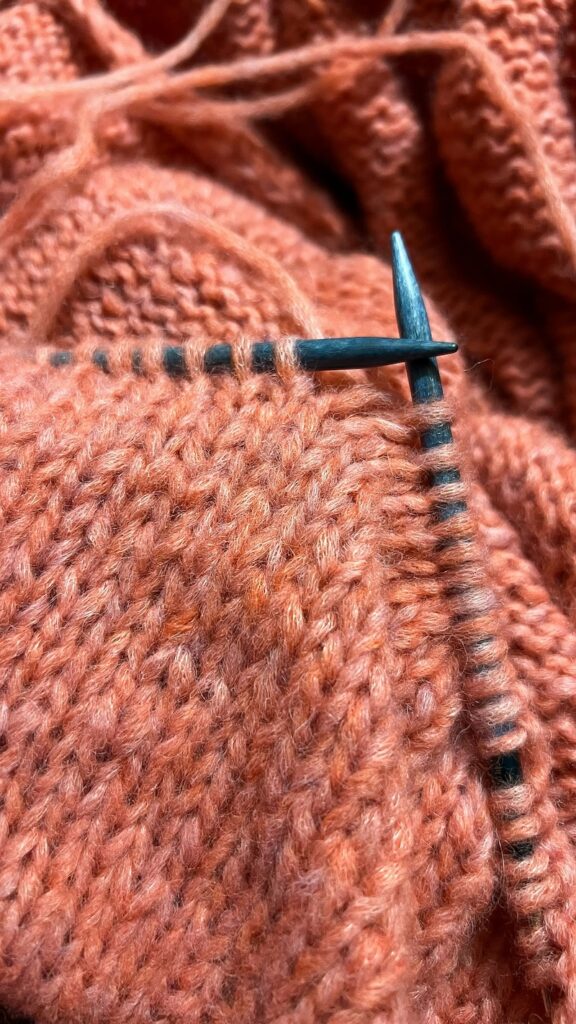
I sat under blankets on the comfy chair, drank fluids, knitted. The wool ran through my fingers, just the right amount of scratchy, smelling faintly of sheep. My hands moved in rhythm. I remembered scenes from my middle school years and took deep breaths. Did my best to come back to myself. There were a lot of reasons why I started knitting in 2022. One of them was that I read studies had shown it had similar effects on the brain as EMDR therapy, or Eye Movement Desensitization and Reprocessing therapy, which was used to treat those with trauma. I didn’t have my PTSD diagnosis yet, but I knew I had trauma, and I figured, why not?
I picked my son up from school that afternoon. As he buckled his seatbelt I said, “Buddy, I’m so sorry about this morning. I wasn’t acting right, and it hurt you, and I wish I could take it all back and make it never have happened.” He glared at me, angry. “No matter what I did, it was the wrong thing. There was no way I could stop you from yelling at me.” I took a deep breath, “I know. Believe me, I know.” As I drove him home, we talked. And I explained. I remember saying, “You’ve always known I’m bipolar, and you’ve known for the past year or so I have a PTSD diagnosis too. But I think this morning was the first time you’ve felt my mental illness. And I’m so sorry, and I wish I could tell you it will never happen again. But I was having a PTSD flashback to mornings from my own childhood, and I can’t promise it won’t happen again, even though I wish I could. But I can promise I’ll keep trying my best to get better, to manage what’s going on in my head.”
He didn’t say, its okay. He didn’t say, I forgive you. He was still angry, and I told him that was okay. But as we got home, I felt a little lighter despite his anger. Because I knew I’d given the best apology I had. I’d explained and not put any of the blame on him. I knew we’d talk about it again, and he was going to be okay. I knew we were going to be okay. But I also knew I needed to take this to my therapist, and my psychiatrist, and get their help working through the flashback, and its source. There was no question that the flashback had been triggered by giving my sermon, and its kind and enthusiastic reception. The fact that both times I’ve been psychotic I’ve believed I was the second coming of Christ isn’t coincidence or cliche. It’s my mind making metaphor of my childhood, where I was both a saving grace, and a vile thing who needed to be crucified with words. It was really no wonder that giving a sermon, even if at a Unitarian Universalist church, would trigger some stuff, would have repercussions. I hadn’t realized they’d repercuss all over my kid.

That’s a problem with grit too. It’s easy to internalize the ableist bullshit all around, to tell myself I need to power through my trauma with more grit. And that’s the message I’ve gotten from others over the years. When I told one person about my mother’s abuse, she said, “Oh honey. Welcome to having a mother.” I tried hard to grit through it, to forgive my mother, to accept her words as symptoms of her own untreated and undealt with mental illness and trauma. But all that grit didn’t change the fact that my childhood with her had given me PTSD, and all that grit wasn’t enough to stop myself from having flashbacks.
My son knows I think he has grit. In eight grade, when faced with a long-term sub who was losing his cool and becoming frighteningly unhinged, my kid gritted through it and kept his own cool. He kept insisting, calmly, that he be allowed to leave and go to another teacher’s class. He told me later that he wanted to lose his own cool, to melt down, but that he knew if he did, he couldn’t trust the sub’s reaction. He remembered what I’ve told him, that he has to learn to save the meltdowns for private, because as he becomes bigger and less cute, having a meltdown in public won’t be safe. “Yeah!” he told me once. “I don’t want to end up in jail!” And I sighed, and explained some more, starting with, “Jail is not actually what I’m most worried about.” My son has more grit than most people know.
And he also has an IEP, and appropriate accommodations, and trusted teachers who know him and understand the kind of support he needs and also know that his word is good. He is a truth teller like me, even in the face of powers that be who want him to lie or stay silent. He has so much grit. And he needs so much trust, and kindness, and care, and accommodations. And I know someday he may well go to someone to talk about his mother. My hope is that if they tell him, “Welcome to having a mother,” it will feel more like a celebration than a threat.
About the Author

Christina Socorro Yovovich has been a writer since forever and a fiber artist since 2021. They’re a bipolar, fat, autistic Latina/x with PTSD and ADHD. She isn’t afraid of a label and likes to make trouble with her words and peace with her hands. You can find more of their work here at Mutha Magazine and at https://
Related Posts
Bloom →
The Dream of Sasha and Cyrus: Part II →
Water I’ve Loved: Escape Artist →