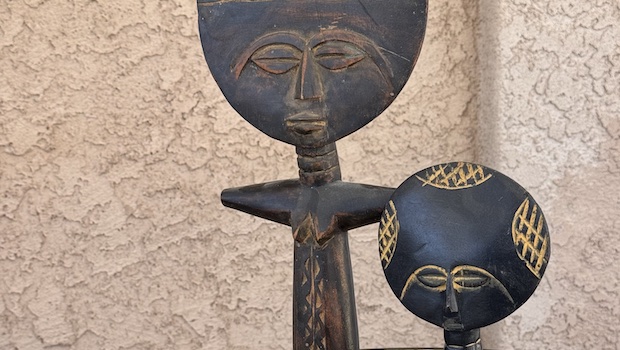
Fertility Dolls
It’s 2 am. The fertility dolls, illuminated by moonlight, mock me from their perch on the windowsill. Arms outstretched, they’re begging to be picked up. I want to pick them up. I want to shout at them, Why don’t you work? But my husband is asleep, so instead I cry quietly.
It’s not the news that we might not be able to have kids that bothered me most. It’s that I fell for the expectation of kids. Not only did I assume pregnancy was a given, I bought into the power of myth, believing that I had an easy pass into motherhood.
Maybe tomorrow I’ll box up the dolls and send them back to Ghana, I think. To my little brother who brought them into our family. Or to my older brother and his wife who passed them on to me. To anyone who knows how to make them work. The truth is they never really felt like mine. The handoff was too forced.
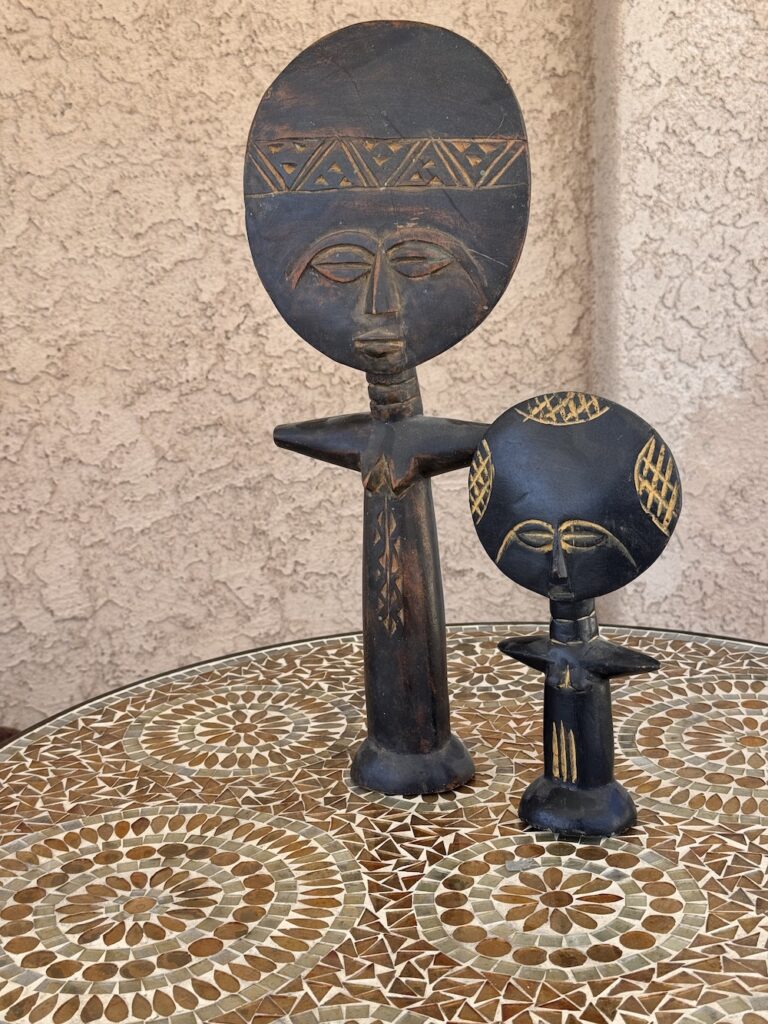
The dolls first appeared at my older brother’s wedding in Cuernavaca, Mexico. Our little brother flew in from Ghana, where he’d been living, for the ceremony. He brought with him two fertility dolls, called Akua’ba, that he gave to the new couple as part of their wedding gift. Traditionally used by Akan women who fear they are infertile, these dolls are believed to help even barren women conceive. As legend has it, there was a woman named Akua who struggled to get pregnant. A priest instructed her to get a small, carved wooden figure resembling a child and carry it on her back like a baby. Although people in her village teased her, she treated the carving like a real child. To everyone’s surprise, she did get pregnant and gave birth to a baby girl. It wasn’t long before other women in her tribe were seen carrying their own fertility dolls on their backs.
I’ve always been fascinated by other cultures, especially when their legends contain magical explanations for ordinary things, or better yet when they explain the inexplicable. It’s why I studied anthropology in college. It’s also one of the reasons I was enamored with my sister-in-law Karla from the moment we met. She grew up in Mexico, in a culture teeming with fantastical stories. And she, a natural storyteller, has a way of making fantastical things feel true.
Karla introduced me to enchanting stories where magic is less mystical and more matter-of-fact. In Latin literature it’s how towns like Macondo exist, where unrequited love persists, and why a cake baked with tears brings heartbreak to those who eat it. Karla devoured these stories, never questioning the credibility of the surreal.
So when the fertility dolls showed up at her wedding, she gave them due respect. Without touching them, she asked her mother to wrap them up and put them away for a later date.
As much as she tried to avoid them, they continued to resurface. The first time was when she accidentally opened the box that held them during a move from one cramped New York City apartment to the next. Nine months later, right in the middle of finals week at law school, she gave birth to their first son. Not a timeline she would have picked. Since then, the fertility dolls have been intertwined with her pregnancy tales. For every pregnancy, the story is the same: She was unsuspecting; she didn’t mean to touch the dolls; nine months later she gave birth. When she tells her kids the story of how they came to be, it starts with two wooden figurines that made a long trek from West Africa to Mexico and finally to the U.S. Just as I imagine Gabriel Garcia Marquez writes from a place of spiritual truth, my sister-in-law believes that magic is just as important as science when it comes to the story of how her kids were conceived.
I loved the tales so much that I wanted them to be part of my pregnancy stories, too. I dreamt of telling my own kids about the powerful legend that we are all part of, and the role it played in how they came to be.
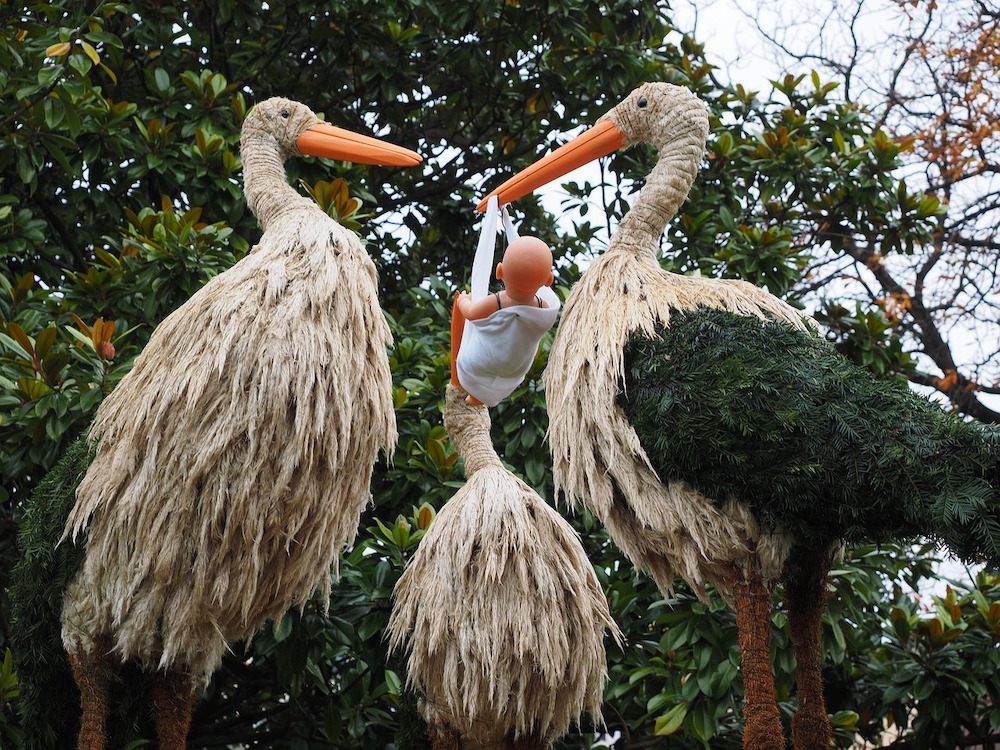
Karla, who did not want to accidentally conceive a fourth child, couldn’t wait to get the dolls out of her house. The first place I saw them was on the gift table at my reception. They also appeared at the end of a wedding video my dad made, a not-so-subtle hint, and finally in a surprise ambush in the photo booth. The pictures show me wide-eyed and suspicious with my girlfriends laughing on either side. My little brother was embarrassed. He said that the dolls are sacred symbols and deserve more respect.
I was not afraid to touch them like Karla was. I put them on display. But the dolls didn’t work. For a while they stood on a shelf in my closet and I would just look at them when I got dressed. After months of trying to get pregnant, however, I started picking them up and running my fingers over the designs carved in the wood. They have large oval faces and high, flat foreheads, a symbol of Akan beauty. One of them is tall—more than a foot. The other is small and lightweight. Standing next to each other they looked like a mother and child, the image of what I craved.
I did get pregnant. Once. My breasts swelled, I slept a lot, and I had a craving for pea soup. Just as quickly as I realized something was happening with my body, however, I started bleeding. My first positive pregnancy test only served as proof of something I already knew no longer existed.
My brother told me that it might help if I wiped off the figurines—a sort of cleansing or rebirth. One night while my husband slept, I climbed out of bed, grabbed the dolls from the closet, and crept down the hall to the bathroom where I sat on the floor and wiped them down with a damp cloth. I removed the dust from their elongated foreheads, wiped clean the creases around their eyes, and ran my thumb over their jagged noses and tiny mouths. I was gentle with them, like Akua was with her doll. I wondered what it might be like to hold my own baby and clean her face. Maybe I should carry them around on my back, like Akua did, I thought. Instead I hugged them to my chest. There, on the bathroom floor in the middle of the night, I felt profound love for someone who didn’t exist.
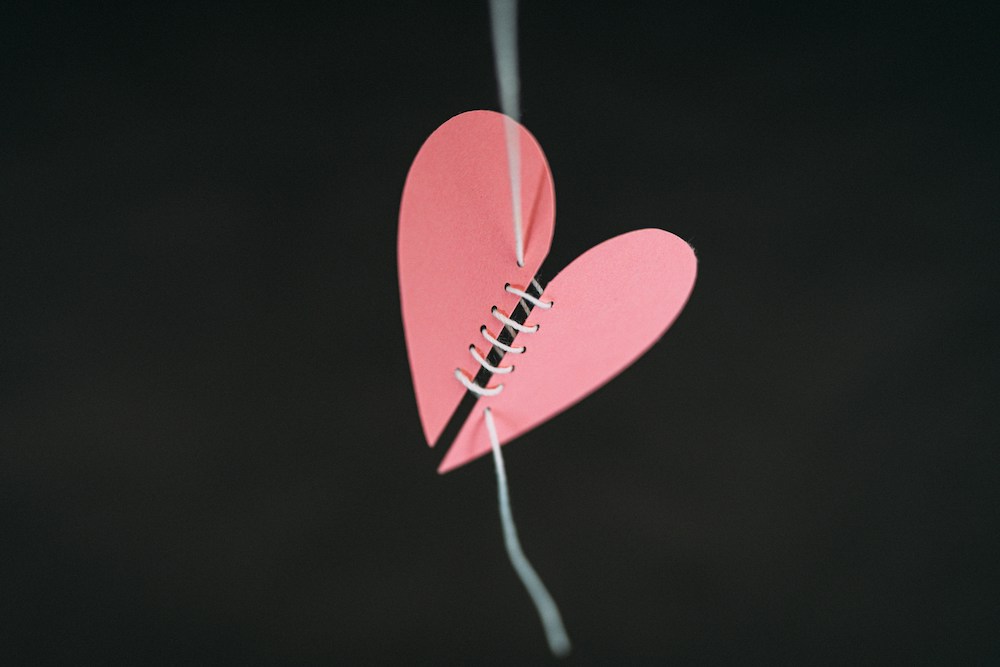
That was the closest I came to treating the dolls as intended, like real children and not just magical objects. When it was over, instead of carrying them with me, I put them back on the shelf. As much as I wanted the dolls to work, I didn’t want to feel what I felt in the bathroom that night—something akin to grief. So I left the fertility dolls on display, always at arms length.
When we finally did get pregnant, it was after we had decided to quit our jobs and travel full time. Did we get pregnant because we released control, or did the dolls actually play a role? Or was it just random luck and continued effort?
Two months after my youngest daughter was born, my sister got married. I wrapped the dolls in tissue paper and packed them in our luggage for another long trek.
My kids, now eight and ten, don’t know that much about the Aku’aba dolls, but they have, in their own way, become part of our family lore. When we look at wedding photos, the kids ask, “What are those?”
As we recount the tale, the power of myth takes hold. “Those are fertility dolls that came all the way from Africa.”
I launch into the story and my mind ruminates on the events. I can’t help but wonder if my ritual of cleaning them ignited a change. What I do know is that it’s not enough to believe a legend. You have to live it. It’s not enough to be in possession of the Aku’aba; you have to mother it. The closest I came to treating the fertility dolls like Akua did was when I sat up with them on the bathroom floor in the middle of the night, and the grief I felt was mixed with an overwhelming emotion I didn’t recognize—the deep ache of motherhood.
I have always believed in the power of myth, that a cake baked with tears really can make people cry, but what I didn’t know back then is that they have to contain all of the emotion—the love and the ache. Caring for children is inseparable from grief and longing. You can’t just add tears to the batter. You have to be willing to weep.
About the Author

Michelle Valenti is a writer and marketer based in the Chicago area. She is the creator of the Wandering Workers podcast, and her multimedia essay, “Why Is Everyone Getting Pregnant But Me?” was published on Medium by TheLi.st. She is currently working on a collection of personal essays about learning to parent a strong-willed kid.
Related Posts

“A Place to Feel It All”: Kelly Grace Thomas on Infertility, Adoption, and Urgent Joy →

Poems from Future Tense →

My Helga, My Omi →