
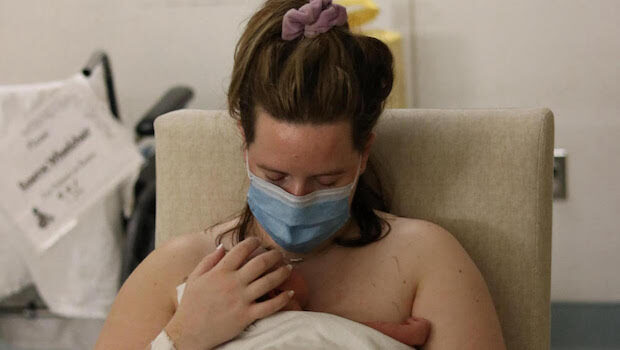
You’re Doing Great, Mama
At about four o’clock in the morning on a Friday in early October, I laid in bed, my legs sunk under the pressure of our two labrador mixes, who snoozed contentedly at my feet. Sweat pooled on my lower back, which pressed against my husband’s. I wiggled a few inches away.
When I closed my eyes, I was back in the operating room.
The fluorescent bulbs above bore relentlessly into my mind’s eye as the medical staff swarmed around, gathering tools, asking me if I felt this pin poke, that pin poke, calling out terms and vital signs faster than I could record them, the obstetrician preparing to make the initial cut. My husband, beside me in the memory as he was in real life, whispered dreamy gibberish about our future, mercifully wrenching the chasm between my terrified mind and my exhausted body farther and farther apart.
The surgery took place seven months and four days earlier, at about exactly the time it was in the present day while I laid sandwiched under the weight of our dogs, listening to our daughter babble herself back to sleep after an early morning bottle.
I willed my attention elsewhere, away from the morning the twins were born, but breathing exercises stood no chance against the gravitational pull of the OR, where I’d been rushed by a fleet of nurses and doctors after my son’s heart rate repeatedly dropped and I was given a shot of terbutaline to slow my contractions.

A few minutes before his heart rate dropped, I’d been laying in a quiet delivery room, drifting in and out of consciousness as a Taylor Swift playlist hummed contentedly on my phone. I was checked in for an induction that had been going mostly well, although labor had stalled after I’d agreed to an epidural around dinner time. Removing pain wasn’t relaxing my stubborn cervix the way we’d hoped.
Then my pain cracked open cracked open. No warning shots. As the staff flew me down the halls on my bed, stale air whipped against my skin, and doctors poked their heads out of passing doors to see if they were needed. For the emergency. Which was me. During the rush, I caught the gaze of a tall, young male obstetrician who had seen me in triage when I’d checked in. He stood in a doorway on my left, his gloved hands held up to his shoulders, his familiar face, briefly, a lighthouse. This is just like Grey’s Anatomy, I thought. His expression was indiscernible, and then he was gone.
*
When the four of us were finally home, after my son spent fourteen days in the newborn intensive care unit, I returned to the operating room so many times that it sometimes felt like there had never been anything else to think about. I was still too afraid to look at my incision, recruiting my iron-stomached husband to assure me, as I lifted the numb pillow of stretched stomach skin upward, that it didn’t look infected.
“I can smell it,” I told him. “Don’t you smell it? Doesn’t it smell weird?”
He looked at me a moment before sniffing one, two, three times.
“I don’t smell anything,” he said, crouched at my navel.
“How? Are you sure?” I pressed.
He sniffed the air near the incision once more.
“Yes,” he said.
I sighed, frustrated that he was obviously lying, and tried to believe him.
As the days wore on and the exhaustion multiplied, our village descended, primarily by way of care packages. Every day, the mail brought more boxes exploding with diapers, tiny cotton pajama sets, cards, and, from my workplace, a chicken noodle soup delivery service. My husband and I routinely grew weepy under the weight of the love, the same way we had on our wedding day. How was it possible that all these people cared this much about us? We marveled, sorted, washed, and texted thank yous.
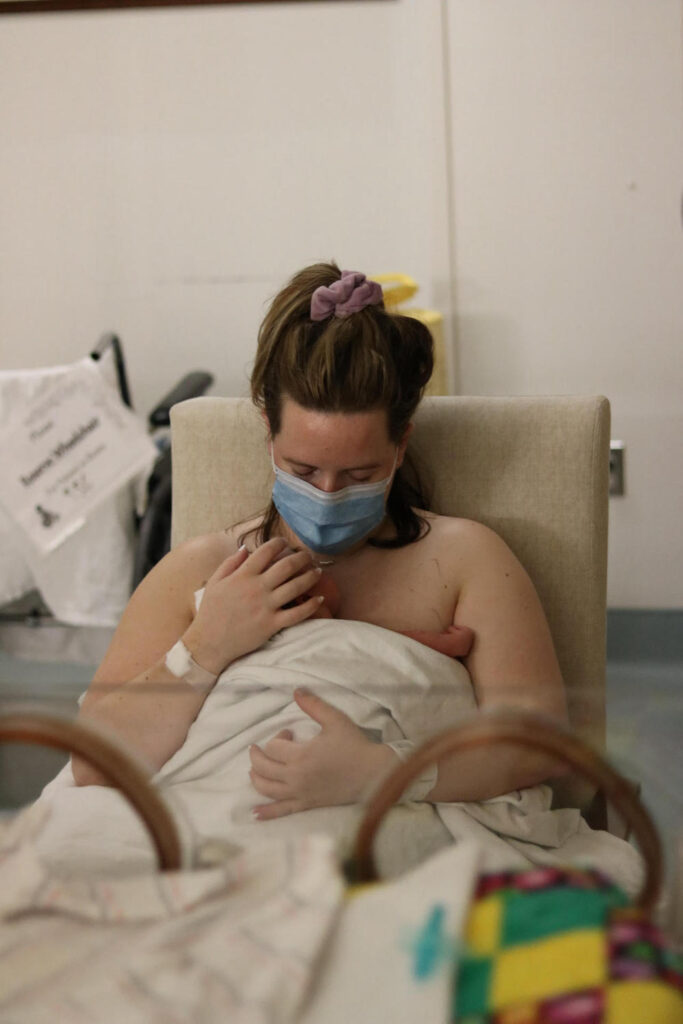
It was in the quiet, night hours, my daughter latched at my breast while I chewed on jelly beans to stay awake, that the operating room loomed. A double life.
*
Spending our first weeks as parents driving back and forth from our unkempt home to the hospital looming on the other end of the highway, the life we were living felt incongruous with the life we had lived. The shock of going from no baby to babies cannot be understated. My attention continually toggled from my needs to theirs, theirs always winning out. Once we were all home, my husband and I learned how to do everything one-handed: make coffee, eat scrambled eggs, plug, unplug, and plug in the various breast pump devices and all of their rubber tubing. We militantly made sure the other was allowed to take showers and use the bathroom as needed, but I always heard phantom cries as soon as I turned the water on.
I wondered how my body could possibly heal under the weight of all the exhaustion. Adrenaline coursed through me like a rocket when they both cried at once.
So many times since delivery, when feeling desperate, often as one or both babies were screaming on and on, or when one or both needed me at exactly the moment I sat down to eat lunch or use the bathroom or open an email, the phrase slipped out of my mouth: It’s like I don’t even exist.
*
Intellectually, I knew I wasn’t alone. While pregnant, I’d joined several social media groups dedicated to women who were due the same month as me. They were full of other mothers going through it at the same time, and sometimes their advice could be helpful. Although I didn’t have many friends who were mothers, there was comradery to be found in the phone propped in the palm of my hand, whose glow I relied on to help keep me awake while I spent half the night pinned to the couch under the weight of two tiny newborn bodies.
After a while, a pattern emerged in the comments of these posts, the ones where mothers wrote that they “just needed to vent,” expressed uncertainty about a decision they’d made, or, sometimes, confessed they weren’t sure they were cut out for motherhood and wondered if they’d made a massive mistake.
“You’re doing great, mama!” someone would write. Frequently, this would be the first thing anyone said to the original poster. Someone else would chime in: “You’re the best mama for your little one,” or, “Remember mama, this too shall pass! It’ll be over before you know it.”
Like clockwork, other members in the group would descend upon the post, militantly lifting the writer up on a pedestal of affirmations. They assured her she was doing the best job, that time would relieve her struggles and anxieties and it was in her interest to surrender to it. She was doing great, and everything was a phase.
It made me uneasy. Although, at first, it felt nice and supportive and all sorts of other good things to see women supporting women, the assurances that sleep regressions, nonstop nursing, and maternal restlessness while bodies healed from delivering babies were, in fact, phases, I began to wonder if everyone really could be doing as great as we were being led to believe. Surely that couldn’t be possible. Parents failed all the time. The local crime blotter was proof enough. There were entire entertainment subindustries devoted to parents, especially mothers, who screwed their jobs up, abandoned their babies, psychologically pressured their children into paste, or some combination of both. I’d spent countless hours in my own life deconstructing parts of my childhood with various therapists for years both during and after college.
The relentless cheerleading had a familiar sheen, although I struggled to place it.
*
In the final days of pregnancy and during the hospital stay afterward, the term postpartum depression was directed at me so many times I stopped fully hearing it. I was, as they said, at risk, given a history of anxiety, trauma, and depression, and it was something I would need to monitor in conjunction with my therapist in the months after delivery. Up to a year, in fact. I dutifully nodded as doctors and nurses reminded me to be on guard for feelings of hopelessness, elevated depression, or any urges to harm myself or my babies over the course of our first twelve months together.
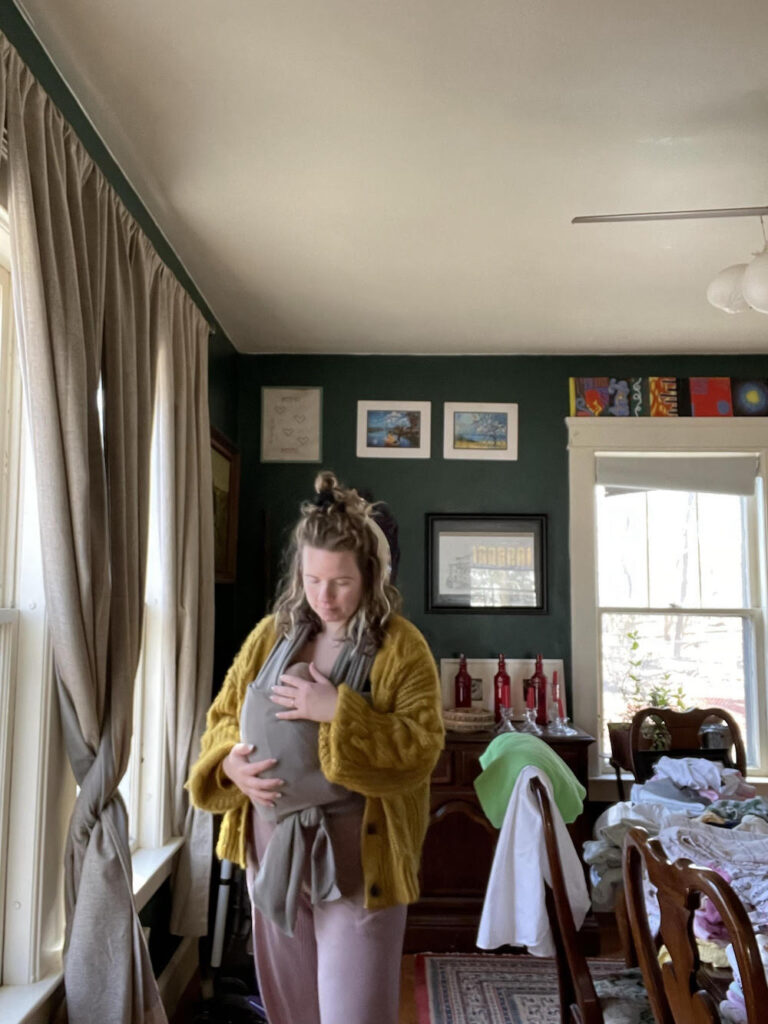
At first, these cautions made me feel seen. Finally, I thought, my health care team is taking my mental health as seriously as my physical health. At my eight-week doctor’s visit, I answered the depression screening as truthfully as I could, tried to quantify the scrambled sense of doom that had, to no one’s surprise, made its home inside me. Yes, I sometimes blamed myself for things that were not my fault. Yes, I felt scared or panicky for no discernible reason. Yes, I’ve been more anxious than usual.
The nurse assessing my results matter-of-factly reported my results and offered to start me on antidepressants, but my doctor and therapist were less enthusiastic. So I passed, assuring myself and everyone else that I would call if my feelings changed. My mother was the only person beside my husband to ask me how the appointment had gone. I couldn’t tell if I was being respected or forgotten.
In the postpartum soup of sweat, exhaustion, diaper changes, blood, and bloating, it was hard to tell what I was feeling at any given moment.
I chewed on this while I continued what felt like a perpetual scroll. There are whole subcultures on the internet devoted to expecting and new parents, which the algorithms on all social media websites dutifully serve up the second they detect a user is pregnant or recently postpartum. Around the time the twins were born, I was fed a lot of content made by other (mostly) women who were living in the same pot of physical and emotional weariness. This content was not in the groups I’d explicitly joined or on the one “social media for moms” app I’d downloaded as a weak attempt to connect with other mothers who lived near me; it lived at the top of every home feed on every social app I frequented, every refresh producing a new wave of reminders that I was a mama now.
Across the comments, as I scrolled and scrolled and scrolled through the early hours of the morning, a refrain caught my attention: It’s like I don’t even matter. A variation on what I’d started saying to my husband: It’s like I don’t even exist.
That’s what the housewives struggling to express their feelings of listlessness and weariness said in the opening pages of Betty Friedan’s The Feminine Mystique, as they tried to name their simmering unhappiness in the face of domestic life, “the problem that has no name.”
Being pregnant had felt almost spectral. I was one of the lucky ones. My anxiety ridden husband fretted about every step I took. When I slipped in front of a coffee shop at the beginning of my third trimester and landed on one knee, he lost years off his life. Over the course of those nine months, I got out of things I didn’t want to do, I was encouraged to eat as much of whatever food I wanted, and friends and family told me, for months, that I looked so happy. Near the end, I was taking long, hot baths almost daily, sinking into a steam of lavender and eucalyptus and practicing meditation exercises. I was tired, scared, and obsessing over wobbly fetal development milestones sent to me each week from a pregnancy tracker app, but the position I occupied in my circles, expectant mother, was concrete.
Adrienne Rich described this sensation in her essay, “Anger and Tenderness”: “As soon as I was visibly and clearly pregnant, I felt, for the first time in my adolescent and adult life, not-guilty. The atmosphere of approval in which I was bathed — even by strangers on the street, it seemed — was like an aura I carried with me, in which doubts, fears, misgivings, met with absolute denial. This is what women have always done.”
After my cesarean, that state of being felt like a memory in someone else’s life. In the days immediately afterward, I was physically and emotionally and spiritually depleted. I was not prepared to swell up like a piece of bread in a pool of water, to spend several days shuffling around a recovery room, gaging the likelihood my abdomen would split open if I were to sit up too quickly. I was certainly not prepared for one of my babies to spend time in the newborn intensive care unit.
I sent a detailed group text recounting what had happened during delivery, a step by step report about how I’d landed in the operating room just after three in the morning. When I didn’t get much of a response, I considered whether the hormones the nurse said were draining from me had temporarily taken control of my mind and my fingers. Was I inflating how horrible it had been?
I wondered if I was being a downer. There were, after all, two beautiful babies now. Two! Strangers, upon learning there were twins growing in my abdomen, had taken to telling me and my husband that we were lucky — so lucky, wow — or, more frequently, blessed. We politely agreed, my hand resting atop my tremendous, quaking stomach. I never knew what to say next. No response I formulated ever made any sense when spoken aloud. God looked favorably upon you. God looked favorably upon YOU. There’s the proof. What can you say to that?
*
In the early weeks and months, staying awake with the babies was an Olympic sport. I ate bright candies, crunchy trail mix, and stared at my phone until my eyes bled. I watched more Instagram Stories and TikToks than my poor brain could have ever made sense of. Anything to keep my eyes open and stop myself from drifting off with a baby, or two, curled up against my chest, the most dangerous thing I could do, according to pretty much everyone.
People in my due date groups were all having their babies, then. Every time I opened Facebook, a new ecstatic puddle of words and pictures greeted me: “SHE’S FINALLY HERE!” The likes and comments from strangers rolled in.
As the days passed, the tenor of these posts shifted. I saw women panicked about their breast milk supply, over concerns about rashes, or maybe their partner was supposed to get up with their baby during a feeding but had slept through the cries for fifteen minutes, twenty minutes, a half hour before the distraught posting mother realized what happened. Would her baby be okay? She felt like a terrible mother.
The cheerleading rolled in mechanically, echoing, often verbatim, the same comments I was reading on TikTok: You’re doing everything right. It’s okay, it’s happened to me.
It evoked what standup comic Iliza Shlesinger termed glitter speak in an October Netflix special.
“In an attempt to empower women, we’ve decided the best way to do that, to communicate with the masses, is to talk to women like they are fucking idiots,” Shlesinger said. She provides ample example in a list that evokes the cadence of slam poetry: “Boss bitch, yes, twerk queen mama, thick raccoon bitch. Do it all day, bubble gum mama thing. Yes queen. Work bitch. Slay all day mama. They stole this language from black gay trans drag queens and made it their own to sell you pencil bags.”
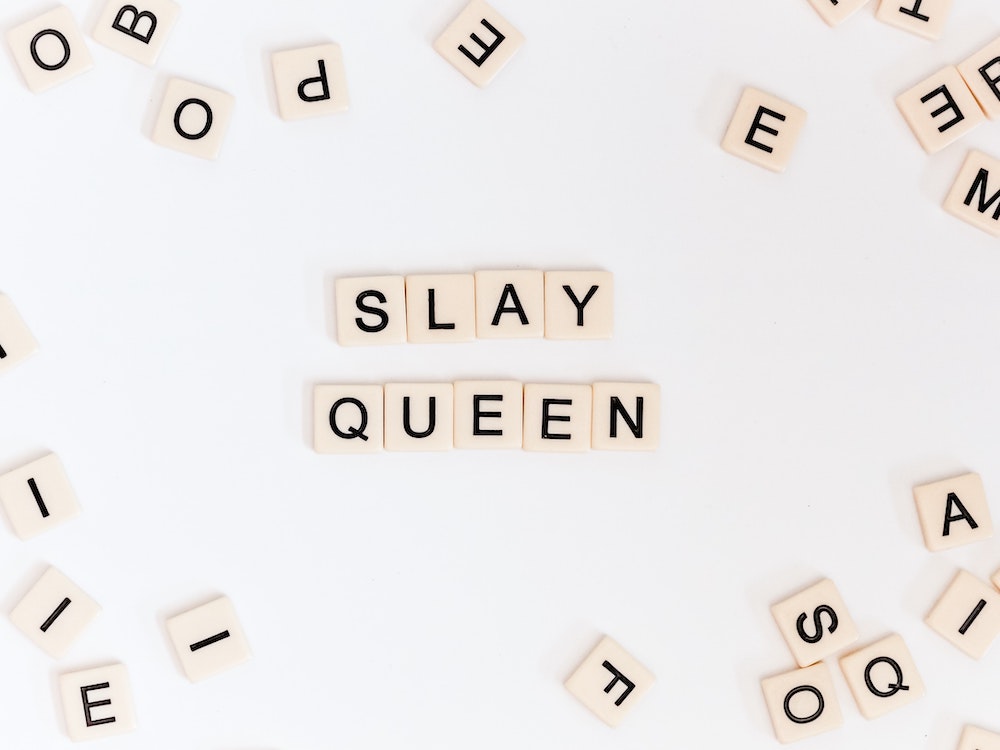
The language, she said, was pejorative and infantilized. But it’s also pervasive to the point where it’s hard to believe most people even know they’re evoking it. More, its spirit is not limited to the internet, or to pencil bags.
Any complaint fired off in a frustrated text or moment of vulnerability was met and solved with a simple, generic phrase of encouragement. Or, more hauntingly, a prolonged silence until, days later, a message would pop up out of the blue, asking me if things were better. It made me want to scream.
Under the dictum of supporting mothers, folks not dealing with the adrenaline fueled marathon of caring for infants were almost unilaterally incapable of agreeing that any part of it sucked, like doing so could somehow knock my sweaty, swollen self another rung lower and it would be all their fault. I felt like maybe I should just shut up.
The relentless cheerleading I witnessed on the internet and received in real life had a cooling effect on me: I turned inward, I quieted. I saved my frustrations and my postpartum rage for private rants shared with my husband, or the empty hallways of my private Instagram account. I wondered whether the nurse who offered antidepressants ever thought about me and wondered how I was doing. I thought about how my postpartum depression wasn’t even really that bad, relatively, but wasn’t sure if that was supposed to prompt gratitude. I took to releasing blood curdling screams into the limp pillows on our bed. I started to feel like that was the point.
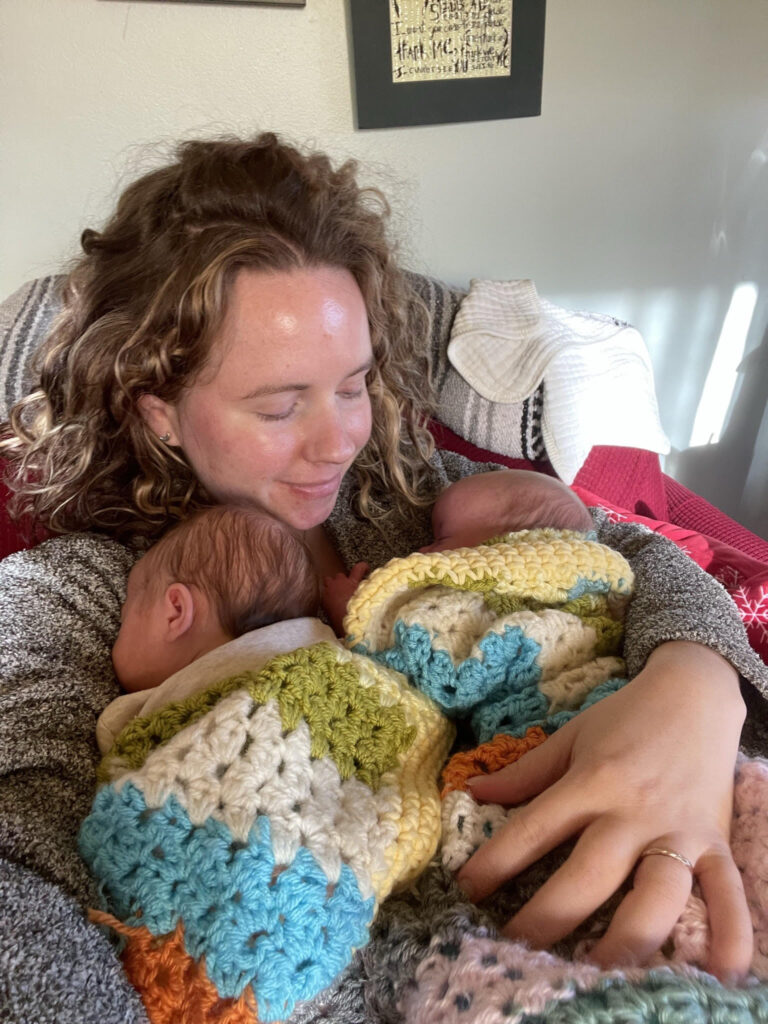
We can’t carry the all the world’s pain with us on our individual shoulders, and most people, especially not women, want to burden others. And the thing about birth and becoming a parent is that it’s so astonishingly mundane. This was a comforting fact while breathing through contractions and rhythmically rocking on a bright green pregnancy ball, watching my pain form small mountains on the monitor above my bed: so many people around the world were going through this exact thing with me at the exact same time. The evidence was all around me. The hospital where we delivered was an overbooked hotel, at capacity and turning over delivery and recovery rooms at a breakneck pace. People were having babies at a rapid clip.
But it doesn’t feel that way when I’m lying awake in my bed in the early hours of the morning, the operating room lights in my brain blinding me with the acute anxiety of feeling the scalpel touch my swollen abdomen, of being warned to let the nurse know the second my anesthetized arms were too tired to hold my freshly delivered daughter so that she didn’t fall to the floor, of all those tiny details that return to me when I am alone and brooding and searching for relief. The imagined unified wail of the global delivery room has gone quiet, and I am, instead, alone in the quiet of the early morning, waiting for my babies to cry out, signifying the start of another day.
About the Author

Monica Benevides is a writer and award-winning journalist based in Central Massachusetts, where she was raised. She is the co-founder and prose editor of the literary magazine Talk Vomit, and also leads writing workshops at the Boston-based nonprofit GrubStreet. Her freelance essays and reportage have appeared in places like Bitch, Man Repeller, and the Columbia Journalism Review. She holds an MFA in nonfiction from Columbia.
Related Posts

Aurora Filii →

Facebook Asks “What’s on Your Mind?”: Selected Posts →

All of the Hidden Almosts →

One Response to You’re Doing Great, Mama