
My Helga, My Omi
My phone dings. I lift it up, the skin on my inner elbow pinching uncomfortably around the IV line. My grandmother has sent me pink hearts and well wishes.
“Dare I say I am probably the one who knows best how you feel,” she writes.
I know that Omi had a miscarriage after my father was born, and that she was never able to have another child. For years, she’s grabbed my arm and implored me with wide eyes, “Don’t have only one child.” I would nod and say “Okay, Omi,” and then change the subject.
But right now, I don’t want to hear about it. I put my phone down.
*
Two and a half years earlier, my husband and I embarked on a grueling journey involving several rounds of IVF to have our second child. Nothing worked, until it did. And I was finally, joyously, pregnant.
The bleeding started a few weeks later. At first just a faint, light discharge. Then a darker brown, and eventually an undeniable red.
For weeks, the bleeding got stronger, fresher, brighter. The doctors didn’t seem worried, though, because the ultrasounds kept showing the same thing: there was her heartbeat, clear and persistent. There were her tiny hands, there were her tiny feet, kicking and kicking.
Yoav joked that I was just addicted to ultrasounds. Everything was fine.
But then, when I was four months pregnant, the doctor’s tone changed. She showed us the large blood clot on the screen that had been separating my placenta from my uterus, and causing the bleeding. “Come back in a week,” she said.
I tried to rest, but conditions weren’t ideal. Israel was at war. Again.
We had no daycare for our three-year-old, and had moved in with Yoav’s parents, because they had fewer missiles than we did in Jerusalem.
When the evening of our follow-up appointment finally arrived, we drove South to Jerusalem, stopping at a dirty gas station so I could change my blood-soaked pad. Then I lay on the examination bed and closed my eyes for a moment as the doctor squeezed warm gel on my belly. Please.
We’d jokingly named her Helga. We felt it evoked an image of a strong, Viking woman. Helga, who wasn’t fazed by a little (or a lot) of blood. Helga who didn’t mind Iranian missiles or midnight runs to the shelter. Helga, with her voracious appetite and unquenchable thirst.
Helga, who wanted to live.
The doctor squinted at the screen and then put the wand down. She waved her hands the way Imri used to as a baby, when he was done with his meal. No more.
We looked at the screen and saw the amniotic sac, once a large balloon she could swim in freely, now wrapping her tiny body tightly.
“You need to go to the hospital now,” the doctor said.
We drove the same dark, windy roads we’d driven three and a half years earlier, when I was nine months pregnant with Imri and writhing with contractions. I felt a growing pressure in my uterus now too, but this time, I knew, we would come back with nothing.
*
These were the words Omi would later stress and repeat when she told me her story.
“You come back with nothing.”
*
In the delivery room, I hear the cat-like wail of a baby being born next door. Ours, I know, will be born in silence.
They keep her behind a sheet, because I’ve asked not to see her. I’m too scared. Instead, I look at Yoav, looking down at her. When I see a small smile and his eyes softening with love, I ask to see her, too.
At first I’m taken aback by her purple-red body, but then I see she’s all there, a spectacular, miniature person. There are her delicate lips, there are her peacefully closed eyes, there is her hand perched on her chest, there are the tiny balls of her toes.
And there is her heart. Her tiny, fluttering, beating heart. She is here. And then she’s not.
A couple days later, Yoav goes to the hospital morgue and brings Helga back in a small plastic container. We dab her body gently with a wet cloth, scared to break her delicate limbs. Already, she’s lost most of the color she had in the hospital. We look at her one last time and then wrap her in a white cloth.
Then I fold another cloth around her small body, a silky, magical-looking paisley cloth we’ve had in the closet for years. I’d never known what to do with it, but always felt it was too special to throw away. Now I know what it was for.
Our close family and friends sit in a semicircle around the grave, beneath the pine and cypress trees. I invited Omi, too, but I knew she wouldn’t come. At 94, it wasn’t just being hit by a missile she feared. “If I have to lie on the side of the road when there’s a siren,” she said, “I don’t think I’ll ever get up.”
The late March sun brightens the red geraniums. We say a few words and then play a sad Hebrew song we both like and cover her with dirt, inviting our families to do the same. My father places a stone on top of the mound, as is customary in Jewish funerals.
After the ceremony I send Omi my eulogy and some photos, and she texts me back.
“Danyale, I read and reread your beautiful words… again and again, with tears running down my cheeks.”
She tells me the other night there were no missiles but she was awake: her miscarriage came back in all its details.
She tells me the baby had been kicking inside her, and then stopped.
She tells me her friend Esther Meiboom came at two in the morning from New Jersey to be with my dad, then two years old.
She tells me she never saw her, never held her, never gave her a name. She’d carried her for seven months, and then poof – gone.
She tells me about the aunt who came to visit her the next day. How she put her arm on my grandmother’s shoulder and said, “Now we’ll forget about it.”
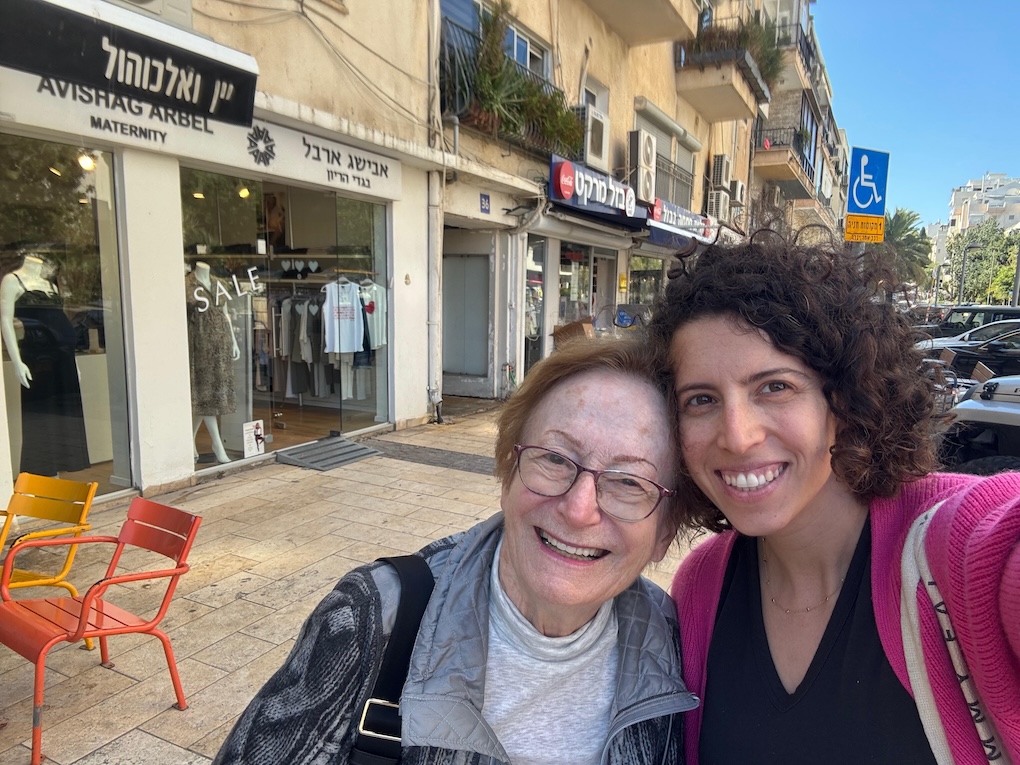
A week after the burial, there is finally a ceasefire with Iran. I pack my bags and drive back to Jerusalem, calling Omi on the way.
She asks how I’m doing, and then kvells about Imri, her great-grandson. “He’s just amazing. So smart. And he never cries. I’ve never seen anything like it.”
I smile. Of course he cries. But I don’t correct her.
I ask about her pregnancy loss, and where Opi, who died a few years ago, fit into the story.
“We never talked about it,” she says, in her German-Israeli-New-Yorker accent. “He always reasoned that it was for the best, that maybe there was some problem…and that was it.”
I think of Yoav. How he wiped the blood off my legs after that first ultrasound in the hospital when I couldn’t stop crying. How he cradled Helga in the delivery room until her heart stopped beating and wouldn’t leave her. How he cried at the ceremony abruptly, mid-sentence.
And then I think of Omi, and how alone she must have felt. Her parents were in Israel where she’d grown up, and she was living in New York. Her husband didn’t want to talk about it. Her friends didn’t talk about it. She slipped on low-heeled pumps, put on a smile, and went to work.
I can just hear Opi saying “Sho-osh,” in that sing-songy voice. As if to say, Shoshana. Come on. We talked about this already. As if it were a conversation to have once and put away in a drawer.
My grandfather didn’t dwell in sadness. It was part of what made him wonderful, with an eternal, childlike sparkle in his eyes. And he loved my grandmother deeply.
But in not wanting to talk about their stillbirth, I realize, he’d denied her the right to mourn.
*
I think of all the times she told me not to have only one child. How I bristled or rolled my eyes. But maybe she hadn’t been instructing me how to live my life. Maybe she’d been trying to tell me something about hers. Maybe she’d been trying to share her pain, and to spare me from it.
Omi had lost a daughter, even if she hadn’t been a fully-formed human yet. So had I. But unlike Omi, I’d given my baby a name. I’d seen her, held her and buried her. We had both loved—but only I had been allowed to mourn.
Omi’s love and pain remained elusive and wordless, something she could never fully grasp. It was as if even the loss itself were missing something.
“You know,” she says now, “I think I talked about it more with you than I did my whole life. We just didn’t talk about it then. The world is a much better place today.”
We pause, considering this. Israel has been stuck in an endless cycle of war—even if in this particular moment there’s a ceasefire—and the rest of the world doesn’t seem fabulous, either.
“Well, better in that respect,” she corrects and we laugh.
We’ve been talking on the phone since the middle of Highway 1; the green fields and tree-topped hills have already made way for heavy Jerusalem stone. I park under our building and stay in the car.
“So why did you name her Helga?” she asks.
“It was a joke!” I say. Helga is not a Jewish name. Yoav said at the ceremony that had we known the belly name would stick forever, we’d have given it a little more thought.
She laughs.
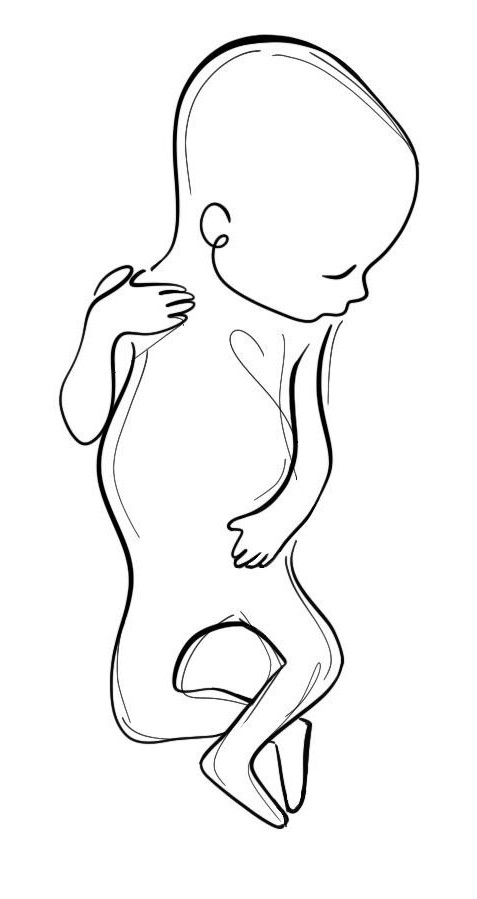
Omi wrote a memoir about her life a couple years ago, mainly for us grandchildren. She summed up the whole experience in one sentence: “When the boys were two years old,” she writes about my father and his best friend Marc, “Shirley gave birth to Marc’s sister Ellen, and I had a miscarriage in the 7th month.”
And that was all. As if it were a fleeting, insignificant moment. As if it hadn’t broken her heart, and shaped the mother and person she would become.
She never really told her story. But now, 65 years later, she finally can.
Thanks to Helga. My dear baby Helga.
About the Author

Danya is a writer and mother living in Jerusalem. Her work has been published in TIME, The Times of Israel and elsewhere. She’s currently at work on a memoir about infertility, motherhood and war. Find her at Danyakaufmann.com
Related Posts
The Red Papasan Chair →

A Lost Mother’s Love is Never Gone: An Interview with Anna Nordberg →

Fireworks →