
Talk to Your Kids, and Don’t Leave Out the Hard Parts
I thought about putting a trigger warning on this, but after we’ve all survived adolescence and read 1% of the Epstein files, it seems that turning on a computer these days is implied consent to engage with traumatic content. That said, proceed with a glass of water and maybe do some pushups when we’re done. My request is that you get through this story, and at the end of it, consider what conversations you’re having with your children about the world, and how those discussions will shape our future.
I don’t remember the first time I was raped, but the images came back to me in short, glitchy, black-and-white moving pictures while I was trying to have sex with my first boyfriend at 17. Instead of orgasming, I kept blacking out and waking up looking at him, terrified and screaming. I ran out of our Tenderloin studio at 4 AM because it felt safer to be amongst strangers in the night than to face whatever lived in that room.
I began therapy and the task of mining for information, and the stories began to surface in a series of terrifying dreams. Tiny parts were revealed from the mouth of a young girl with a black bob who was standing on a boat I remembered being on as a five-year-old. The dreams would wake me up in a pool of sweat, shaking and hyperventilating, and eventually me telling her out loud that I didn’t want to know anymore: “This is too fucking scary. Please stop.” I knew the who and the where and some of the what—enough to never put myself in the way of that person again (he’s part of my biological family), but not enough to say that I completely remember.
People are collectively horrified about what we’re reading about Epstein, his victims, and accomplices, but we’re not really doing anything about it because we’re not surprised. We are seeing stars cut ties with Wasserman, Lex Wexner get subpoenaed, and widespread boycotts called for companies with corporate ties to listed perpetrators, but we also know that survivors’ names have been published, whilst abusers’ names have been redacted. We know that full transparency and the sacred act of truth telling will never be a part of our government driven bureaucratic process, and that the nature of the exploitative systems this empire supports and feeds on will not go on to be challenged or torn down by anyone aligning with the architecture of power itself. We know that survivors won’t define what justice looks like, that child sex trafficking rings exist because we live inside an institutional regime that allows and benefits from their operations, and we know too, that hellacious stories like those we’ve encountered in the Epstein files are not sequestered to this short moment in history—they are still happening.
Those girls tell stories that are our own. Stories our friends have told us over and over and over again. Those men are our brothers. Our co-workers. Our neighbors. A friend of a friend’s. The father of a child our kids go to school with. I remember the first time my son learned about the sexual abuse suffered by one of his school friends. They were in fifth grade, and we had just played and laughed in a bounce house with the predator.
“But mom. He seemed so nice. He brought chips to the party.”
Living amongst monsters and not collectively holding them accountable is a protected function of the heteropatriarchal, white supremacist, colonialist, capitalist empire in which we live. The fact that so many of us have sexual assault stories and the ways that this sort of abuse continues to play out in the world are direct results of these interconnected systems at play.
We protest when we can see our own children in the way of direct harm, but not for long enough to create lasting change, and not for long enough to disinvite perpetrators from tables, boards, respected positions, and parties.
These are the same reasons why white liberal moms in my parenting circles who claim to be anti-racist feminists will bring their families to the local block party organized by cops. Last August, three different moms I know sent a similar message in group chats: “Come meet us at National Night Out! It’ll be so fun.” If children are growing up with a glorified notion of how these systems operate and a superficial grasp of how they fail, they will continue championing their existence with the myth that reform in such a plagued machine is possible.
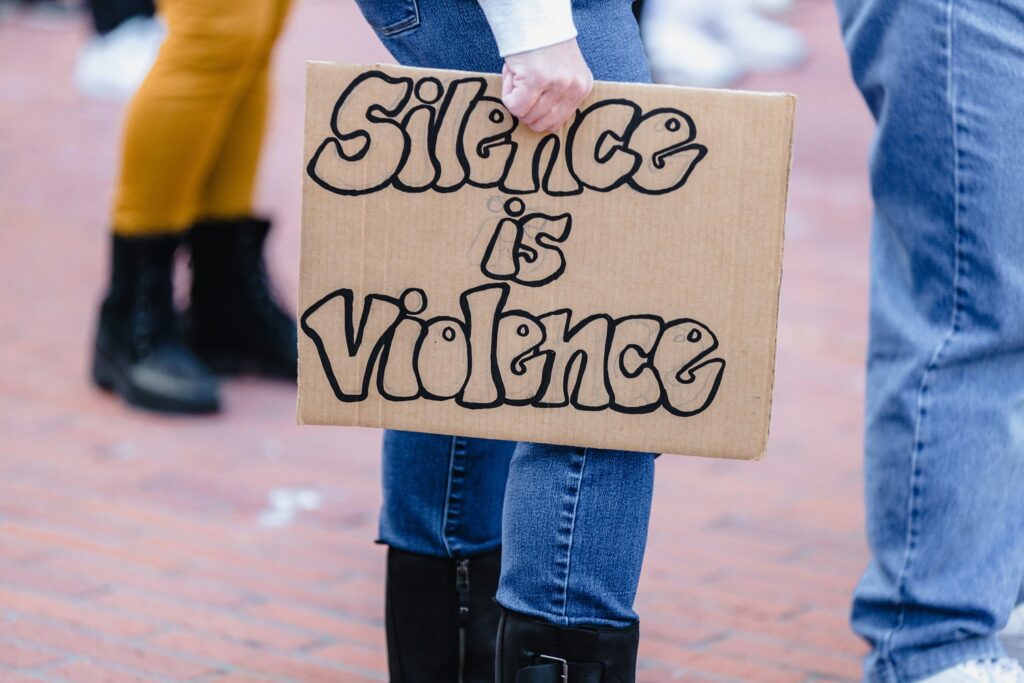
We know that reform doesn’t transform systems—it sustains them. Incremental shifts toward something idealistically better is something we entertain and latch onto when enough privilege exists to support not being in the way of direct harm, and when we don’t want to relinquish the ways in which we benefit from the matrix. We need more of us willing to harshly examine and dismantle the interconnected toxic systems at play in our world, whether or not we benefit from them personally, and because they are listening—we need our kids in tow.
The day after Rene Good was murdered, a person I know in one of my parenting communities posted on FB, “I already left a toxic marriage, but I didn’t know I’d also wake up to a toxic country.” Suddenly, liberal white women can see themselves in the eye of danger enacted by the state and system and feel compelled toward action. As many before me have pointed out, it is not that the country became toxic overnight, but that certain people are now understanding that they too are expendable if they demonstrate a threat to the empire.
Instead of cherry picking from harmful people and institutions by accepting networking extensions offered to us by known abusers, attending government funded block parties, and simultaneously criticizing atrocious behavior enacted by the same predatory people and organizations, we need to model alignment with our morals and tell our kids about it too. We don’t invite rapists to dinner, and we teach our kids that ALL cops are bad because the whole vile network of agencies were literally developed to patrol slaves and no one is going to reform that system–we need a new one. Even if that cop arrived at training with good intentions thinking he actually wanted to protect his community, is a neighbor, brought beer to your party, or coached his kid’s little league team. Hierarchical power will always become weaponized, and is a purposeful structure inside an intentionally oppressive regime. Taking a seat at those tables doesn’t serve communities- it creates more sycophants of an iniquitous system.
All of us are accountable for the behavior of the people we run with because how else are we supposed to find safety? If you defend why your rapist brother gets to come to your birthday celebration, who is responsible for the young girl who is penetrated by him by force? If you vouch for the “good cop” in your circle, how are we supposed to contend with knowing you will only call out problematic systems when they directly impact you but not your neighbors? And what are our children learning by watching these actions?
The second and third and fourth time I was raped I was a teenager. Is rape like a concussion or an autoimmune condition? Once you experience one, you’re exponentially more likely to experience another? Or is it just really that common, like HPV or a cold? Maybe rape is just part and parcel of being born with a vulva and its violation is imminent—like sexual assault should be expected at some time or another and often many times over?
When I was 16, I worked at Pretzelmaker in the mall with a cute 24-year old with pigtails named Autumn, who for some reason wanted to befriend me and my teenage bestie. We started spending a lot of time at her house where she’d dress us up “like hookers,” get us heavily intoxicated, and put VHS porn on the TV. Sometimes she’d drive us to Canada where she’d get us into dance clubs, and we’d end up back at her house with a handful of older men. I’d get the spins, feel nauseated, and desperate to lay down. She’d shoe me into her bedroom where I’d pass out, and after a while, she’d send a boy in.
The first time I had sex that I can fully remember, I woke up scared with a 25-year old man on top of me. My pussy was wet—so I must have wanted it, right? I didn’t keep trying to push him off of me, so I didn’t really say no. Right? I felt sick and confused, but also strangely special because Autumn giggled and congratulated me like I was chosen for a sacred ritual. He left in the morning, but not without saying, “Nice meeting you,” in my direction.
You might also be thinking: Was it really rape? Or wondering where my parents were, or blaming me for getting so intoxicated and being in a house with adult men, unsupervised. You too have been raised inside white supremacist rape culture, and we don’t want to believe that it is so common, or that we are surrounded by bad people, or that it’s our own husbands, brothers, cousins, or neighbors enacting such harms. If you’re thinking instead that I’m brave for telling these stories, please don’t say so—and you’re missing my point.
I didn’t understand those experiences were rape either until probably a decade later in San Francisco. By then I’d been raped two more times, both by co-workers, when I was 17 and 18. Brent nicknamed me “fluffer” at the restaurant I worked at and I hadn’t seen enough porn yet to know what that meant. We lived near one another and were walking to meet co-workers in the daytime and stopped at his Nob Hill apartment to grab a sweatshirt. After he attacked me, he walked me down the street softly whispering toward me even though I hadn’t uttered a word, “You know, I’m not a rapist or anything. You know that—right?” I shrugged. He kept calling me fluffer and I kept working at the restaurant, and no one ever said a word about any of it.
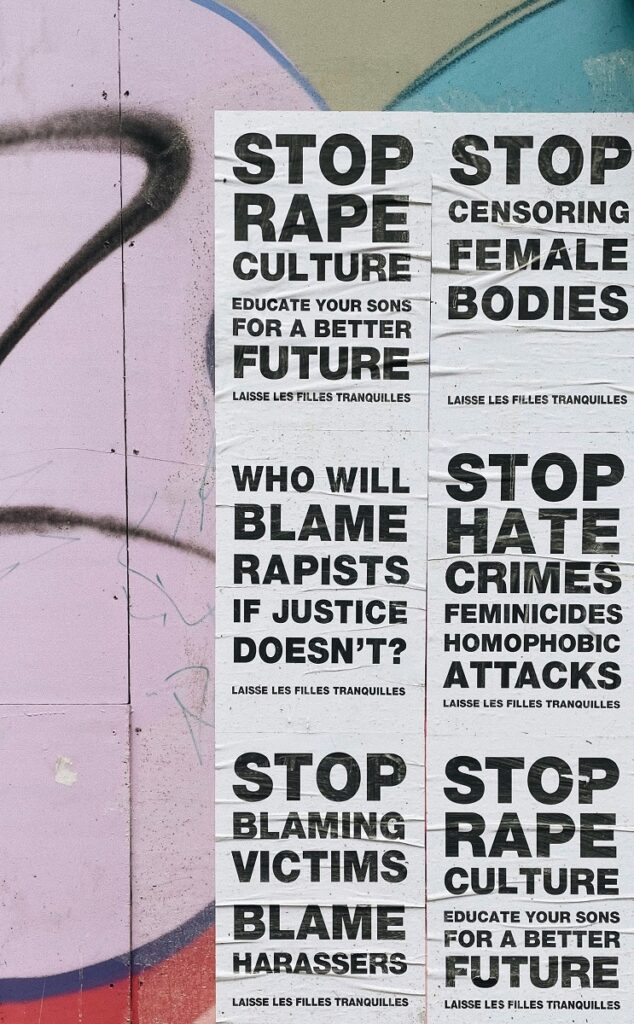
It’s not that I didn’t understand what happened in my late teens or wasn’t a strong person. It’s that I learned the concept of strength was about individual, internal reconciliation––box breaths, and center of calm, and peace amongst the collective. When will we instead learn to grow capacity for sitting with and metabolizing anger—our own and that of other people—and use its fire to hold perpetrators accountable and destroy harmful systems? Shouldn’t we define anger as a vital player in true regulation, rather than evidence of the opposite?
Autumn recently befriended me on Facebook and sent me condolences about that same bestie who killed herself a few years ago. How could this person who orchestrated some of the more traumatic sexual scenes of my adolescence speak to me like we were great buddies? Autumn still has long pigtails, became a cop, and has four children—all girls. I blocked her but didn’t ask more questions.
“Don’t come at me! I know it’s been a privilege to not have these conversations, but I just don’t want to scare my children! I don’t want them to grow up and be bad people either- so if you have any advice for how I can make sure they don’t become a part of the ill parts of our society without scaring them with stark stories of reality—please weigh in!” This is the basic structure of earnest, sheepishly posed questions we’re all encountering from mostly middle and upper class liberal white moms in online spaces.
Shrouding awareness about state-sanctioned violence from our families in the name of protecting them or anyone else from harm is unethical and wrong. Educating our children about the ills of society and how we might tear all the interconnected systems down is a small part and necessary path toward collective liberation. Is it too late for families who are new to this work? No, everyone is welcome—but we’d better not skip the hard parts.
All of these stories are related scaffolds of a system that normalizes injustice and harm while asking us to take deep breaths and not scream too loudly. If we don’t want our children to grow up and be racist, sexist, or rapists, be complicit in the efforts of such people, or be their victims, we must speak to them about what’s going on in the world. Otherwise, we’re part of the problem. How are we supposed to break patterns if we don’t have full and shared awareness of their pathways?
I keep encountering fluff-filled guides outlining options for how to speak with children in different age brackets about atrocities and movements in the world—the death of Trayvon Martin, the MeToo Movement, the genocide against Palestinians, school shootings, ICE raids—by overwhelmingly focusing on staying calm, shrouding details, and delivering promises of safety. “Look for the helpers.” “Use simple—not scary—language to validate emotions.” “Try to focus on moments of resilience or bravery.” While it seems like a positive thing to encourage and support people in facilitating these conversations, engaging in discussions about ongoing threats of harm while protecting everyone in the room from feeling any kind of impact is a problem. Wouldn’t our children be better served if they learned about resistance and righteous anger, rather than resilience and keeping peace despite ongoing injustice?
Prioritizing comfort above the unpacking of danger, harm, inequity, and violence is a white supremacist device. This is “both sides.” This is “peacekeeping” at the expense of the most marginalized. Unless we are willing to step into the circle of discomfort and bring our children with us—we are complicit in the system. If we want change to unfold, we need to engage in harder conversations and we need to involve our kids.
Many of us understand that when a person grows up in a family system where certain kinds of traumas have been experienced or enacted by people in our lineage, we learn about those harms whether or not they’re still prevalent danger. And yes—it scared us as children. Our caregivers led us through those stories anyway because the information made us less likely to experience or reenact the harms. Leaving our children out of larger, detailed discussions about the world is upholding systems we say we’re not OK with, and not keeping them safer either.
From not discussing politics at the family picnic, to allowing the known abuser to still come to the parties in the name of cultivating “peace,” what lengths do we travel to foster comfort rather than truth or accountability in our circles, and whose safety or feelings of health and well being are at the expense of those choices? Who will grow into their adolescence and adulthood understanding their complicity within these systems with a lukewarm education about what’s actually going on? Who will get raped? Who will be the rapists? Our children are observing—are we willing to call out, critique, and tear down predatory frameworks in the name of building a new world?
About the Author

Chrystal Sunshine is a queer, witch, single mother, arts educator, designer, and marketing maven living in Oakland, who has a penchant for colorful plants and tender metaphors. Her writing unpacks transgenerational stories of trauma, identity, class, and the re-visioning of possible worlds. She has been published in Passage & Place: An Anthology of Letters, Essays, and Visual Art by Both Free-World and Incarcerated Queer Writers/Artists, and she is currently working on a creative non-fiction manuscript.
Related Posts

Laundry and Innocence →

All roads go back to mom →

The Patriarchal Roommate →

One Response to Talk to Your Kids, and Don’t Leave Out the Hard Parts