“Will You Know How Much I Loved You?” Tiffany Graham Charkosky on Parenting in the Face of Cancer Risk
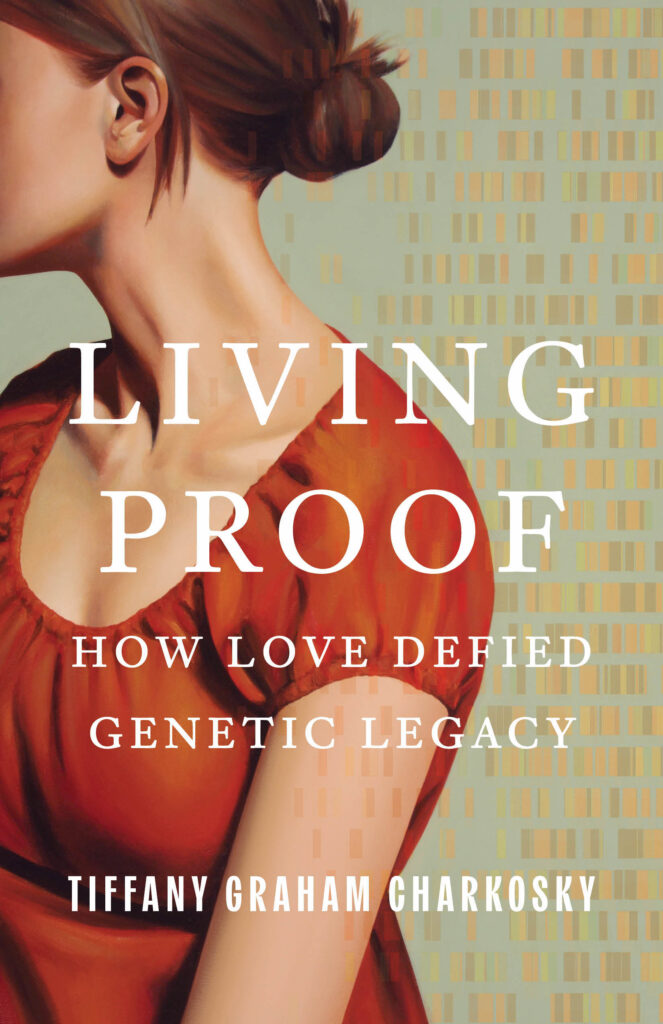
Like Tiffany Graham Charkosky, whose memoir Living Proof: How Love Defied Genetic Legacy is out this month from Little A, I have a genetic mutation that took my mom and left my sister and I with hard choices that didn’t feel like choices at all, plus an anxious doom cloud that often hovers over my life. Reading this slim but evocative memoir made me feel less alone. It’s not just a book for mutants, though; it’s for anyone who has struggled with loss and with the challenges of living in a body they can’t entirely control, which is to say, everyone. (Go here to read an excerpt from the book.)
Cheryl Klein: So, full disclosure—and very much related to your book—one reason it took me so long to send you questions is that I spent a lot of the summer stressing about some bloodwork I needed to do because I have the BRCA2 mutation, and the whole topic of hereditary cancer felt even closer than usual. Which leads me to my question: How do you navigate the mental toll of so much medical testing? We do it for ourselves and our families, but—for me at least—sometimes the anxiety makes me less present as a human and a parent.
Tiffany Graham Charkosky: Some days and years I navigate it better than others! Like you, I’ve been living with this information for a long time (about thirteen years at this point). I’ve learned my own rhythms and know, for example, that anxiety, for me, can show up as a need to clean the entire house. I also know that when I need to do something, I can do it by removing myself from its big picture and just do the little steps that make it up. For example, I will pick up my colonoscopy prep as soon as my doctor puts in the order. It sits in my linen closet for over a month, waiting for when I’m ready to use it. I try to separate myself from the physical actions I’m taking from their bigger picture for as long as possible. So, yes, I think that definitely makes me less present as a human in some ways, but it allows me to compartmentalize better (sometimes!).
Your book toggles back and forth between your point of view as a child, when you lost your mother, and your point of view as the mother of young children. How does the first experience inform the second?
My experience of parenting is wholly informed by having lost my mom as a child. When I was creating this book, the thing I struggled with the most was how I would show readers why I was so scared. I needed to somehow demonstrate that while I did feel like I was drowning in grief, it didn’t come from nowhere. I was committed to doing whatever I could to not face the same fate as my mother and to put my own family through the same loss that my siblings and I went through. Now that my children are older than my siblings and I ever were when our mom was still alive, I feel like I continue to carry the experience of childhood and adolescence very close to my surface. I strive for a close relationship with my children that feels very much modeled on what felt absent to me.
Relatedly, I love this passage: “If newborn Ben allowed me to forgive my mother for dying, then preteen Ben helped me forgive myself for all the heavy feelings I carried for so many years. He showed me I’d been such a young girl, that nothing I said or did or felt had made me responsible for any of it.” What else have you learned from your children?
As I’ve raised my older son, who is now 16, I’ve been able to see how young I was. It broke my heart for the young version of myself to see that I didn’t feel like a child, even though I was one. Losing my mom robbed me of the innocence of childhood. But having a child gave me the life experience to see that even though I hadn’t felt like a child anymore, I still was.
I think raising children, for me, is the ultimate form of healing. I get to see what it’s like for them to experience the world without the cloud of grief I lived with (and the wild ways that showed up throughout my teen years). They’re athletic, both have a great group of friends, and have a self-confidence I never remember having. They make me laugh and keep me living in the moment instead of inside my own head all the time.
I tend to ideate about the possibility of my untimely death, and I think about who—in addition to my partner—would be there to support my kids. Do you do this? (Although, I hope for your sake that you don’t have the same dark spirals that I do.) The fact that so much about our bodies isn’t fully in our control is so humbling. Has it influenced the village or support network you’ve built for your children?
This is a good question and I feel like I have a bit of an opposite response to it than you. I feel like rather than build huge networks around our children, my husband and I try to make our own family unit as safe and close as possible. It’s almost less “who will take care of you if something happens to me?” and more “will you know how much I loved you if I’m gone?” So I try to be as honest about myself as possible all the time. I ask my boys lots of questions and get to know their friends and try to show up for them as much as possible.
But my kids are both really active and while they’ll chat with me in the car or at dinner, they want to do things. For example, both of my sons have gotten into golf. So, on the day before the last day of school, I went golfing for the first time in my life with them. I was just as bad as you’d expect, but we laughed about it and had a great time. I’ve been trying to think about the kind of relationship I want to have with them as they grow up and realize that in order to stay close to them, I need to be willing to enter their worlds instead of only asking them to stay in mine.
What kinds of conversations have you had with your children about Lynch Syndrome? I imagine they must evolve as your kids have gotten older.
At 16 and 13, my sons both know that my mom and uncle died of cancer and that I had surgeries because I could have the same thing they had. They both know I get colonoscopies every year. But I think it takes a long time for this information to sink in for them and it’s evolved over time. I try to keep it casual because one of my main goals in life is to show them how to manage living with these risks. Our conversations tend to be things like, “Make sure you never start vaping – you know our family doesn’t have a great medical history to start with.”
In the book, you are at first uncertain about doing genetic testing. Medically, it seems like we’re at the tip of a genetic iceberg—more and more genes for various predispositions will be revealed, along with the possibility of early detection, treatment, and cures. At the same time, we are seeing a surge in eugenics in the U.S., with Medicaid being cut, the Make America Healthy Again movement, and a large cohort of people who boast about their alleged genetic superiority (to name just a few red flags). Do you have thoughts on the ethical decisions and responsibilities that come with increased medical knowledge? Your book sticks closely to your personal story, which makes sense, but I’m curious how the larger implications land for you.
At my very darkest, I will think about how from an evolutionary standpoint, I shouldn’t still be here. So, yes, these larger conversations and implications hit close to home for me! I also try to eat a well-balanced diet and exercise. But, in my case and I’m sure for many others, shunning medical care in favor of a more natural or healthy lifestyle would have possibly ended my life already.
As far as the tip-of-the-iceberg feeling you describe is concerned, I think people like you and me —who already know at least one of our genetic mutations—are the frontrunners in a huge race. We have genetic variants that are relatively easy to find and test for. I’m curious to see over the next several decades how more and more people will have access to this kind of information. There could be a point when most of us carry the weight of knowing our genetic flaws and they may not all be able to be managed in the way mine have been.
I think science and technology have given us access to a lot of information that our brains and hearts aren’t necessarily ready to process. For me, the emotional impact of my genetic testing journey has been just as strong, if not stronger, than the physical impact. I’ve talked with a number of folks who’ve had genetic testing and I’ve learned that almost none of them have had access to someone who helps them navigate the psychological side of this information. I hope more people are able to access the care they need to not only manage the physical implications of the kinds of genetic information we can learn, but also the emotional ones, which for me have honestly been the more challenging part.
I remember taking an anthropology class in college and my professor asking what the first sign of human culture was. We speculated about things like primitive tools, cave drawings, etc. The professor shared that it was finding a skeleton with a bone that had broken and then healed. He told us this meant the person who had been wounded was cared for and not left for dead. I think about this a lot, about how what makes us human is our willingness to care for those who need it. I’ll be happy when the political pendulum swings back in that direction.

Tell me a little bit about writing this book: How did you decide on the structure? When did you feel like you were ready to take on this subject matter?
I’m the kind of person who has to find a book about everything that happens in my life. So, when I discovered that I may need genetic testing, I looked for books written by people who had been through it. Back in 2011, I couldn’t find the books I needed to read. I kept a journal and started a blog that I was too embarrassed to share with any readers. But a couple years later, the idea that I may have a story worth sharing took hold of me. I wrote my first draft and when I re-read it, it was so bad that I stuck it in a drawer. There was such a gulf between my level of skill and the book I envisioned writing. But over time, I studied the craft of writing and I kept working on it until it stopped reading like a collection of disconnected vignettes and felt like a story with forward momentum.
The structure of Living Proof took a lot of trial and error to figure out. I needed to be able to show readers how I felt when I was going through the genetic testing process (spoiler alert: really terrible) and why I felt that way, which was because I’d seen my mom transform from a healthy, vibrant woman into a critically ill one who ultimately died just a few weeks shy of her 31st birthday. So for the first part of my book, which is broken into three parts, I wrote chapters that alternated between my discovery that my family carried Lynch syndrome and my childhood. For the second two parts of the book, I stopped using the past and wrote the rest of the story in a linear direction.
I still don’t know if I feel qualified to write this book. In all honesty, I thought a publisher might want to publish my book if I wove it into the larger implications of genetic testing and the ethical dilemmas around eugenics you brought up earlier. But I have a full-time job and no training in genetics, so I kept my story focused on the personal narrative and here we are.
So often, I imagine the conversations I might have with my mom now that I’m a mother. What would you want to ask your mom? What would you want to tell her? What ways do you keep her spirit and story alive in your life?
My mom had an eye for four-leafed clovers. She found them everywhere. When I was young, I was so jealous of her for this. One day, she took me on a picnic and then we went for a walk, just the two of us. I scoured the grass next to the sidewalk for what felt like miles. Finally, I found my first four-leaf clover and it was one of the happiest moments of my life.
When I was pregnant with my older son, my husband and I were sitting in our backyard the day before the 20-week anatomy scan. I was so nervous about this appointment. I looked down and saw a four-leaf clover. I felt like it was my mom telling me everything would be okay. Every time I find one now, I feel like it’s my mom’s way of saying hi to me.
In Living Proof, I write a lot about how becoming a mother made me feel very close to mine in a way I hadn’t before. So, I’ve felt her with me as I raise my children. I hope she knows my brother, sister, and I are all doing okay. That she has three beautiful grandchildren and we all feel her with us all the time.
It’s hard for me to think about what I’d ask her, because all I really want is a different past. I want one where she was here.
About the Author

Cheryl Klein’s column, “Hold it Lightly,” appears monthly(ish) in MUTHA. She is the author of Crybaby (Brown Paper Press), a memoir about wanting a baby and getting cancer. She also wrote a story collection, The Commuters (City Works Press) and a novel, Lilac Mines (Manic D Press). Her stories and essays have appeared in Blunderbuss, The Normal School, Razorcake, Literary Mama, and several anthologies. Her MUTHA column “Onesie, Never Worn” was selected as a Notable Essay in Best American Essays 2022. She blogs about the intersection of art, life, and carbohydrates at breadandbread.blogspot.com. Follow her on Threads: @cherylekleinla.
Related Posts

Wanderlust: A Supposedly Fun Thing I Would Definitely Do Again →
A Lost Mother’s Love is Never Gone: An Interview with Anna Nordberg →
Drama in the Mommune: Domenica Ruta Talks to Jade Sanchez-Ventura About Her Radical Summer Read →